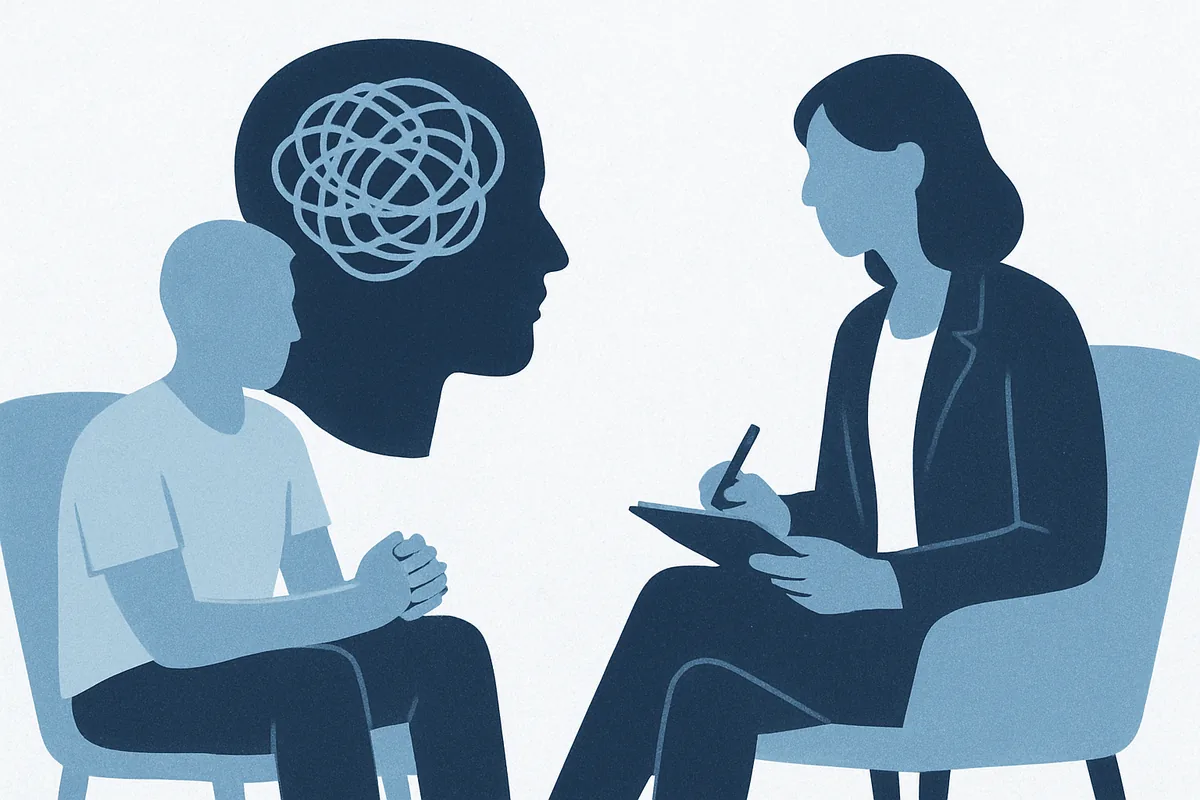
- Approximately 70% of people are exposed to at least one potentially traumatic event in their lifetime, yet the majority of those who seek structured trauma therapy in Dubai report waiting months, or years, before reaching out (WHO, 2023).
- The four evidence-based approaches available in Dubai, EMDR, TF-CBT, CPT, and Somatic Experiencing, target different trauma presentations; matching the modality to your history and symptoms is the first clinical decision in treatment.
- EMDR carries a "Strong For" first-line recommendation in the 2023 VA/DoD Clinical Practice Guideline, with 40–87% of patients no longer meeting PTSD diagnostic criteria after 9–15 sessions.
- A 2022 meta-analysis of 28 RCTs found TF-CBT produces Hedges' g effect sizes of 1.14–1.32 for PTSD symptoms in children and adolescents aged 3–21, sustained at 12-month follow-up.
- Dubai's private specialist clinics are currently the primary access point for structured trauma therapy in the UAE; the DHA's Mental Wealth Strategy 2023–2027 does not yet include a dedicated trauma or PTSD care pathway, meaning early help-seeking routes into treatment.
This guide is for people researching how trauma therapy works. If you're ready to speak to someone, visit our trauma therapy service in Dubai to book an assessment. For a step-by-step look at EMDR specifically, see our EMDR 8-phase protocol guide.
The World Health Organization estimates that 70% of people globally experience at least one potentially traumatic event across their lifetime, yet only a fraction ever access structured, evidence-based care. In Dubai, that gap is sharpened by an additional layer: a predominantly expat population where high-functioning professionals often mask significant distress behind demanding schedules, social obligations, and the unspoken pressure to simply keep moving.
Trauma therapy in Dubai has expanded meaningfully in recent years, with trained psychologists now offering EMDR, Trauma-Focused CBT (TF-CBT), Cognitive Processing Therapy (CPT), and Somatic Experiencing from DHA-regulated clinical settings. The challenge most people face is not finding a clinic. It is knowing which approach fits their experience, whether their experience is "serious enough" to warrant therapy at all, and what to realistically expect from the process.
At CAYA World, we work with adults, children, adolescents, and families across the full spectrum of trauma presentations: single-incident events, complex and relational trauma, medical trauma, and the quieter, cumulative kind that builds across a career or a childhood. This article explains how each evidence-based modality works, which presentations each suits best, and how trauma therapy unfolds clinically, from the first assessment session to the end of active treatment.
What is trauma, and does your experience count?
Trauma is not defined by the event itself. It is defined by the impact that event has on your nervous system, your sense of safety, and your ability to function in its aftermath. Two people can experience the same road accident; one processes it within weeks, the other carries intrusive flashbacks, hypervigilance, and emotional numbing for years. Neither response is a character flaw. They reflect the biological reality that the human brain does not encode all distressing memories the same way.
The DSM-5 defines PTSD as a condition arising from direct or indirect exposure to actual or threatened death, serious injury, or sexual violence, with symptoms persisting for more than one month across four clusters: intrusion (flashbacks, nightmares), avoidance, negative alterations in cognition and mood, and marked alterations in arousal (American Psychiatric Association, DSM-5). But PTSD is one end of a spectrum. Many people who benefit from trauma therapy do not meet full PTSD criteria. They may carry what clinicians call a trauma response, persistent anxiety, relationship difficulties, sleep disruption, or a chronic sense of not being safe, without meeting every diagnostic threshold.
Complex PTSD (C-PTSD), recognised in the ICD-11, describes the impact of prolonged or repeated trauma, childhood abuse or neglect, domestic violence, long-term emotional manipulation, or years of workplace harassment. C-PTSD often presents with difficulties in emotion regulation, a persistently negative self-concept, and chronic relational disturbance that can look, on the surface, like personality disorder or treatment-resistant depression.
We often see people at CAYA World who arrive apologising for "not having it as bad as others." The clinical reality is that trauma is not a competition. If something happened that overwhelmed your capacity to cope, and the effects are still disrupting your life, that experience qualifies. The question is not whether your trauma is serious enough. It is which approach will help your nervous system process it most effectively.
A 2024 cross-sectional study published in PLOS ONE found that 40.6% of UAE school students met criteria for PTSD symptoms following the COVID-19 pandemic, a figure that underscores how broadly traumatic stress is distributed across this population, well beyond the categories of combat or catastrophic violence that dominate the public imagination of PTSD.
What does trauma therapy in Dubai actually involve?
Regardless of which modality your psychologist recommends, structured trauma therapy follows a phased model. Jumping straight into memory processing without adequate preparation is clinically contraindicated. It can destabilise rather than heal. The three core phases, adapted from the EMDR standard protocol and widely applied across trauma modalities, are stabilisation, processing, and integration.
Phase 1: Stabilisation
Before any trauma processing begins, your clinician focuses on building psychological safety within the therapeutic relationship, developing your capacity to regulate intense emotions, and constructing a reliable set of grounding tools you can use between sessions. For some clients this phase takes two or three sessions. For those with complex or developmental trauma, it may take considerably longer. At CAYA World, we don't rush this stage, a well-resourced client processes trauma faster and more safely than a destabilised one.
Phase 2: Trauma Processing
This is the phase most people picture when they think of trauma therapy, the direct engagement with traumatic memories, beliefs, and body sensations. The specific techniques used here vary by modality (explained in detail in the next section), but all evidence-based approaches share a common mechanism: they help the brain reprocess a stuck, dysregulated memory into one that can be stored as a coherent past event rather than an ongoing present threat. You do not need to narrate every detail of what happened. In several modalities, notably EMDR and some somatic approaches, extensive verbal description is not required at all.
Phase 3: Integration and Consolidation
The final phase anchors the gains from processing into daily functioning. This includes reinforcing adaptive beliefs about yourself and the world, addressing residual avoidance patterns, and building the kind of forward-looking psychological flexibility that makes relapse less likely. Termination in trauma therapy is not an abrupt end. It is a graduated handover of the tools your clinician has helped you develop.
Sessions are typically 50–60 minutes, though EMDR protocol often benefits from extended 90-minute sessions during the processing phase to allow memory networks to reach full resolution within a single sitting rather than carrying activation between appointments. Your psychologist will advise on session length based on your presentation and tolerance.
If you are in Dubai and ready to understand which approach might be right for you, our clinical team at CAYA World offers trauma assessments and a clear rationale for treatment planning from the first session. Learn more about our trauma therapy programme.
EMDR, TF-CBT, CPT, and Somatic Experiencing, which trauma therapy approach is right for you?
No single modality is superior for every trauma presentation. The decision is clinical. It depends on trauma type, age, symptom profile, personal preference, and how verbal or body-centred you naturally process experience. Below is a plain-language breakdown of how each approach works and which presentations it tends to suit best, followed by a clinical comparison table.
EMDR (Eye Movement Desensitisation and Reprocessing)
EMDR uses bilateral stimulation, typically side-to-side eye movements, but also alternating taps or tones, to activate the brain's natural information-processing system while you hold a traumatic memory in awareness. The theory, supported by substantial neuroscience research, is that the same oscillatory mechanism activated during REM sleep is engaged by bilateral stimulation, allowing the brain to complete the processing of memories that were stored in a fragmented, dysregulated state during the original event.
According to the 2023 VA/DoD Clinical Practice Guideline, EMDR carries a "Strong For" first-line recommendation for PTSD, with 40–87% of patients no longer meeting diagnostic criteria after 9–15 sessions. It is particularly well-suited to single-incident or identifiable multi-incident trauma, including accidents, assaults, medical trauma, and disaster exposure. Clients who struggle to talk about what happened, whether from shame, avoidance, or an absence of verbal narrative, often find EMDR more accessible than talk-based approaches.
TF-CBT (Trauma-Focused Cognitive Behavioural Therapy)
TF-CBT is the gold-standard psychological treatment for children and adolescents with trauma histories. It is a structured, components-based model that combines psychoeducation about trauma, relaxation and affect regulation skills, cognitive processing of trauma-related thoughts, a trauma narrative component, and, for younger clients, parallel work with caregivers. A 2022 meta-analysis of 28 RCTs (N = 4,523) found TF-CBT produces Hedges' g effect sizes of 1.14–1.32 for PTSD symptoms in children aged 3–21, with gains sustained at 12-month follow-up. At CAYA World, TF-CBT is one of our primary protocols for paediatric and adolescent trauma, including relational trauma and abuse histories. It also adapts well for adults who respond strongly to structured, skills-based frameworks.
CPT (Cognitive Processing Therapy)
CPT addresses the meaning trauma survivors assign to what happened, the stuck points, often beliefs about safety, trust, power, esteem, and intimacy, that keep PTSD symptoms active long after the event itself has passed. The approach involves structured written accounts and systematic challenging of distorted appraisals across 12 sessions. The VA PTSD National Center reports large PTSD symptom reductions (Hedges' g = 0.90–1.24 versus inactive controls), and a 2023 VA study found eight or more CPT sessions produced 11.9% greater recovery rates than non-evidence-based care. CPT is particularly well-suited to survivors of sexual trauma, assault, moral injury, and complex interpersonal violation where guilt, shame, and distorted self-blame are prominent.
Somatic Experiencing
Somatic Experiencing (SE), developed by Dr. Peter Levine, works at the level of body sensation rather than cognitive narrative. The theory holds that trauma is stored as incomplete defensive responses in the nervous system, the fight, flight, or freeze activation that could not complete during the original event. SE guides clients to track and gradually discharge this stored physiological activation through titrated attention to body sensation, movement, and breath, without requiring verbal reconstruction of the traumatic event. SE is particularly effective for developmental and early-life trauma, where explicit verbal memory is limited, and for clients who find traditional talk therapy re-traumatising rather than relieving.
| Modality | Best suited for | Session structure | Verbal narrative required? | Evidence level |
|---|---|---|---|---|
| EMDR | Single-incident and multi-incident trauma, PTSD, phobias | 8–15 sessions; 90-min processing preferred | Minimal | VA/DoD 2023 "Strong For" |
| TF-CBT | Children and adolescents (3–21), abuse, relational trauma | 12–25 sessions; caregiver sessions parallel | Moderate (trauma narrative component) | 28 RCTs, Hedges' g 1.14–1.32 (2022) |
| CPT | Sexual trauma, moral injury, shame-based stuck points | 12 structured sessions | Yes (written account + cognitive worksheets) | VA/DoD 2023 "Strong For"; Hedges' g 0.90–1.24 |
| Somatic Experiencing | Early-life, developmental, complex trauma; clients for whom talk therapy is re-traumatising | Variable; typically 20–30 sessions | Minimal | Emerging; several controlled trials; APA-endorsed adjunct |
In practice, many presentations call for a combination rather than a single modality in pure form. A client with C-PTSD might begin with somatic stabilisation work before moving into EMDR processing. A teenager with abuse history and a non-participating caregiver might receive adapted TF-CBT with CPT elements for the cognitive stuck points. At CAYA World, our psychologists are trained across multiple modalities precisely because rigid adherence to one protocol can underserve complex clinical presentations.
Concerned About Trauma Therapy?
Our specialist team at CAYA World offers comprehensive assessment and evidence-based treatment, conducted from our clinic in Palm Jumeirah, Dubai.
How does the Dubai context shape trauma therapy?
Dubai's population is approximately 88% expatriate, and that demographic reality shapes trauma presentation and help-seeking in ways that a clinic operating in a stable, home-country context does not encounter to the same degree. Relocation stress, cultural displacement, the absence of extended family support networks, and the particular pressure of maintaining a high-functioning external life in a competitive city all compound how trauma is carried and how readily people seek help for it.
We regularly see clients at CAYA World who have lived in Dubai for several years and have never once considered that the hypervigilance, the sleep disruption, or the persistent sense of not belonging might be a trauma response rather than a personality trait or a professional shortcoming. The high-functioning mask is particularly robust in expat populations, where the cost of appearing vulnerable can feel professionally or socially prohibitive.
The DHA's Mental Wealth Strategy 2023–2027, a AED 105 million initiative running to 2027, prioritises stigma reduction and early intervention across the emirate. However, as the Research Module for this article notes, the strategy does not yet include a dedicated PTSD or trauma care pathway. The DHA's 2024 Mental Health Screening Guidelines equip primary care practitioners to screen for depression and anxiety using PHQ-9, but trauma symptoms typically surface through these referral channels rather than a direct route into specialist care. This structural gap means private DHA-regulated clinics are currently the primary access point for structured trauma therapy in Dubai, a practical reality, not a criticism of the system, and one that is actively being addressed through the Mental Wealth initiative.
For expats, therapy in a DHA-regulated private clinic offers a confidential clinical setting that is entirely separate from employer visibility, social circles, and the community networks that can feel uncomfortably small in this city. Sessions at CAYA World are private consultations covered by standard clinical confidentiality, your employer, your family, and your social network are not involved unless you choose to include them. For clients from cultures where discussing emotional distress carries particular stigma, our team is experienced in working across this boundary with sensitivity and without judgment.
A 2024 cross-sectional study published in PMC found that 57.2% of participants in a UAE sample reported at least one mental health disorder, a figure that reflects the breadth of unmet clinical need across this population and contextualises why anxiety, depression, and trauma responses so frequently co-occur in the clients we see. Expats navigating major life transitions, a new role, a relationship rupture, the end of a visa, often find that these pressures activate trauma responses that had been dormant for years. Addressing those responses directly, rather than managing only the surface anxiety, is precisely what structured trauma therapy offers.
What to expect when you start trauma therapy
Starting trauma therapy is not the same as starting general counselling. The first one or two sessions are dedicated to a structured clinical assessment: your psychologist will gather a thorough history of your presenting symptoms, relevant personal and developmental background, prior treatment history, and current functioning across work, relationships, and daily life. This is not a formality, the quality of this assessment directly informs the treatment plan and the modality selection that follows.
You will not be asked to describe your trauma in detail in the first session. Stabilisation comes first, always. Your clinician will introduce grounding tools and work with you to build a shared understanding of how your specific trauma response has developed and what it currently looks like in your body, your thoughts, and your behaviour. This phase is active therapeutic work, not merely a warm-up for the "real" therapy.
Clients frequently ask how long treatment will take. The honest answer is: it depends on trauma type, complexity, chronicity, and your individual nervous system. Single-incident PTSD treated with EMDR often resolves in 9–15 sessions. Complex or developmental trauma treated with a combined somatic and EMDR approach typically requires 25–40 sessions across 6–12 months. CPT is a fixed 12-session protocol by design. Your psychologist will give you a realistic estimate in the treatment planning conversation, revisit it at the midpoint of treatment, and adjust the plan based on clinical response.
Between sessions you may notice increased emotional activation, vivid dreams, heightened irritability, or a temporary increase in intrusive material, particularly in the early processing phase. This is a normal part of the neurological reprocessing that trauma therapy sets in motion, not a sign that therapy is making things worse. Your clinician will prepare you for this possibility and ensure you have the grounding tools to manage it. For clients managing significant symptoms between sessions, more frequent initial appointments, twice weekly rather than once, can provide additional containment during the processing phase.
If you are also experiencing symptoms of depression, anxiety, or significant sleep disruption alongside trauma, these are addressed as part of an integrated plan rather than treated in isolation. Trauma rarely travels alone, and at CAYA World our approach combines the modalities and techniques your full clinical picture requires: rather than applying a single protocol regardless of fit. Clients navigating major life changes alongside a trauma history may also benefit from our life transitions therapy work, which addresses the displacement and identity disruption that frequently co-occur with expat trauma presentations.
Frequently Asked Questions About Trauma Therapy in Dubai
No, and this is one of the most important clarifications to make. EMDR and Somatic Experiencing both process traumatic memories without requiring detailed verbal narration. In EMDR, you hold the memory in awareness while bilateral stimulation is applied; extensive description is not part of the protocol. TF-CBT does include a trauma narrative component, but this is constructed gradually and collaboratively, never as a sudden recounting. Your psychologist will always prepare you before any memory work begins and will not push you to disclose more than you are ready for.
EMDR is generally recommended for adults with identifiable traumatic memories, single-incident PTSD, phobias with a traumatic origin, or multi-incident trauma where specific memory targets can be identified. TF-CBT is the first-line choice for children and adolescents, and adapts well to adults who benefit from a skills-based, structured framework. Your psychologist at CAYA World will make this recommendation in your assessment session, drawing on your symptom profile, trauma history, age, and personal preference. There is no single right answer; for many clients, a hybrid approach is most effective.
Session count varies by modality and complexity. CPT is a fixed 12-session protocol. EMDR for single-incident PTSD typically resolves in 9–15 sessions; complex trauma may require 25–40 sessions. TF-CBT for children and adolescents typically runs 12–25 sessions, including parallel caregiver sessions. Somatic Experiencing for complex or developmental trauma is usually 20–30 sessions. Your clinician will give you a personalised estimate in the treatment planning conversation and revisit it at the midpoint of your treatment.
Yes. Residency status does not affect your ability to access private psychological care at CAYA World. You do not need a long-term UAE visa, a local insurance plan, or any particular employment status to begin therapy. Many of our clients are mid-contract professionals or individuals in transitional residency situations. We accept self-pay and can provide session documentation for clients seeking insurance reimbursement from international providers. The only requirement is that you are physically present in Dubai for your sessions, or able to access online sessions where clinically appropriate.
This is the question we hear most often, and the clinical answer is: the threshold for trauma therapy is not the severity of the event but the severity of its impact on your life. If you are experiencing intrusive memories, persistent avoidance, emotional numbing, hypervigilance, chronic shame or self-blame, significant sleep disruption, or relational difficulties that trace back to a specific period or set of experiences, those symptoms warrant clinical attention regardless of how your event compares to someone else's. Minimising your own experience is itself a common trauma response, not an accurate measure of whether you need support.
Sources and Further Reading
- Post-traumatic stress disorder fact sheet, World Health Organization (2023)
- PTSD symptoms among UAE school students in the post-COVID-19 period, PLOS ONE (2024)
- EMDR for PTSD: Evidence Brief, VA/DoD Clinical Practice Guideline (2023)
- Meta-analysis of TF-CBT for children and adolescents with PTSD (28 RCTs, N=4,523), PubMed (2022)
- Cognitive Processing Therapy for PTSD: treatment essentials, VA National Center for PTSD (2023)
- Mental health disorder prevalence in a UAE cross-sectional study, PMC (2024)
- Mental Wealth Strategy 2023–2027, Dubai Health Authority (2023)
- Diagnostic and Statistical Manual of Mental Disorders, Fifth Edition (DSM-5), American Psychiatric Association (2013)
If you have concerns about your trauma history and whether structured treatment is the right next step, our clinical team at CAYA World is here to help. We offer evidence-based trauma therapy, including EMDR, TF-CBT, CPT, and somatic approaches, from our clinic in Palm Jumeirah, Dubai. Reach out via WhatsApp on +971 4 572 3755, call us on 04-572-3755, or email [email protected]. We respond quickly.
This article was written by the clinical team at CAYA World Clinic, a DHA-licensed psychology and wellbeing clinic in Palm Jumeirah, Dubai. cayaworld.ae