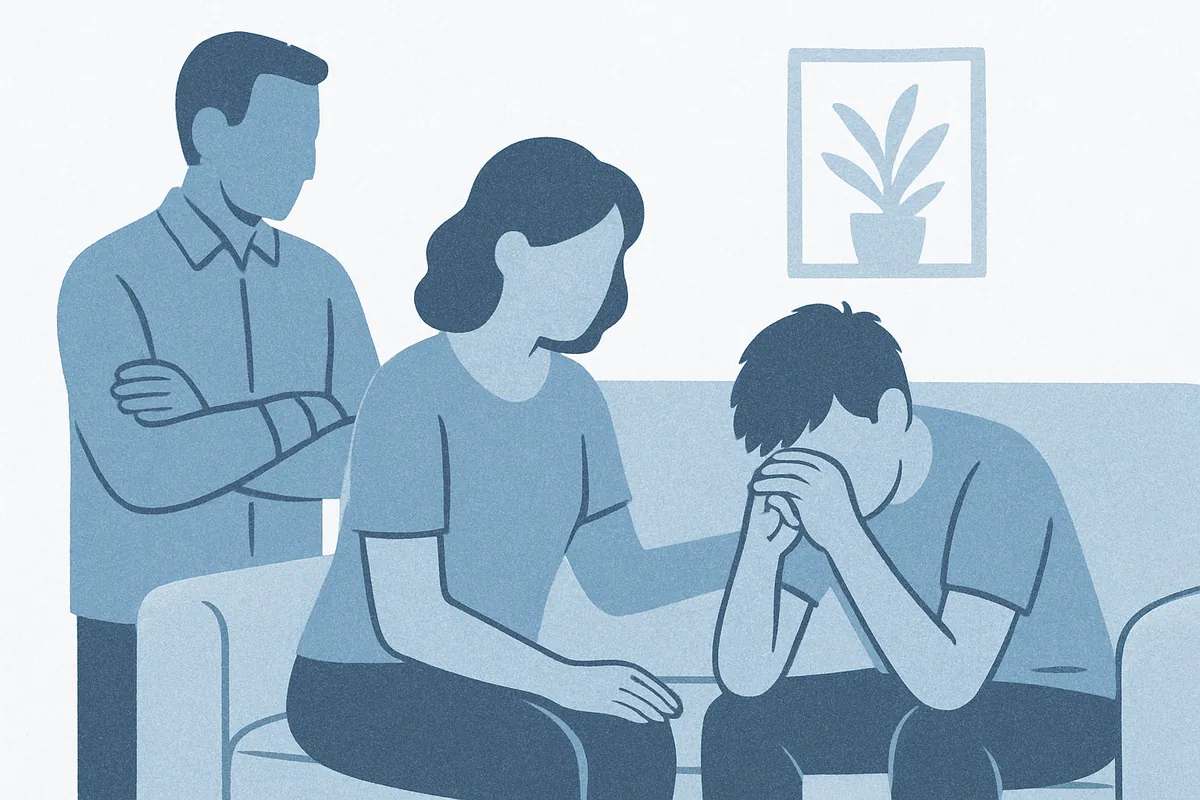
- 28% of UAE school-aged adolescents meet diagnostic criteria for an anxiety disorder, with girls affected at nearly double the rate of boys (33.6% vs 17.2%), according to Al Maskari et al., BMC Psychiatry (2020), yet the majority of cases are not identified until problems are well established.
- The three most consistently misread signals in Dubai teens are attitude and irritability (which often mask anxiety rather than signal defiance), declining academic performance (a reliable proxy for internal distress rather than laziness), and social withdrawal from family at home while maintaining a functional school-facing persona.
- 68.7% of Third Culture Kid participants in a UAE sample were at clinical risk of depression, driven by disrupted belonging, identity confusion across cultural settings, and the psychological instability of anticipated departure, stressors specific to Dubai's expat-heavy international school population.
- The WHO estimates that 50% of all lifetime mental health conditions are established by age 14; DHA's 2024 Mental Health Screening Guidelines introduced mandatory PHQ-A depression screening for all UAE adolescents aged 12 to 18 at first primary care visit, reflecting institutional recognition that teen distress is chronically under-identified.
- A school counsellor is the right first contact for academic adjustment and peer conflict; a clinical psychologist is the appropriate referral when symptoms have lasted more than two weeks, are affecting function across two or more settings, or include self-harm, persistent sleep disruption, or significant weight change.
According to Al Maskari et al., published in BMC Psychiatry (2020), 28% of UAE school-aged adolescents meet diagnostic criteria for an anxiety disorder. That is more than one in four teenagers sitting in Dubai classrooms right now. Yet in clinical practice, the majority of those teenagers are not referred for assessment until their difficulties have compounded for months, sometimes years. The gap is not indifference. It is misreading. The signals of teenage mental health distress in Dubai are frequently mistaken for attitude, laziness, a phase, or the understandable stress of a demanding school system.
This article is written for parents who sense something is off but cannot name it precisely. It covers the specific presentation patterns that get missed most often in Dubai's international school population, the compounding pressures unique to this city, and a practical framework for deciding whether your teenager needs a conversation with the school counsellor or an assessment with a clinical psychologist. If you are already wondering whether your child would benefit from professional support, our guide to what teen therapy looks like in practice covers the clinical process in detail.
Why teenage mental health in Dubai is so often missed, and why it matters
The WHO's adolescent mental health fact sheet (2021) places a striking finding on record: 50% of all lifetime mental health conditions are established by age 14. Depression is the leading contributor to disability among adolescents globally. These are not rare or exceptional cases. They are typical trajectories that begin, and frequently go unaddressed, during the school years.
In Dubai specifically, several structural factors push identification even later. The city's international school culture normalises high performance under pressure. Parents who are themselves high-functioning professionals may interpret a teenager's increasing stress as proportionate and manageable. The expat context adds a layer of minimisation: families who have relocated multiple times learn to adapt and push through, and this survival skill can translate into underestimating how much a teenager is actually struggling.
There is also a cultural dimension. In many of the communities represented in Dubai's international schools, seeking psychological support carries a perceived social cost. Framing distress as weakness, or as something to be handled privately within the family, delays referral. The Emirates Council for Child Protection published a dedicated parent guide in 2025 specifically naming teen distress signals, including persistent sadness, fatigue, declining school performance, self-harm, and substance use, as signals commonly missed by UAE families. The guide's existence signals how widespread the under-identification problem is.
At CAYA World, we consistently see teenagers who arrive for assessment after a prolonged period of manageable-seeming decline. By the time parents book an appointment, the teenager has typically been symptomatic for six months to a year, and sometimes longer. Earlier identification changes the clinical picture significantly. A teenager with mild to moderate anxiety assessed at the first signs of functional impairment has a meaningfully different treatment trajectory than one assessed after chronic avoidance has become structurally embedded in their daily life.
This is why the missed-signal problem matters clinically, not just parentally. Getting the read right, early, is not catastrophising. It is appropriate vigilance.
What normal adolescent behaviour actually looks like: the clinical baseline
To identify what is clinically significant, parents need a clear picture of what is developmentally typical. Adolescence involves predictable neurobiological and psychosocial changes that produce behaviours that look alarming but fall squarely within normal range.
Between the ages of 12 and 17, the adolescent brain undergoes significant remodelling. The prefrontal cortex, responsible for impulse regulation, forward planning, and emotional modulation, is not fully mature until the mid-twenties. This means that emotional intensity, impulsive decisions, and difficulty tolerating frustration are neurologically expected, not character flaws. A teenager who occasionally loses their temper over something that seems trivial, or who becomes intensely preoccupied with peer relationships at the expense of family interaction, is displaying developmentally appropriate behaviour.
The clinical baseline for normal adolescent behaviour includes:
- Increased desire for privacy and reduced spontaneous sharing with parents
- Strong investment in peer opinion, sometimes to an extent that seems disproportionate to adults
- Mood variability across the day, including irritability in the late afternoon or evening
- Delayed sleep phase: natural biological shift toward later sleep onset and later waking
- Periods of boredom or low motivation, particularly during school holidays or unstructured time
- Testing of parental limits and values as part of identity formation
These features are expected. They become clinically significant when they shift in intensity, persist beyond two weeks, cross into multiple life domains simultaneously, or represent a clear departure from the teenager's baseline functioning. The word "baseline" matters. A teenager who has always been somewhat introverted becoming more withdrawn is a weaker signal than a previously sociable teenager who suddenly stops responding to friends' messages. The change relative to individual baseline is often more diagnostically meaningful than the behaviour in isolation.
At CAYA World, one of the first questions Dr. Al Ghriwati and our clinical team ask parents is: "What was your teenager like twelve months ago?" That comparison anchors the assessment in the child's own developmental history rather than a generalised norm, which is where the most clinically useful information tends to emerge.
The missed signals: how teenage mental health problems present differently in Dubai teens
The standard list of teen mental health warning signs, mood changes, withdrawal, appetite shifts, sleep problems, is well known. What is less often discussed is how these signals are disguised in high-functioning, high-achieving adolescents in competitive school environments. Dubai's international school population presents a specific pattern: teenagers who are skilled at compartmentalisation, who maintain a functioning school-facing persona while deteriorating internally, and whose distress is only visible in the settings where they feel safe enough to drop the performance.
Irritability and attitude as anxiety, not defiance
Anxiety in adolescents does not always look like worry. In teenagers, and particularly in adolescent boys, anxiety frequently presents as irritability, agitation, snapping at family members, and low frustration tolerance. The teenager who comes home from school and immediately picks a fight, who reacts disproportionately to small requests, or who seems inexplicably on edge for days at a time may be experiencing chronic anxiety rather than exhibiting oppositional behaviour.
This matters because the parental response to perceived defiance, which tends to be authoritative correction and boundary-setting, is almost the opposite of what an anxious teenager needs. Treating anxiety-driven irritability as a discipline problem can escalate the family dynamic and push the teenager further into avoidance.
Academic decline as an anxiety and depression proxy
A drop in academic performance is one of the most reliable early indicators of adolescent mental distress. In Dubai's international schools, where academic achievement is culturally central, parents may initially interpret declining grades as motivational, attributing the change to laziness, distraction, or excessive screen time. The clinical read is different. When a student who previously achieved comfortably begins missing deadlines, producing work far below their capability, or avoiding assessments, this pattern most often reflects cognitive depletion secondary to depression or anxiety, not a motivational failure.
Depression impairs concentration, working memory, and executive function. A teenager with a PHQ-A score in the moderate range (10 to 14) will typically report that they read the same paragraph multiple times without retaining it, that tasks that previously felt manageable now feel insurmountable, and that they cannot identify why. Attributing this to effort rather than neurobiological state leads parents to apply pressure that compounds the teenager's distress.
Sleep disruption as a mood symptom, not a habit problem
Persistent sleep disruption in teenagers, particularly difficulty falling asleep before 1 or 2 a.m., repeated waking, or sleeping 12 or more hours on weekends while being exhausted during the week, is frequently misread as a screen-time habit or adolescent laziness. Clinically, disordered sleep is both a symptom and a maintaining factor for depression and anxiety. The teenager who cannot sleep is often experiencing a racing, ruminative mind, not poor discipline. Addressing the symptom without addressing the underlying state rarely produces lasting improvement.
Social media use and withdrawal as depression indicators
A teenager who increases social media engagement dramatically while simultaneously withdrawing from in-person social contact is displaying a pattern consistent with low mood. Social media use, particularly passive scrolling, provides low-effort stimulation that requires nothing from the user. It is the digital equivalent of lying on the sofa staring at the ceiling. A teenager who previously had an active social life and now declines invitations while spending hours on their phone is not simply going through a phase. This is a signal worth taking seriously.
Conversely, a teenager who withdraws from social media entirely, especially one who was previously an active poster, may be experiencing shame, negative self-perception, or social anxiety that has become acute enough to make online exposure feel threatening.
If you have been noticing one or more of these patterns and are not sure whether what you are seeing crosses a clinical threshold, our teen behaviour support service at CAYA World offers an initial consultation to help parents clarify what they are observing before any formal assessment is undertaken.
The Dubai pressure stack: international schools, exam culture, and Third Culture Kid identity stress
Every city has adolescent stressors. Dubai's are layered in a particular way that compounds risk beyond what standard adolescent mental health literature describes. Understanding this pressure stack helps parents distinguish between a stressed teenager and a clinically distressed one.
Exam culture in Dubai's international schools
The OECD's 2024 review of wellbeing policies in Dubai's private school sector explicitly identified IB, IGCSE, and A-Level exam periods as recognised pressure points for adolescent mental distress, with UAE school policies acknowledging these as periods of elevated emotional vulnerability. The competitive university admissions context that many international school families are oriented toward, particularly for universities in the US, UK, and Canada, intensifies this further. Teenagers in Year 11, 12, and 13 in Dubai are frequently managing workloads and performance pressures that adults in demanding professions would find taxing.
The clinical problem is not the pressure itself. It is when a teenager begins applying the coping strategy of relentless effort to a level of stress that effort alone cannot resolve, without any adult recognising that the system is overloaded.
Third Culture Kid identity stress
A large proportion of teenagers in Dubai's international schools are Third Culture Kids (TCKs): children who have grown up across multiple cultural contexts and do not hold a singular national or cultural identity. Research consistently identifies this as a compounding mental health risk factor. Greenfield et al. (2021), published in the Journal of Cross-Cultural Psychology, found that 68.7% of TCK participants in a UAE sample were at clinical risk of depression. The primary drivers were disrupted sense of belonging, identity confusion across cultural settings, and acculturative stress.
For a teenager who has moved between schools and countries, who feels British in Dubai and too Dubai-shaped to fit in when visiting the UK, who anticipates another family relocation within two years, the foundational adolescent task of identity formation becomes significantly more complex. This is not melodrama. It is a well-documented clinical vulnerability that Dubai parents of international-school teenagers should be aware of.
A 2022 systematic review of TCK literature, published in PMC by Fail et al., confirmed that the primary adjustment challenges across TCK populations are disrupted belonging, identity confusion, and acculturative stress, all of which are elevated in Dubai's international school population specifically.
Expat transience and anticipatory loss
Beyond identity stress, many Dubai teenagers live with low-grade anticipatory loss: the knowledge that friends will leave, that they themselves may leave, and that relationships that feel central are structurally temporary. This creates a pattern some clinicians refer to as pre-emptive withdrawal: teenagers who become reluctant to invest deeply in friendships because the cost of loss feels too high. Parents observe this as social disengagement and may interpret it as maturity or independence. Clinically, it can be a protective avoidance strategy that, when sustained, increases isolation and depressive risk.
Dubai's data on overall youth depression sits at 17% to 22% across UAE youth broadly, with a 2020 sub-group study showing approximately one in three South Asian adolescents and one in five Emirati adolescents displaying depressive symptoms. These figures are not outliers. They describe the population your teenager lives and studies within.
Wondering if It's Time to Talk to Someone?
Our specialist team at CAYA World offers comprehensive assessment and evidence-based treatment, conducted from our clinic in Palm Jumeirah, Dubai.
How parents can observe without interrogating: a practical approach
One of the most consistent themes at CAYA World is the parent who knows something is wrong but whose every attempt to open a conversation results in a closed door. The teenager shuts down, leaves the room, or produces a monosyllabic "I'm fine" that carries no information. This is not a parenting failure. It is a predictable feature of adolescent development: the teenager is developmentally primed to separate from parents, and direct inquiry about emotional states can trigger defensive closure even when the teenager genuinely wants support.
The following approach is grounded in what clinical research and clinical practice show actually works:
Observe and name without demanding a response
Rather than asking "What's wrong?", which requires the teenager to have both insight and words for their state, try naming what you observe without a question attached: "I've noticed you seem exhausted this week" or "I've seen your light on at 2am a few nights." This opens a channel without creating pressure. The teenager does not need to respond. You have communicated that you see them, which is often enough to lower the defensive barrier slightly over time.
Use side-by-side time, not face-to-face conversation
Adolescents typically find direct face-to-face emotional conversations more threatening than conversations that occur alongside a shared activity. Driving to school, cooking together, watching a series: these create a relational container in which teenagers are more likely to disclose, often indirectly and briefly. A parent who is consistently present in low-pressure contexts gathers far more information than one who schedules sit-down conversations about feelings.
Monitor function, not just mood
Rather than trying to assess your teenager's emotional state, which they may not be able to articulate accurately, track functional indicators: sleep, appetite, social engagement, academic effort, and physical activity. These are observable and do not require the teenager's cooperation to measure. A clear pattern of functional decline across two or more domains, sustained for two or more weeks, is a clinically meaningful signal that warrants professional input.
If you are finding it difficult to know how to approach your teenager's wellbeing as a parent, our parenting support service at CAYA World offers practical guidance for parents navigating this exact challenge. You do not need to wait until you have a clinical diagnosis to benefit from professional input on how to support your child.
School counsellor or psychologist? A decision framework for Dubai parents
This question comes up in almost every initial consultation at CAYA World. Dubai families have access to well-resourced school counsellors in most international schools, and many parents rightly try that route first. The following framework is not a ranking of services. School counsellors are skilled professionals who serve an important function. It is a guide to which resource fits which situation.
| Situation | School counsellor | Clinical psychologist |
|---|---|---|
| Academic adjustment and study skills | Primary contact | Not usually necessary |
| Peer conflict and friendship difficulties | Primary contact | If sustained beyond 4 weeks or linked to wider withdrawal |
| Exam stress in an otherwise functional teenager | Primary contact | If functional decline is present across two or more domains |
| Symptoms present for more than two weeks | Supplement (school-side coordination) | Primary referral |
| Functional impairment at home AND at school | Supplement | Primary referral |
| Any mention or evidence of self-harm | Inform school immediately, and... | Contact same day |
| Suspected anxiety disorder or depression | Not the primary resource | Primary referral |
| Suspected ADHD contributing to academic decline | Supportive role | Formal assessment required; see ADHD signs in teenagers |
The clearest clinical rule of thumb is this: if the difficulty is situational and primarily school-based, the school counsellor is the right first contact. If the difficulty is crossing into home life, persisting beyond two weeks, or touching on safety, a clinical psychologist is the appropriate referral without first exhausting the school counsellor route.
The DHA's 2024 Mental Health Screening Guidelines introduced mandatory PHQ-A depression screening for all adolescents aged 12 to 18 at their first primary care visit, reflecting institutional recognition that adolescent depression is chronically under-identified in routine clinical settings. If your teenager has a GP visit scheduled and has not been screened, this is worth raising directly with the treating physician.
At CAYA World, our initial consultations for adolescent concerns begin with a parent intake session before any direct assessment of the teenager. This gives us the observational data from your perspective, helps us calibrate what we are looking for, and ensures the teenager is not introduced to a clinical setting without context. If after reading this article you are still uncertain whether what you are seeing crosses a threshold worth acting on, that parent intake conversation is a useful first step rather than a formal commitment to a full assessment pathway. Reach out via WhatsApp on +971 4 572 3755 and our team will help you work out what makes sense.
Frequently Asked Questions About Teenage Mental Health in Dubai
The most useful clinical question is whether what you are seeing represents a change from your teenager's own baseline, not just whether the behaviour looks extreme in isolation. Moodiness and some withdrawal are developmentally typical. The threshold shifts when symptoms have persisted for two or more weeks, are present across multiple settings (home and school), or represent a clear departure from how your teenager usually functions. If they have stopped doing things they previously enjoyed, are sleeping significantly more or less than usual, or seem consistently flat rather than just temporarily irritable, those patterns are worth a professional conversation.
Yes. This is a well-documented presentation pattern, and it is one of the most commonly misread signals in high-achieving Dubai teenagers. Maintaining a composed, functional school-facing persona while deteriorating at home requires significant psychological effort. Home is where the performance drops because it is the setting where the teenager feels enough safety to stop managing their presentation. The shutdown at home is not the problem itself. It is the cost of the effort being expended elsewhere. A teenager who can hold it together at school but falls apart at home is often under considerably more internal pressure than parents initially recognise.
School counsellors are trained in academic guidance, adjustment support, and peer mediation. They are the right first contact for situational difficulties that are primarily school-based: exam anxiety in an otherwise functional student, friendship conflict, or adjustment after a school transition. A clinical psychologist conducts formal psychological assessment, diagnoses mental health conditions, and delivers structured evidence-based therapy such as CBT. When symptoms are crossing into home life, have persisted beyond two to three weeks, or involve any indication of self-harm or significant functional decline, a clinical psychologist is the appropriate referral without first exhausting the school route.
Exam stress is expected and, at manageable levels, can sharpen performance. It crosses into clinical territory when it produces functional impairment: sleep disruption lasting more than a week, inability to complete work despite genuine effort, physical symptoms such as recurring headaches or stomach pain with no medical cause, or emotional escalation that the teenager cannot regulate. If your daughter is describing a feeling of being unable to cope, is avoiding preparation because the anxiety of starting feels overwhelming, or is showing signs of perfectionism that paralyse rather than motivate, these patterns warrant a clinical assessment rather than additional study strategies.
Avoid direct emotional interrogation such as "Are you depressed?" or "Do you need to see a therapist?" which tends to trigger closure. Instead, name what you observe without requiring a response: "I've noticed you seem exhausted lately" or "I've seen your light on at 2am a few nights this week." These statements open a channel without applying pressure. Create opportunities for conversation during shared activity rather than face-to-face conversation, which adolescents find more threatening. If you want to introduce the idea of professional support, frame it as a practical resource: "Some people find it useful to talk to someone outside the family" rather than a statement about the severity of the problem.
Sources and Further Reading
- Prevalence and determinants of anxiety disorders among school children in the UAEAl Maskari et al., BMC Psychiatry (2020)
- Third Culture Kids and depression risk in the UAEGreenfield et al., Journal of Cross-Cultural Psychology (2021)
- Adolescent mental health fact sheetWorld Health Organization (2021)
- Promoting children's and adolescents' mental health in the UAE in the 21st centuryInternational Health Policies (2022)
- Third Culture Kid adjustment challenges: a systematic reviewFail et al., PMC (2022)
- Dubai Mental Health Screening Guidelines Version 1.0Dubai Health Authority (2024)