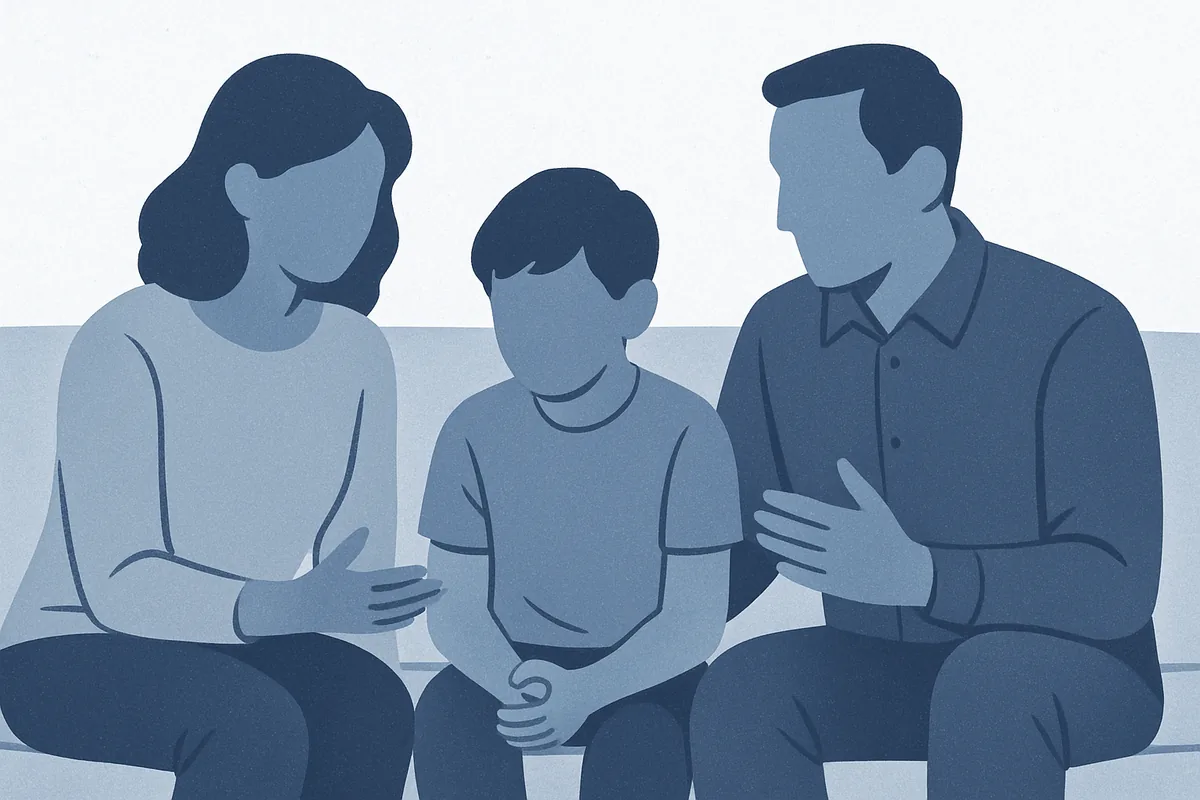
- A 2020 peer-reviewed study found that 28% of UAE adolescents meet criteria for an anxiety disorder, yet research consistently shows most children never initiate mental health conversations with their parents without prompting.
- Talking to children about mental health is most effective as an ongoing family practice rather than a single crisis conversation; children who grow up in emotionally open homes are more likely to disclose distress early, when it is easier to address.
- Conversation language needs to match developmental stage: children aged 3 to 6 respond to body-sensation words ('tight tummy', 'fizzy chest'), while adolescents aged 12 to 16 respond better to autonomy-respecting openers that invite rather than interrogate.
- Many Dubai children already encounter validated mental health vocabulary at school through formal wellbeing curricula, which means parents can build on language their child already recognises rather than introducing it from scratch.
- When a child discloses distress, the single most protective parental response is regulated curiosity: staying calm, naming what you heard, and asking one follow-up question rather than moving immediately to reassurance or problem-solving.
The World Health Organization estimates that 1 in 7 adolescents aged 10 to 19 globally experiences a diagnosable mental disorder (WHO, 2024). Closer to home, a peer-reviewed study found that 28% of UAE adolescents meet criteria for anxiety disorders, and a KHDA study of Dubai schools found that 17.5% of pupils already showed mental health symptoms above the normal range (KHDA, 2013). These are not abstract statistics for families living in this city. They describe children sitting in classrooms in Jumeirah, Al Barsha, and Business Bay right now.
This guide is not about what to say when your child asks about going to a psychologist. That conversation is important, and we have addressed it separately. This guide is about something broader and, in many ways, more foundational: how to build a family environment where mental health is a normal, recurring topic, so that when your child is struggling, they already know they can tell you. Talking to children about mental health consistently across years creates the conditions where crises are caught early and children feel genuinely known by the adults who love them.
At CAYA World, we work with families across Dubai every week. One of the most common things parents tell us is that they noticed something was wrong for months before their child said anything. The gap between what a child is carrying and what they share at home is not a gap of love. It is a gap of language, habit, and confidence on both sides. This guide is designed to close it.
Why talking to children about mental health is harder than it sounds
Most parents want to talk to their children about their inner lives. The intention is there. But research reveals a consistent gap between intention and action: a UK poll found that 64% of children rarely or never speak to their parents about their mental health, while 28% of parents reported they simply did not know how to start that conversation (Happiful, 2023). An earlier BBC-reported survey from 2015 found that 55% of parents had never spoken to their children about stress, anxiety, or depression at all. UAE-specific parental communication data at this level of granularity is not yet available in published research, but clinical experience at CAYA World suggests the pattern is similar, and frequently amplified by the specific pressures of expat family life.
Several things make these conversations genuinely difficult, and acknowledging them honestly is where good parenting starts.
Generational modelling. Most adults today grew up in households where emotions were managed privately. "We don't air our problems" is a value that was transmitted across cultures, including many of those represented in Dubai's diverse expatriate community. When parents did not learn an emotional vocabulary at home, producing one for their own children requires deliberate effort.
Fear of making it worse. A worry Dr. Nour Al Ghriwati hears frequently in parent consultations at CAYA World is: "What if I bring it up and I plant the idea?" The evidence does not support this fear. Asking a child directly whether they are feeling anxious or sad does not create those feelings; it creates permission to name feelings that already exist. Children who are asked tend to open up. Children who are not asked tend to conclude the topic is off-limits.
The "fix it" instinct. When a child says they feel sad or scared, a parent's natural impulse is to reassure: "You'll be fine," "Don't worry," "It's not that serious." This instinct comes from love, but it inadvertently communicates that the feeling is a problem to be solved rather than an experience to be understood. Children learn quickly that if expressing distress produces dismissal, it is safer not to express it at all.
Cultural stigma around mental health. In many communities, mental health problems are still associated with weakness or character failure. For parents from these backgrounds, speaking openly about emotions can feel like an act of rebellion against deeply held cultural values. At CAYA World, we work with families from across the Middle East, South Asia, East Asia, Europe, and the Americas, and we see this tension show up differently depending on background. The goal is not to erase cultural identity but to find a version of emotional openness that fits within a family's values.
What your child already knows: how Dubai schools are building on mental health literacy
One of the most important practical insights for Dubai parents is this: your child may already have mental health vocabulary that you have not tapped into yet.
Dubai's private school sector has formally embedded social-emotional learning and wellbeing into curricula across most schools. The Abu Dhabi Department of Education and Knowledge (ADEK) requires schools to promote wellbeing policies through formal curriculum delivery, staff training, school websites, and Parent Handbooks, as set out in the ADEK Wellbeing Policy (2023). Schools including Brighton College Dubai, The Aquila School, and The Millennium School Dubai run dedicated wellbeing programmes covering emotional regulation, resilience, and coping skills. Most children in Dubai private schools encounter structured emotion-language teaching from early primary years.
This matters practically. When a teacher asks a Year 3 class to identify what they notice in their body when they feel nervous before a test, and uses the word "anxiety" naturally in that context, children absorb that vocabulary. They learn that adults talk about these things at school. The disconnect comes when they arrive home and those conversations stop. The OECD's 2023 review of Dubai private school wellbeing noted that current data-collection tools do not yet fully capture students' health literacy levels, confirming that the home-based conversation gap is real and under-researched in the UAE context.
In 2025, the Emirates Child Protection Authority (ECA) published a dedicated mental health guide for parents, reflecting official UAE recognition that home conversations are a critical complement to school-based wellbeing education. This is not a fringe concern; it is policy priority at the national level.
The practical implication for parents: ask your child what they have been learning in wellbeing or PSHE. Ask what words they use at school for feelings. Use those same words at home. You are not starting a new conversation; you are extending one that your child's school already began.
At CAYA World, we find that children whose parents know what social-emotional content their school covers are more prepared to talk about their own experiences. If your child's school has a wellbeing coordinator, introducing yourself and asking what vocabulary the children are learning is one of the most practical steps a Dubai parent can take.
Age-by-age guide to talking to children about mental health (3–6, 7–11, 12–16)
Talking to children about mental health is not a one-size-fits-all conversation. Developmental stage determines the vocabulary, the pacing, and the level of abstraction a child can handle. The following framework is grounded in child development research and adapted for the practical reality of raising children in Dubai.
| Age Group | What They Can Understand | Useful Language | Sample Opener |
|---|---|---|---|
| 3 to 6 years | Body sensations; big/small feelings; that feelings pass | "tight tummy," "wobbly inside," "heart going fast," "big feeling in your chest" | "I notice your tummy looks like it has butterflies. Can you tell me where in your body you feel that?" |
| 7 to 11 years | Named emotions; cause and effect; that minds can get tired like bodies | "worried," "frustrated," "low," "overwhelmed," "stressed," "burnt out" | "Sometimes our brains feel full up, like a cup that's overflowing. What's filling yours up lately?" |
| 12 to 16 years | Complex emotional states; internal conflict; identity; social dynamics | "anxious," "depressed," "disconnected," "pressure," "burnt out," clinical language used matter-of-factly | "I'm not going to pretend to know what's going on for you. But I'm here if you want to think out loud." |
Ages 3 to 6: start with the body
Young children do not have the neurological development to identify abstract emotional states, but they are highly attuned to body sensations. Feeling scared lives in the stomach; feeling excited is a fizzing in the chest; feeling angry can be heat in the face. Start there. Name what you see in their body before you try to name the feeling. "Your shoulders are really tight right now. What's happening in there?" is more accessible to a five-year-old than "Are you feeling anxious?"
Books are excellent tools at this age. The Colour Monster by Anna Llenas assigns colours to emotions and gives children a shared vocabulary for sorting feelings that feel muddled. Reading it together once a week creates a natural on-ramp to feeling-conversations without requiring a child to produce language spontaneously.
Ages 7 to 11: connect feelings to context
Children in middle childhood can understand cause and effect. They know that something happened and now they feel a certain way. The goal at this stage is to build the habit of naming feelings specifically rather than defaulting to "fine" or "I don't know." Normalise the idea that the brain, like the body, can feel tired, overwhelmed, or in need of rest. "Your brain has been working really hard this week" is a frame that removes blame and opens space for a child to agree and elaborate.
At this age, children are also developing social comparison and starting to notice if they feel different from peers. Statements like "lots of kids feel really nervous about exams, even when they don't show it" provide reassurance that their internal experience is not uniquely broken.
Ages 12 to 16: respect autonomy above all
Adolescents have developed the capacity for abstract self-reflection, but they are also at the developmental stage where parental opinion is frequently experienced as intrusion. The most common error parents make at this age is asking too many questions in a row, which teens interpret as interrogation. Dr. Nour Al Ghriwati advises parents of teenagers at CAYA World to offer presence before information-gathering: sit alongside rather than opposite; share something briefly about your own emotional experience that week; then leave a long, unhurried pause. Silence is not failure. It is often the condition under which a teenager finally speaks.
Avoid openers that assume you know what is wrong: "You seem depressed, are you depressed?" closes the conversation. "I've noticed you seem a bit quieter than usual lately. I'm not going to guess what's going on, but I'm here" keeps it open.
If you have concerns about your teenager's wellbeing and the conversations at home are consistently shutting down, our teen behaviour support service at CAYA World can help you develop strategies specific to your child's temperament and situation.
When your child discloses distress: what to say and what to avoid
The moment a child tells a parent that they feel anxious, sad, or overwhelmed is one of the most clinically significant moments in a child's development. What happens in the next two minutes determines whether that child will disclose again. At CAYA World, we spend considerable time with parents on exactly this scenario, because the instinct to respond with comfort or problem-solving often inadvertently shuts the conversation down.
The single most protective response is what we call regulated curiosity: staying visibly calm, reflecting back what you heard, and asking exactly one open follow-up question. Nothing more. Jumping to solutions signals that the feeling itself is a problem. Asking too many questions signals interrogation. Staying calm while naming what you heard signals: "I received what you said, and it didn't break me, which means you are safe to say more."
What to say:
- "Thank you for telling me that. I want to make sure I understand. Can you tell me a bit more about when it started?"
- "That sounds really hard. I'm glad you said it out loud."
- "I'm not going to try to fix it right now. I just want to hear you."
- "It makes sense you'd feel that way, given everything."
What to avoid:
- "You shouldn't feel that way" or "There's nothing to worry about", these invalidate the emotional experience and teach a child their feelings are wrong.
- "When I was your age, I had it much harder", redirects the focus away from the child at exactly the moment they need to feel centred.
- "Have you tried just thinking more positively?", suggests the feeling is a cognitive error of their own making, which increases shame.
- Immediately texting another parent, calling a doctor within earshot, or showing visible alarm, this signals the child has caused a crisis by disclosing, which dramatically reduces the likelihood they will share again.
If a child discloses something that genuinely alarms you, such as talk of self-harm or hopelessness, it is appropriate to stay calm in the moment, take it seriously, and then seek clinical guidance. Reacting visibly in the moment with panic, however understandable, tends to result in the child quickly retracting or minimising what they said. Stay with them first. Act on what you heard second.
If you are navigating a situation where your child has disclosed something serious and you are not sure what to do next, our parenting support service at CAYA World offers clinical guidance for exactly these moments. A single consultation can give you a framework and a plan. You do not need to work it out alone.
Wondering if It's Time to Talk to Someone?
Our specialist team at CAYA World offers comprehensive assessment and evidence-based treatment, conducted from our clinic in Palm Jumeirah, Dubai.
How to talk about therapy without making it feel like a punishment
This article is specifically about building ongoing mental health conversations at home rather than preparing a child for a clinical appointment. But the two are connected: if therapy has been introduced punitively in the past, or if a child associates the idea of a psychologist with being "broken," they are far less likely to open up at home. Normalising professional support is therefore part of normalising mental health conversation broadly.
The most effective framing positions therapy the same way you would position physical health support. "When my knee was hurting from running, I saw a physio who helped me understand what was going on and gave me exercises to make it better. A psychologist does something similar for feelings." This analogy works well across most age groups from about seven upward, and it removes the implication that therapy is for people who cannot cope.
Avoid framing therapy as a consequence: "If you don't stop having these meltdowns, we'll have to take you to someone." This is one of the most common ways therapy becomes associated with shame or punishment, and it makes future clinical engagement much harder. Also avoid: "We're sending you because we don't know what to do with you." Even well-meaning honesty can land as rejection.
What works instead: matter-of-fact normalisation. "Lots of kids in Dubai see a psychologist, including some of your classmates probably. It's just a space where you talk to someone whose job is to understand how brains and feelings work." Children take their emotional cues from parents. If you talk about therapy with the same neutrality you use for a dentist appointment, your child is far more likely to approach it with curiosity rather than dread.
At CAYA World, we often see children and teens who were reluctant to attend their first appointment arrive and then ask when they can come back. The anticipation is usually worse than the reality, and framing matters enormously in shaping that anticipation. If you are navigating this conversation specifically, we have a separate guide on how to talk to your child about going to a psychologist that covers the appointment conversation in detail.
Building an emotionally open family environment as a daily habit
The research on children's mental health help-seeking is consistent on one point: children who disclose distress early, before it becomes a clinical problem, are the children who grew up in households where feelings were talked about regularly, not just in crises. Talking to children about mental health once, when something has gone wrong, is far less effective than building a low-stakes daily practice that makes emotional language ordinary.
Here are the practices that Dr. Nour Al Ghriwati recommends most consistently to families at CAYA World:
The "rose, thorn, bud" check-in
At dinner or bedtime, each family member shares one good thing from the day (the rose), one hard thing (the thorn), and one thing they are looking forward to (the bud). This structure works from about age four upward and takes under five minutes. Its power is in the repetition: it creates a daily expectation that everyone, including parents, has an inner life worth mentioning. Parents sharing their own thorns is especially important. When a child hears a parent say, "My thorn today was that I felt really anxious about a presentation at work," they learn that adults have hard feelings too, and that naming them is not weakness.
Modelling emotional language in everyday moments
Parents are the most powerful emotional literacy teachers their children will ever have. Narrating your own emotional experience in real time, without dramatising it, gives children a live demonstration of emotional vocabulary in use. "I'm feeling a bit overwhelmed right now because I have a lot to do before your grandparents arrive. I'm going to take five minutes to sit quietly." This models identification, naming, and self-regulation in a single sentence. Children absorb this.
Using media as a conversation bridge
Films, books, and TV series regularly feature characters experiencing anxiety, grief, loneliness, and anger. These are low-pressure entry points for mental health conversations, because the feelings belong to a character rather than to your child. "What do you think was going on for that character when he stopped talking to his friends?" invites emotional reasoning without requiring personal disclosure. Over time, children learn to apply that same analytical framework to their own experiences.
Choosing the right moment
Sitting opposite a child at a table and asking "how are you really feeling?" tends to produce one-word answers. Side-by-side activities, such as driving to school, cooking together, or walking the dog, remove the social pressure of eye contact and produce far more natural conversation. For teenagers especially, this is not a trivial observation. Many of the most meaningful conversations that happen between adolescents and parents happen in the car. Use it deliberately.
Repairing ruptures openly
When parents lose their temper, dismiss a feeling, or respond poorly to a disclosure, repairing that moment explicitly builds emotional trust more than avoiding the rupture would have. "I want to come back to what you said yesterday. I don't think I handled that very well, and I'd like to listen properly this time" teaches a child that relationships can recover from misattunement, and that the adults in their life are willing to be accountable. This is one of the most underrated tools in parenting support work.
If you are finding that family conversations around emotions consistently feel stuck, or if you are parenting a child with anxiety, grief, or behavioural challenges that make these conversations harder, our team at CAYA World can support you. Our parenting therapy and support service works with parents directly to build the skills and scripts that make emotionally open family life sustainable, not just aspirational.
Frequently Asked Questions About Talking to Children About Mental Health in Dubai
There is no minimum age. Children as young as two and three can learn basic emotion vocabulary: happy, sad, scared, angry, calm. The language you use should match their developmental stage rather than waiting for a "right" age to introduce the topic. Starting early, even with simple body-sensation words, builds the emotional literacy that makes more complex conversations possible as children grow. Families who wait until adolescence often find that teenagers have already formed the habit of not sharing, which is much harder to reverse.
The most effective response is simpler than most parents expect: reflect back what you heard and ask one open question. "It sounds like you've been feeling really anxious about school. Can you tell me more about when it started?" This communicates that you received what they said without alarm, and that you want to understand rather than immediately fix. Avoid reassurance as a first response. "You'll be fine" feels dismissive to a child in distress, even when it is kindly meant. Staying with the feeling for a few minutes before problem-solving makes a significant difference.
The most accessible explanation for young children is something like: "A psychologist is someone whose whole job is to help kids understand their feelings and figure out what to do when things feel too big." Drawing a parallel to physical health helps: just as a doctor helps when a body hurts, a psychologist helps when feelings are getting too heavy to carry alone. Avoid phrases that frame therapy as a consequence of behaviour or as something for children who are "not normal." At CAYA World, many children arrive nervous and leave asking when their next appointment is.
The most common responses that inadvertently close conversations down are: "You shouldn't feel that way," "There's nothing to worry about," "Think positive," and "When I was your age, I managed." Each of these, however well-intentioned, signals that the child's feeling is wrong, excessive, or inconvenient. Also avoid visible alarm or immediately problem-solving without acknowledging the feeling first. The response that keeps the conversation open is calm, curious, and validating: "I hear you. That sounds really hard. Tell me more."
Behaviour change is often the first visible sign that a child is carrying something they have not yet found words for. Rather than asking directly "what's wrong," try an observation without pressure: "I've noticed you seem a bit quieter lately. I'm not going to push, but I want you to know I'm here whenever you want to talk." Follow this with a shared low-pressure activity rather than sitting and waiting for a response. For older children and teens, normalising that you have noticed change without framing it as a problem reduces defensiveness. If the behaviour change persists for more than two to three weeks, a conversation with a clinical psychologist can help you determine whether professional support is warranted.
Sources and Further Reading
- Adolescent mental health fact sheetWorld Health Organization (2024)
- Mental health study in Dubai schoolsKnowledge and Human Development Authority (KHDA) (2013)
- Prevalence of anxiety disorders among adolescents in the UAEPubMed Central / peer-reviewed (2020)
- Two thirds of children don't talk to parents about mental healthHappiful (2023)
- Parents struggle to talk to children about mental healthBBC News (2015)
- ADEK Wellbeing Policy: Requirements for Schools. Abu Dhabi Department of Education and Knowledge (2023)