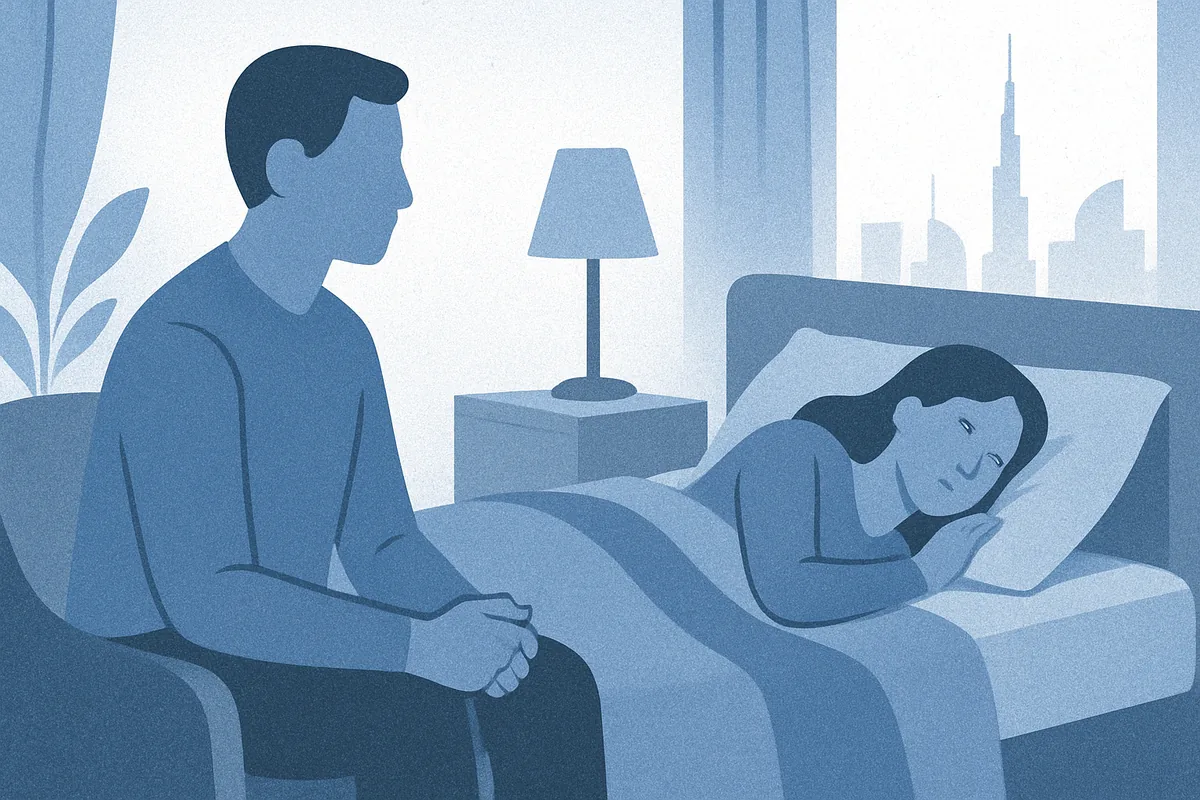
- Nearly 30% of UAE adults were sleep deprived in a 2024 cross-sectional study, with those affected reporting significantly higher rates of low mood and depressive symptoms than those who slept well.
- Chronic insomnia carries approximately a 2 to 3 times greater risk of developing depression, and in people already living with depression, it is associated with a more relapsing course of illness.
- Sleep problems are sometimes the primary clinical issue and sometimes a symptom of an underlying mood or anxiety disorder; the distinction matters because it changes what treatment looks like.
- Cognitive behavioural therapy for insomnia (CBT-I) produces durable results: one long-term follow-up found 66% of participants no longer met insomnia criteria at ten years, with Insomnia Severity Index scores dropping from 18.3 at baseline to 10.1 post-treatment.
- Dubai's combination of extreme summer heat, late-night social culture, high rates of shift work in healthcare and hospitality, and frequent long-haul travel creates a circadian environment that is clinically distinct from most other cities, and one that routinely disrupts sleep architecture even in otherwise well people.
A 2024 cross-sectional study of UAE adults found that nearly 30% were sleep deprived, and those individuals reported significantly higher rates of low mood and depressive symptoms than people sleeping adequately (Al Hammadi et al., Preprints.org, 2024). Sleep and mental health in Dubai are not two separate concerns that occasionally overlap. They are part of the same clinical picture, each capable of generating and sustaining the other in a cycle that, without intervention, tends to worsen over time.
This article is the clinical primer on that relationship. It explains why the bidirectional loop exists, what Dubai's specific environment does to it, and how to recognise whether poor sleep is driving your mood or your mood is driving your sleep. It does not reproduce a checklist of anxiety symptoms, because we have covered the anxiety-to-insomnia pipeline in detail in a dedicated piece. What this article offers instead is the broader framework: sleep as a mental health topic across mood, anxiety, and stress conditions, with a clear account of what treatment looks like and when to seek it.
Why sleep and mental health are a two-way street
The relationship between sleep and mental health is genuinely bidirectional. That word gets used loosely, so it is worth being precise about what it means clinically. It does not simply mean that both problems tend to appear together. It means that each one causally influences the other through distinct biological mechanisms, and that treating one without addressing the other frequently produces a partial or temporary result.
On the sleep-to-mood pathway, the mechanism is well-established. During slow-wave sleep, the brain clears metabolic waste products via the glymphatic system, consolidates emotional memories, and regulates the amygdala's threat-response threshold. When sleep is fragmented or shortened, the amygdala becomes hyperreactive to negative stimuli, the prefrontal cortex's capacity to modulate that reactivity is reduced, and the result is a person who is more irritable, more anxious, and less able to regulate difficult emotions through the following day. Do this repeatedly across weeks and months, and the cumulative neural effect begins to look clinically indistinguishable from the early stages of a mood disorder.
On the mood-to-sleep pathway, the mechanism runs through the stress and arousal systems. Depression alters sleep architecture directly, reducing slow-wave sleep and increasing early-morning waking. Anxiety keeps the sympathetic nervous system active at bedtime, preventing the drop in core body temperature and heart rate variability that sleep onset requires. Chronic stress elevates cortisol, which is physiologically antagonistic to melatonin. In each case, the mental health condition is not merely making sleep uncomfortable. It is actively disrupting the neurobiological processes that sleep depends on.
A 2024 review published in PMC found that chronic insomnia confers approximately a 2 to 3 times greater risk for incident depression, and is linked to a more relapsing course in people who already have a depressive disorder (PMC Review, 2024). The National Sleep Foundation's 2024 Sleep in America Poll found that nearly 7 in 10 adults dissatisfied with their sleep reported mild or greater depressive symptoms, while over 90% of adults with the highest sleep-health ratings reported favourable mental health (National Sleep Foundation, 2024). These are not coincidences of co-occurrence. They reflect the shared neurobiology of sleep and mood regulation.
At CAYA World, we routinely assess sleep as part of any psychological evaluation, not as an afterthought at the end of the intake form but as a substantive clinical domain. The quality, duration, architecture, and timing of sleep tell us a great deal about the severity and likely trajectory of the presenting concern.
How poor sleep in Dubai affects your mental health
Sleep deprivation does not affect every person or every mental health domain equally. The pattern of impairment depends on what is being disrupted, how often, and for how long. But several effects are consistent enough to describe with confidence, and they are directly relevant to the clinical picture we see at CAYA World among Dubai residents.
Emotional dysregulation is the most immediate consequence. After a single night of poor sleep, people show measurably greater emotional reactivity to negative stimuli and a reduced capacity to reframe distressing situations. This is not simply "feeling tired." It is a functional impairment in the neural systems that govern emotion regulation, equivalent in some studies to a moderate alcohol intoxication effect on prefrontal function. For someone already managing stress from work, relocation, family separation, or the financial pressures common in expat life, this daily erosion of emotional resilience compounds quickly.
Cognitive performance declines in specific ways that are often misattributed. Working memory, attentional control, and processing speed all degrade with chronic sleep restriction. People frequently interpret these changes as signs of ADHD, early cognitive decline, or burnout, when the actual driver is insufficient or fragmented sleep. A clinical assessment that fails to ask about sleep quality and duration risks misattributing cognitive symptoms entirely.
Appetite regulation is disrupted through changes in ghrelin and leptin signalling, driving cravings for high-calorie food and making it harder to use eating as a regulated, intentional behaviour. For people managing anxiety or depression through food, this adds a layer of difficulty that is physiological in origin, not primarily psychological.
At the population level, the figures for Dubai are striking. DHA-linked data, cited in publicly available Dubai health communications (2023), puts insomnia prevalence among Dubai residents at approximately 31.3%, making it the most commonly reported sleep disorder in the emirate. Against the NSF's finding that 7 in 10 people dissatisfied with their sleep have mild or greater depressive symptoms, this means a substantial proportion of Dubai's population may be living with sleep-driven mood impairment that is neither recognised nor treated.
How anxiety and depression disrupt sleep, and why that makes both worse
Anxiety and depression disrupt sleep through different mechanisms, and it matters clinically which one is operating because the intervention differs.
Anxiety at bedtime typically produces sleep-onset difficulty. The mind rehearses threats, contingencies, and worst-case outcomes. The body responds with physiological arousal: elevated heart rate, muscle tension, shallow breathing. These are the stress system's adaptive responses to perceived danger, and they are incompatible with the nervous system state required to initiate sleep. Over time, the bed itself can become a conditioned cue for arousal through a process called stimulus control erosion, meaning the bedroom environment begins to trigger wakefulness reflexively rather than sleepiness. This specific anxiety-to-insomnia loop, and the treatment approaches most effective for breaking it, are covered in detail in our article on anxiety and sleep problems in adults in Dubai.
Depression disrupts sleep differently. The most characteristic pattern is early-morning waking: falling asleep without great difficulty, then waking at 3 or 4 am with an inability to return to sleep, often accompanied by ruminative, negatively-toned thinking. This is driven by the abnormal REM sleep architecture associated with depression, in which REM onset is earlier and more intense than in unaffected individuals. Hypersomnia, sleeping significantly more than usual without feeling refreshed, is equally common in depression, particularly in atypical presentations and in seasonal affective patterns. Both the under-sleeping and the over-sleeping variants represent the depressed nervous system's dysregulated relationship with rest, not a choice or a habit failure.
The clinical problem with treating either anxiety or depression without addressing the sleep dimension is that untreated insomnia is one of the strongest predictors of relapse. A person whose depression lifts through therapy but whose sleep remains fragmented is at substantially elevated risk of a recurrence within six to twelve months. Sleep is not a byproduct of improved mental health. It is a prerequisite for sustaining it.
Dubai-specific factors that make sleep harder than in other cities
Dubai's environment creates a set of sleep-disrupting conditions that are, taken together, clinically distinctive. None of these factors is individually unique to Dubai, but their combination and intensity are.
Extreme summer heat. Between June and September, daytime temperatures regularly exceed 45 degrees Celsius. The practical consequence is that outdoor activity shifts to evenings and nights. Dinner reservations at 9 or 10 pm are standard, socialising runs past midnight, and the body's circadian signal that evening is a time for winding down is actively countermanded by a lifestyle schedule that treats it as the day's main activity window. Core body temperature must drop by approximately one degree Celsius to initiate sleep. Late-evening activity and social arousal delay that drop, consistently pushing sleep onset later.
A 24-hour city culture. Dubai's retail, dining, and entertainment infrastructure operates around the clock. This is a feature of the city, not a problem in itself, but it means that the environmental cues that reinforce circadian rhythm in other cities, quiet streets, closed shops, reduced social activity, are largely absent. For people who do not actively impose structure on their evenings, the city's ambient wakefulness tends to extend their own.
Shift work and rotating schedules. Healthcare, hospitality, logistics, and aviation collectively employ a large share of Dubai's workforce. All four sectors involve shift work, night shifts, or rotating schedules at high rates. Shift work disorder is a recognised clinical entity characterised by chronic circadian misalignment, insomnia or excessive sleepiness depending on schedule, and elevated rates of depression and anxiety. It is not simply tiredness. It is the chronic physiological consequence of working against the body's endogenous timing system.
Frequent long-haul travel and time-zone transitions. Expats in Dubai often travel to home countries across two to eight time zones, sometimes four to six times per year. Each trip requires circadian resynchronisation, which takes roughly one day per time zone crossed. For frequent travellers, the circadian system may never fully stabilise before the next disruption arrives.
Relocation stress and social jet lag. Newly arrived expats often experience a period of circadian disruption that is partly physiological (adjusting to Gulf Standard Time) and partly social (adapting to different daily schedules, work patterns, and social norms). This resynchronisation period can last weeks and, when combined with the emotional stress of relocation, significantly increases vulnerability to sleep difficulties that persist well beyond the initial adjustment.
Wondering if It's Time to Talk to Someone?
Our specialist team at CAYA World offers comprehensive assessment and evidence-based treatment, conducted from our clinic in Palm Jumeirah, Dubai.
Is your sleep problem a symptom, or the problem itself?
This is one of the most clinically important questions in the assessment of sleep difficulties, and it is one that many people have never been asked. The distinction changes the treatment approach significantly.
When poor sleep is a symptom, it is a sign that something else is dysregulating the systems that sleep depends on. In depression, the altered REM architecture is a biological feature of the mood disorder. In anxiety, the bedtime hyperarousal is an expression of a hyperactive threat-detection system. In post-traumatic stress, nightmares and hypervigilance at night are part of the intrusion and hyperarousal symptom clusters. In all these cases, treating the sleep problem in isolation will produce limited results. The sleep improves meaningfully only when the underlying condition is adequately treated.
When poor sleep is the primary problem, the insomnia has its own maintaining mechanisms independent of any underlying mood or anxiety condition. Stimulus control erosion, sleep effort (trying hard to sleep, which is physiologically counterproductive), catastrophic beliefs about the consequences of sleeplessness, and maladaptive compensatory behaviours like extended time in bed or daytime napping all sustain insomnia as a self-perpetuating cycle. In these cases, targeted insomnia treatment is indicated rather than, or in addition to, general mental health therapy.
The complication is that the two presentations often co-occur and interact. A person whose insomnia began as a symptom of an anxiety episode may find that the anxiety resolves but the insomnia continues, maintained now by its own perpetuating factors. Equally, a person with primary insomnia who has never had a mood disorder may develop clinical depression after months of poor sleep, at which point treating only the insomnia is insufficient.
A good clinical assessment disentangles these threads. It asks about the timeline: which came first? It asks about the quality of sleep during periods when mood was stable. It maps the specific features of the sleep difficulty, whether onset, maintenance, or early waking, against the diagnostic profiles of different conditions. If you are trying to work out which pattern fits your own experience, our article on signs that it might be time to see a therapist in Dubai offers a practical framework for recognising when a problem has reached the threshold where professional support is warranted.
| Sleep feature | More typical of primary insomnia | More typical of mood or anxiety disorder |
|---|---|---|
| Onset pattern | Difficulty falling asleep most nights regardless of life stress | Difficulty falling asleep that began with or worsened alongside mood or anxiety changes |
| Waking pattern | Waking during the night, difficulty returning to sleep | Early-morning waking with low mood (depression); waking with racing thoughts (anxiety) |
| Sleep when away from home | Often no better or only slightly better | May sleep normally in new environments, suggesting stimulus control factors are limited |
| Associated daytime symptoms | Fatigue and irritability as primary complaints | Persistent low mood, anhedonia, or anxiety symptoms regardless of sleep quality |
| Sleep history | Often a lifelong or long-term pattern | Usually a change from prior baseline, linked to an identifiable period or event |
At CAYA World, our clinical team uses structured intake assessment to map exactly this territory before recommending a treatment direction. The distinction between symptom and primary problem is not always obvious on self-report, but it becomes clearer with careful clinical questioning.
If you are in Dubai and uncertain whether what you are experiencing warrants professional input, reaching out to a clinical psychologist for an initial consultation is a straightforward way to get clarity. You can send a WhatsApp message to the CAYA World team on +971 4 572 3755, with no commitment required, and a clinician will help you understand whether structured assessment or therapy would be useful in your situation.
How CBT addresses sleep and mental health together in Dubai
Cognitive behavioural therapy for insomnia, commonly referred to as CBT-I, is the first-line recommended treatment for chronic insomnia in all major clinical guidelines, including those from the American Academy of Sleep Medicine and the American College of Physicians. It is not a set of relaxation exercises or general sleep hygiene advice. It is a structured, evidence-based protocol that targets the specific cognitive and behavioural mechanisms that perpetuate insomnia.
The core components of CBT-I are well-established. Sleep restriction therapy involves temporarily reducing time in bed to consolidate sleep and rebuild the homeostatic sleep drive. This sounds counterintuitive and often is uncomfortable in the first week, but it is consistently the most potent technique in the protocol. Stimulus control involves re-associating the bed with sleepiness rather than wakefulness by restricting bed use to sleep and eliminating compensatory behaviours like lying in bed awake for hours. Cognitive restructuring targets the catastrophic beliefs about sleep that perpetuate arousal: beliefs like "I cannot function on less than eight hours", or "another bad night will destroy my health", which are themselves physiologically activating. Sleep hygiene education addresses the environmental and behavioural factors, light exposure, caffeine timing, exercise scheduling, that support or undermine circadian entrainment.
The evidence for CBT-I's effectiveness is robust and unusually durable. A long-term follow-up study published in the journal Cognitive Behaviour Therapy found that average Insomnia Severity Index scores improved from 18.3 at baseline to 10.1 post-treatment, with 64% of participants no longer meeting insomnia criteria at one year and 66% at ten years, demonstrating that treatment gains are maintained over a decade (Kaldo et al., Cognitive Behaviour Therapy, 2021). A randomised trial published in JAMA Psychiatry found 56.6% achieved insomnia remission and 69.7% were treatment responders at one-year follow-up (Manber et al., JAMA Psychiatry, 2017).
When sleep problems are comorbid with anxiety or depression, treatment addresses both dimensions. CBT techniques for anxiety reduce the bedtime hyperarousal that prevents sleep onset. CBT techniques for depression target the behavioural withdrawal and ruminative thinking that disrupt sleep architecture. In practice, a course of therapy for someone presenting with both insomnia and low mood will often integrate CBT-I components alongside standard depression-focused CBT, with the two areas of work informing and reinforcing each other across the course of treatment.
At CAYA World, our team uses CBT-based approaches with clients presenting across the sleep and mood spectrum, from primary insomnia through to sleep difficulties embedded in anxiety, depression, burnout, and adjustment to life transitions. Our sleep support service is available for adults experiencing persistent sleep problems, and our anxiety therapy service addresses the full range of anxiety presentations, including those where insomnia is a central feature. For clients whose sleep difficulties are primarily driven by low mood, our depression therapy service provides structured, evidence-based care that addresses sleep as part of the broader clinical picture.
The practical takeaway for anyone reading this in Dubai is that you do not need to have a diagnosis to seek help with sleep. A single clinical conversation is often enough to identify which pattern is operating and what the most effective starting point would be.
Frequently Asked Questions About Sleep and Mental Health in Dubai
Both directions are clinically real and well-documented. Anxiety activates the sympathetic nervous system, raising heart rate, core body temperature, and cognitive arousal in ways that are directly incompatible with sleep onset. Over time, this produces genuine insomnia. Equally, chronic insomnia degrades the prefrontal cortex's capacity to regulate the amygdala, which increases anxiety reactivity. In most clinical presentations, both processes are operating simultaneously, which is why treatment that addresses only one dimension tends to produce partial results. A good assessment identifies which came first and which is now the dominant driver.
The distinction requires clinical assessment rather than self-diagnosis, but a few indicators are useful. If your sleep difficulty began alongside a significant change in mood, stress level, or life circumstances, a mood or anxiety component is plausible. If you sleep normally when away from your usual environment, behavioural and cognitive factors in your home routine are likely involved. If your sleep has been poor for most of your adult life regardless of circumstances, primary insomnia with its own perpetuating mechanisms is more likely. Any sleep problem persisting beyond three months and affecting daytime function warrants a professional evaluation.
A therapist working with sleep difficulties will first conduct a thorough assessment to understand the timeline, pattern, and likely drivers of the problem. If CBT-I is indicated, treatment typically runs across six to eight structured sessions and involves specific techniques: sleep restriction to rebuild sleep drive, stimulus control to re-associate the bed with sleepiness, cognitive restructuring to address catastrophic beliefs about sleeplessness, and practical sleep scheduling. Where a mood or anxiety condition is contributing, therapy integrates sleep-focused techniques with the appropriate evidence-based approach for that condition, most commonly CBT.
Hypersomnia, sleeping significantly more than usual without feeling refreshed, is a recognised feature of depression, particularly in its atypical presentation and in seasonal affective patterns. It is not a sign that things are less serious than classic insomnia; it is equally a marker of the depressed nervous system's dysregulated relationship with rest. If you are sleeping ten or more hours and still waking exhausted, or if you are sleeping as a way of escaping waking experience, both are worth discussing with a clinician. Hypersomnia in depression responds to the same treatments that address the underlying mood disorder.
Be as specific as you can: note the time you typically go to bed, roughly how long it takes to fall asleep, how many times you wake and for how long, your usual waking time, and how you feel during the day. Mention how long the pattern has been present and whether it has changed alongside anything else in your life. If you have noticed a link to stress, travel, shift patterns, or mood changes, say so. You do not need to arrive with a diagnosis or a theory. Giving the therapist a clear factual picture of your sleep pattern is enough to begin a useful clinical conversation.
Sources and Further Reading
- Sleep deprivation and mood outcomes in UAE adults (cross-sectional study)Al Hammadi et al., Preprints.org (2024)
- Bidirectional relationship between insomnia and depression: PMC reviewPMC / National Library of Medicine (2024)
- Sleep and Mental Health Position StatementNational Sleep Foundation Sleep in America Poll (2024)
- Long-term outcomes of CBT for insomnia: 10-year follow-upKaldo et al., Cognitive Behaviour Therapy / Tandfonline (2021)
- CBT for insomnia in adults with depression: randomised trialManber et al., JAMA Psychiatry (2017)
- Insomnia prevalence among Dubai residents (31.3%). DHA-linked data, cited in publicly available Dubai health communications (2023)