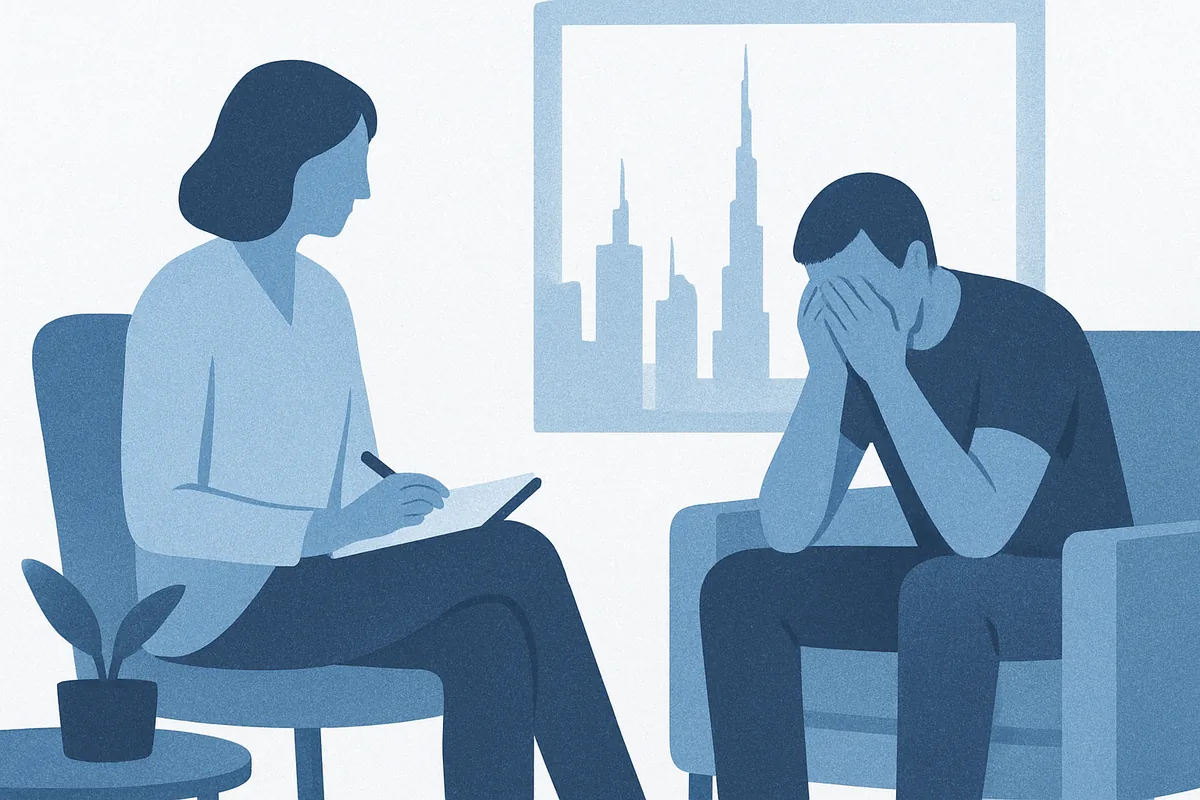
- During a panic attack, diaphragmatic breathing (4 counts in, hold 2, 6 counts out) and the 5-4-3-2-1 grounding technique are the two fastest evidence-based ways to interrupt the physiological spiral, with the grounding technique producing a statistically significant reduction in acute anxiety in clinical trials (Applied Nursing Research, 2025).
- Cold water applied to the face activates the dive reflex and produces a moderate-to-large reduction in heart rate within seconds, making it one of the most physiologically direct tools available during an acute panic episode (Psychophysiology, 2023).
- In the hours after a panic attack, gentle movement and brief written note-taking about triggers are more helpful than resting and replaying the event, because avoidance of the sensations and situation reinforces the panic cycle.
- Up to 90% of people who complete a full course of CBT for panic disorder are completely panic-free six months after treatment ends, with most remaining panic-free at two-year follow-up (ABCT, 2022).
- Dubai's extreme heat produces physical sensations including rapid heart rate, sweating, and dizziness that are physiologically indistinguishable from early panic, which means heat exposure can trigger or amplify panic episodes in people already prone to them.
Approximately 13.2% of the global population experiences a panic attack at some point in their lifetime, yet the majority of those people never receive specific guidance on what to do when one strikes (Kessler et al., World Mental Health Survey, PMC, 2016). This article addresses exactly that gap. If you are looking for what helps panic attacks in Dubai right now, or you had an episode last week and want to reduce the chance of the next one, you are in the right place. We cover what to do in the moment, how to recover afterwards, and which longer-term skills consistently reduce panic frequency. For a deeper explanation of how panic disorder develops and why CBT works as a treatment, our article on panic attack therapy in Dubai covers that ground; we keep the therapy framing here brief and practical.
What actually happens during a panic attack and why it feels so terrifying
A panic attack is a sudden surge of intense fear or discomfort that peaks within minutes and involves at least four physical or cognitive symptoms: racing heart, chest tightness, shortness of breath, dizziness, numbness, sweating, chills, nausea, a sense of unreality, or a fear of losing control or dying. It is not dangerous. But it is completely convincing that it is. That conviction is the engine of the whole experience.
What is actually happening is this: your brain's threat-detection system, the amygdala, fires an alarm. Adrenaline and cortisol flood your bloodstream within seconds. Your heart rate climbs. Blood diverts to your muscles. Your breathing becomes shallower and faster. Carbon dioxide in your blood drops, which paradoxically creates tingling, dizziness, and a feeling of suffocation. The body is doing exactly what it is designed to do. The problem is that the alarm fired without a real threat, and the physical sensations it produces then become the threat. You feel your heart race, interpret it as danger, feel more afraid, and the adrenaline climbs further. This feedback loop is the mechanism David Clark described in his 1986 cognitive model of panic: the catastrophic misinterpretation of bodily sensations.
Knowing this is useful, but in the middle of an attack you cannot think your way out of it with understanding alone. You need techniques that interrupt the physiological spiral directly. Those are below.
What helps during a panic attack: evidence-based techniques for the moment
The goal in the acute phase is not to suppress what is happening. It is to give your nervous system a signal strong enough to counter the adrenaline flood. Three techniques consistently meet that standard in the clinical literature.
Diaphragmatic breathing with a lengthened exhale
Breathing is the one part of the autonomic nervous system you can consciously control, and the exhale in particular activates the parasympathetic branch. A 4-2-6 pattern works well under pressure: breathe in slowly through the nose for four counts, hold lightly for two counts, breathe out through the mouth for six counts. The extended exhale is the active ingredient. Repeat five to eight cycles. If you are mid-attack, this will not stop it instantly, but it does interrupt the hyperventilation loop that sustains it. Place one hand on your abdomen to confirm the breath is reaching your diaphragm, not just your upper chest.
This technique is labelled diaphragmatic breathing or slow paced breathing in the clinical literature. It is the most commonly taught first-line technique in CBT for panic disorder and forms part of the NICE CG113-recommended treatment protocol.
The 5-4-3-2-1 grounding technique
Grounding works by redirecting your attention to sensory input in the present environment, which competes with the inward focus on body sensations that feeds panic. A 2025 study published in Applied Nursing Research found that five-senses grounding produced a statistically significant reduction in acute anxiety (p < 0.001), with high-anxiety occurrence dropping meaningfully post-intervention (Applied Nursing Research, 2025). The technique: name five things you can see, four you can physically touch (and notice the texture), three you can hear, two you can smell, one you can taste. Slow and deliberate is better than fast. This is particularly useful when your surroundings are safe but your mind is pulling you inward.
Cold water facial cooling
Splashing cold water on your face, or pressing a cold, wet cloth to your cheeks and forehead, activates the mammalian dive reflex via the trigeminal nerve. A 2023 systematic review in Psychophysiology found a moderate-to-large positive effect of cold water facial cooling on cardiac vagal activity (measured by RMSSD), supporting its use as an acute autonomic down-regulation technique (Psychophysiology, 2023). In plain terms: the cold triggers a rapid heart rate reduction through a reflex the nervous system cannot easily override. In Dubai, where a bathroom or cold water source is rarely far away, this is an underused but highly practical technique.
Cognitive labelling
Naming the experience out loud or in your head matters more than it sounds. "This is a panic attack. It will peak and pass. My heart racing is adrenaline, not a heart attack. I have felt this before." Neuroimaging studies show that affect labelling reduces amygdala activation. You do not have to believe the words fully. Repeat them anyway. Combine labelling with one of the three techniques above.
| Technique | What it targets | Evidence base |
|---|---|---|
| Diaphragmatic breathing (4-2-6) | Hyperventilation loop; CO2 imbalance | NICE CG113 first-line recommendation |
| 5-4-3-2-1 grounding | Inward sensory focus; attentional narrowing | p < 0.001 anxiety reduction (Applied Nursing Research, 2025) |
| Cold water facial cooling | Heart rate; sympathetic arousal via dive reflex | Moderate-to-large vagal activation effect (Psychophysiology, 2023) |
| Cognitive labelling | Amygdala activation; threat appraisal | Affect labelling reduces amygdala response (neuroimaging literature) |
After the attack: what to do in the hours that follow
The attack has passed. You feel wrung out, possibly embarrassed if it happened in public, and perhaps frightened about when the next one will come. What you do in the next few hours matters, because it either reinforces the panic cycle or begins to weaken it.
Do not retreat completely
The instinct is to lie down, cancel plans, and stay somewhere familiar and safe. Some rest is reasonable. Full withdrawal is not. When you avoid the place, the activity, or the physical state associated with the attack, your brain records that avoidance as the solution. This is how agoraphobic restriction develops: through individually reasonable decisions that collectively narrow your world. If the attack happened in a shopping mall, it does not mean you need to go back to the same mall in the next hour. But it does mean staying home from all public places that afternoon is not the answer. A short, gentle walk, or continuing with a modified version of whatever you were doing, sends your nervous system a different message.
Write down what you noticed
A brief factual note about the episode is useful data, not rumination. Time of day, location, what you had eaten or drunk, how much sleep you had the previous night, any identifiable stressor in the preceding 24 hours, and what physical sensation came first. At CAYA World, we often ask clients to keep a simple panic record in the early weeks of working together, because the patterns it reveals frequently surprise people: attacks clustered on Sunday evenings, or after the third coffee of the day, or during a particular commute. Patterns can be addressed. Vague dread cannot.
Do not catastrophise the episode
Replaying the attack and asking "why did this happen to me" or "what is wrong with me" keeps your nervous system in an elevated state and primes you for the next one. A more accurate internal response is: "My alarm system misfired. That is unpleasant and it will happen again unless I build specific skills to reduce it. I now know what to do." That framing is not minimising. It is accurate.
Limit stimulants for the rest of the day
Caffeine, high-sugar foods, and alcohol all modulate cortisol and adrenaline in ways that either elevate baseline arousal or produce a later crash that mimics panic-onset sensations. After an episode, lowering your physiological baseline for the remainder of the day gives your body a cleaner recovery window. In Dubai's heat, hydration with plain water also matters: dehydration raises heart rate and can produce the lightheadedness and flushing that lower the panic threshold.
If you have had more than two or three panic attacks in the past month and are starting to notice avoidance creeping in, talking with a clinical psychologist sooner rather than later is worthwhile. At CAYA World, an initial conversation can help clarify whether what you are experiencing warrants structured support and, if so, what that would involve. Send us a WhatsApp message at +971 4 572 3755 and a member of our clinical team will respond promptly.
Longer-term strategies: how CBT techniques for panic attacks reduce frequency
Self-management during and after an episode is valuable. But the evidence is unambiguous that structured CBT is what produces lasting reduction in panic frequency. Data from the Association for Behavioral and Cognitive Therapies (2022) shows that up to 90% of people who complete a full course of CBT for panic disorder are completely panic-free six months after treatment ends, with most remaining panic-free at two-year follow-up. The NICE Clinical Guideline CG113 (2011, reaffirmed 2023) recommends CBT as the first-line psychological treatment for panic disorder, typically delivered across 7 to 14 hours of clinical time.
For a full explanation of how CBT for panic disorder works, our panic attack therapy article covers Clark's cognitive model in detail. Here we focus on three specific techniques that emerge from that model and that you can begin building awareness of independently.
Interoceptive exposure
Interoceptive exposure is the CBT technique that most directly targets panic disorder, and it is the one most people have never heard of. The principle is that panic attacks are maintained partly by fear of the body sensations themselves. Interoceptive exposure deliberately induces those sensations in a controlled, graduated way: spinning in a chair to create dizziness, breathing through a narrow straw to create mild breathlessness, doing jumping jacks to raise heart rate. Repeated exposure to these sensations, in a context where nothing bad happens, teaches the nervous system that the sensations are tolerable. Over multiple repetitions, the sensations lose their alarm value. This technique should be done with a trained clinician initially; attempting it without guidance can be counterproductive if the exposure is too intense or poorly graduated.
Cognitive restructuring of catastrophic misinterpretation
Clark's model identifies the catastrophic misinterpretation of body sensations as the core maintaining mechanism of panic. CBT teaches you to identify the automatic thought ("my heart is racing, I am having a heart attack") and examine it systematically: What is the evidence for and against this interpretation? What is an alternative explanation? How many times have I felt this sensation without a heart attack following? Repeatedly challenging these interpretations, with specific evidence rather than vague reassurance, gradually weakens the threat value of the sensations. This is different from telling yourself to calm down, which does not work and often amplifies anxiety.
Reducing safety behaviours
Safety behaviours are the subtle things people do during an attack to feel safer: sitting down immediately, gripping something, checking their pulse, calling someone, carrying medication they never take. These behaviours feel helpful, but they prevent disconfirmation of the feared outcome. You never learn that you would have been fine without them. CBT gradually reduces safety behaviour use alongside exposure, so that mastery of the situation becomes genuinely attributed to your own capacity rather than to the behaviour. Our anxiety therapy service in Dubai uses this CBT-based approach in a structured, session-by-session format for both panic disorder and broader anxiety presentations.
Wondering if It's Time to Talk to Someone?
Our specialist team at CAYA World offers comprehensive assessment and evidence-based treatment, conducted from our clinic in Palm Jumeirah, Dubai.
Why panic attacks can feel worse in Dubai: the heat and expat stress connection
Dubai's climate is a clinically relevant factor that rarely appears in generic panic-attack content written for temperate audiences. The physical symptoms of heat exposure, specifically rapid heart rate, dizziness, sweating, and shortness of breath, are physiologically indistinguishable from the early sensations of a panic attack. For someone who has experienced panic before, the misattribution runs in both directions: a hot afternoon walk produces sensations that trigger the panic interpretation, or a genuine panic attack is initially dismissed as heat discomfort until it escalates. Chronic heat stress also elevates cortisol, lowering the threshold for fight-or-flight activation in people who are already physiologically primed.
For the expatriate population, which makes up roughly 88% of Dubai's residents, compounding stressors add further load. Disrupted social networks, cultural and legal adjustment demands, the absence of extended family support, and constrained outdoor activity during summer months (June to September in particular, when temperatures regularly exceed 40°C) all create conditions where panic attacks may first emerge or worsen. The isolation is real: people who relied on walking, outdoor socialising, or exercise to regulate their nervous system in other countries find those options severely restricted for four months of the year.
The Dubai Health Authority (DHA) classifies acute anxiety and panic disorders as psychiatric emergencies under the Family Medicine Scope of Practice, and uses the GAD-7 as its recommended anxiety screening tool in Periodic Health Assessments (DHA Periodic Screening Guideline, 2024). The GAD-7 does not screen specifically for panic disorder, but a score of 10 or above should prompt further clinical evaluation. If you have noticed that your anxiety or panic symptoms increase during the summer months or following periods of reduced outdoor activity, this context is worth raising with a psychologist. It is a legitimate clinical variable, not a weakness.
At CAYA World, we hear this pattern from clients regularly. The combination of heat-triggered sensations and expat stress load means that what began as an isolated episode in summer month one can become a more frequent pattern by month three, particularly when avoidance of hot environments becomes part of the picture. Early intervention shortens that trajectory substantially.
When panic attack self-help is not enough: signs it is time to seek professional support
Self-help strategies are a legitimate and evidence-supported starting point. They are not always sufficient. The following signs indicate that working with a clinical psychologist is the appropriate next step, and that waiting is likely to make the situation harder to address.
- You are having two or more panic attacks per week with no clear reduction over a four-week period of consistently applying self-help strategies.
- You have begun avoiding places, situations, or activities specifically because of panic: driving, crowded malls, lifts, restaurants, social events. This avoidance is restricting your daily functioning or your relationships.
- You are leaving situations quickly when you feel anxious (escape behaviour) or you are only entering situations with a trusted person present as a condition of going at all.
- Panic attacks are beginning to affect your work performance, your attendance, or your ability to engage with colleagues.
- You are experiencing persistent low mood alongside the panic, difficulty sleeping, or a general sense of dread between episodes that does not lift.
- You are using alcohol or other substances to manage anxiety or prevent attacks.
- You have had panic attacks that have led to repeated visits to emergency services or urgent care, and each time a cardiac or other medical cause has been ruled out.
Women are more than twice as likely as men to develop panic disorder, a pattern consistent across WHO cross-national epidemiological studies and NIMH data (2022-2023). Hormonal fluctuations across the menstrual cycle, postpartum period, and perimenopause are all associated with increased vulnerability, and this should be mentioned to a clinician if it appears relevant to the timing of your episodes.
If any of the above applies, the right step is a clinical assessment with a psychologist trained in CBT for panic disorder, not a repeat Google search. Our team at CAYA World completes structured clinical interviews and, where indicated, standardised assessment to confirm whether panic disorder criteria are met and to determine the most appropriate treatment structure. The treatment itself is finite, skills-based, and well-evidenced. Most people working through a structured CBT programme for panic disorder see measurable reduction in attack frequency within the first eight to ten sessions.
For readers whose panic attacks occur in the context of a chronic medical condition, our chronic illness psychological support service addresses the specific complexity of anxiety that is entangled with physical health. For readers uncertain whether what they are experiencing is panic disorder or OCD-related anxiety, our OCD therapy service information may also be relevant, since both involve CBT-based approaches and share some overlapping features.
Frequently Asked Questions About Panic Attacks in Dubai
No. A panic attack cannot cause a heart attack or cause you to stop breathing, faint, or lose control. The physical sensations, including chest tightness, racing heart, and shortness of breath, are caused by adrenaline acting on a healthy cardiovascular system. They feel identical to serious cardiac symptoms, which is why many people end up in emergency departments following their first episode. If you have not yet had a medical evaluation and are unsure whether your symptoms are cardiac or panic-related, a GP or cardiologist assessment is a reasonable first step. Once a cardiac cause has been ruled out, the diagnosis and management focus shifts to anxiety and panic.
Cold water applied to the face produces one of the fastest physiological responses, activating the mammalian dive reflex and reducing heart rate within seconds. Combine this with a 4-2-6 diaphragmatic breath pattern (4 in, hold 2, 6 out) and cognitive labelling ("This is a panic attack. It will peak and pass."). The 5-4-3-2-1 grounding technique adds a further attentional anchor if the physical techniques alone are not interrupting the spiral. There is no technique that stops a panic attack instantly and completely; the goal is to interrupt the escalation cycle rather than force an immediate halt.
NICE CG113 recommends 7 to 14 total hours of CBT for panic disorder, which typically translates to approximately 12 to 15 weekly sessions of one hour each. Most people begin noticing measurable reduction in attack frequency in the first 6 to 8 sessions, with more significant change building from there. Up to 90% of people who complete a full course are completely panic-free at six-month follow-up (ABCT, 2022). The number of sessions can vary depending on whether agoraphobic avoidance is present, the duration and severity of symptoms, and the consistency of between-session practice. A clinical psychologist will give you a clearer individual estimate after an initial assessment.
Because heat exposure produces physical sensations that are physiologically indistinguishable from early panic: rapid heart rate, sweating, dizziness, and shortness of breath. If your nervous system is primed for panic, it can interpret these heat-related sensations as the start of an attack, which then triggers the real adrenaline cascade. Chronic heat stress also elevates cortisol, lowering the threshold for fight-or-flight activation. Additionally, reduced outdoor activity and exercise during Dubai's summer months removes one of the most reliable physiological regulators of anxiety. This pattern is clinically recognised and worth discussing with a psychologist, particularly if your symptoms show a clear seasonal pattern.
The DSM-5 does not include "anxiety attack" as a formal diagnostic term, but clinicians use it informally to describe intense anxiety that builds gradually in response to a recognisable stressor, as opposed to a panic attack, which has a sudden onset (peaks within minutes) and is often unexpected. The distinction matters clinically because the treatment emphasis differs slightly: panic disorder treatment prioritises interoceptive exposure and catastrophic misinterpretation work, while generalised anxiety treatment places more weight on worry management and cognitive restructuring around uncertainty. If you are unsure which applies to you, a structured clinical assessment will clarify the picture and ensure the right treatment is recommended.
Sources and Further Reading
- Lifetime prevalence of panic attacks: World Mental Health SurveyKessler et al., Harvard Medical School / PMC (2016)
- Panic Disorder: StatisticsNational Institute of Mental Health, NIMH (2022-2023)
- Panic Disorder Fact SheetAssociation for Behavioral and Cognitive Therapies, ABCT (2022)
- Generalised Anxiety Disorder and Panic Disorder: Clinical Guideline CG113National Institute for Health and Care Excellence, NICE (2011, reaffirmed 2023)
- Cold water facial cooling and cardiac vagal activity: a systematic reviewPsychophysiology, Wiley (2023)
- Effect of 5-4-3-2-1 grounding technique on acute anxietyApplied Nursing Research, ScienceDirect (2025)
- DHA Periodic Screening Guideline 2024. Dubai Health Authority (2024)
- Clark, D. M. (1986). A cognitive approach to panic. Behaviour Research and Therapy, 24(4), 461-470