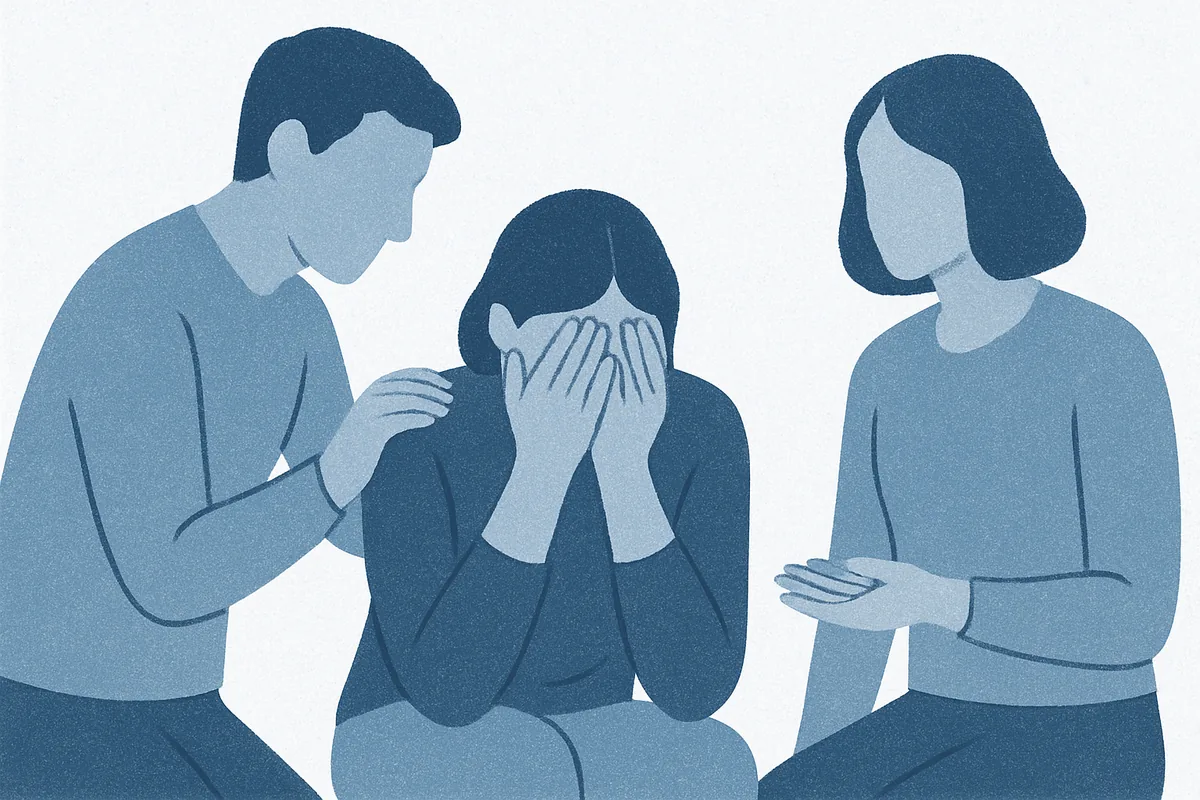
- Panic attacks typically peak within 10 minutes and resolve within 20 to 30 minutes; the single most effective bystander action is staying physically present and speaking in a low, steady voice.
- Chest pain lasting more than 15 minutes, arm or jaw pain, or loss of consciousness signals a possible cardiac event rather than panic: call 999 in Dubai immediately rather than assuming it will pass.
- Certain well-intentioned phrases, including 'calm down' and 'there is nothing to worry about', can intensify a panic attack; low, specific language such as 'I am right here, this will pass' is clinically preferable.
- In Dubai, anyone can self-refer to a DHA-licensed psychology clinic without a GP referral first, and UAE Federal Law No. 10 of 2023 on Mental Health protects the confidentiality of any help-seeking.
- Panic disorder responds well to CBT, with research showing 70 to 90 percent of people experiencing significant symptom reduction with evidence-based treatment, making a conversation about professional support genuinely worth having.
You are at a work meeting in Dubai when a colleague suddenly pushes back from the table, grips the edge, and says she cannot breathe. Or you are at a family gathering on the Palm and your cousin goes silent, pale, and starts pressing his hand to his chest. Or your flatmate wakes you at 2 a.m. shaking and convinced something is catastrophically wrong. You do not know what to do. You have never seen a panic attack before and you are not sure whether this is one.
Knowing what to do if someone is having a panic attack is one of the most practically useful things you can learn. Panic attacks have a lifetime occurrence rate of approximately 13.2 to 27 percent of the general population, depending on population and definition studied (Wiley/Depression and Anxiety, 2024). The chances that you will be beside someone when one happens are not small. This guide is written for you: the friend, partner, colleague, or family member who is the bystander. It covers what to recognise, what to do moment by moment, what to say and what not to say, and how to support someone in the hours and conversations that follow.
At CAYA World, we work with adults and teens in Dubai whose panic attacks have become a recurring pattern. We also hear regularly from the people who care about them: partners who feel helpless, colleagues who froze, parents who did everything wrong out of love. This guide is for all of them.
What does a panic attack actually look like? Recognising one in real time
Panic attacks are sudden, intense surges of fear or physical discomfort that reach a peak rapidly, typically within 10 minutes of onset. From the outside, they can look alarming precisely because the person experiencing one often looks physically unwell rather than distressed in a recognisable emotional sense.
As a bystander, you are likely to notice some combination of the following:
- Rapid or visible breathing, sometimes described as gasping or over-breathing (hyperventilation)
- A pale or flushed face, with visible sweating that does not match the temperature or exertion
- Trembling or shaking in the hands, legs, or whole body
- The person pressing a hand to their chest or throat, or saying they cannot breathe
- A look of terror that seems disproportionate to what is happening in the room
- Dizziness, swaying, or reaching for something to hold onto
- Nausea, or a sudden need to leave the room or get fresh air
- The person saying things like "I'm dying", "something is wrong with my heart", or "I need to get out of here"
What makes this hard to recognise is that the person is not necessarily crying or visibly emotional in a way you would associate with psychological distress. The body's alarm system has fired at full volume and the physical symptoms are real, not performed. The chest tightness is real. The breathlessness is real. The dizziness is real. The brain, incorrectly reading a threat as life-threatening, has flooded the body with adrenaline.
According to the American Psychiatric Association (2023), panic disorder affects approximately 2.7 percent of adults globally in any given year, with a lifetime prevalence of around 4.7 percent. It is roughly twice as common in women as in men. But panic attacks themselves occur far more broadly, in people who have never been diagnosed with anything, in people going through high-stress periods, and in people for whom this is the first episode they have ever experienced.
In Dubai specifically, clinicians at our practice observe that first-time panic attacks frequently occur during periods of acute stress: a new job that came with a relocation, a visa renewal process that stretched on longer than expected, or the accumulated pressure of living far from family without a local support network. You do not need to understand the cause to help. You just need to know what you are looking at.
Panic attack or medical emergency? How to tell the difference and when to call 999
This is the question that paralyses most bystanders. Panic attacks and cardiac events share enough surface symptoms, particularly chest pain, shortness of breath, and a sense of impending doom, that distinguishing between them in real time feels impossible. The clinical reality is that you should not try to definitively diagnose the situation yourself. What you can do is look for red flags that push the situation firmly into medical emergency territory and act on them without hesitation.
The table below sets out the distinguishing features that help differentiate panic from a cardiac or medical emergency. Use it as a reference, not a diagnosis tool. When in doubt, call 999.
| Feature | More consistent with panic attack | Red flag: consider calling 999 |
|---|---|---|
| Chest pain onset | Sudden, often described as pressure or tightness; not usually crushing | Crushing, heavy, or squeezing pain; radiates to arm, jaw, or back |
| Duration | Peaks within 10 minutes; typically resolves within 20 to 30 minutes | Chest pain persisting beyond 15 minutes without any easing |
| Breathing | Fast, shallow; often improves with slower breathing | Severe shortness of breath that does not respond to any intervention |
| Consciousness | Person remains fully conscious and oriented throughout | Loss of consciousness, even briefly; unresponsive or confused |
| Skin colour | Pale or flushed; sweating | Grey or blue-tinged lips or fingertips (cyanosis) |
| Context | Known history of panic attacks; episode following an identifiable stressor | First episode ever in a person over 40; episode during physical exertion |
| Response to reassurance | Some reduction in visible distress when spoken to calmly | No response to reassurance; worsening despite your presence |
In Dubai, if you are in any doubt, call 999 for emergency ambulance services. This is the correct call. A paramedic can rule out a cardiac event far more reliably than any bystander, and arriving with a false alarm is always preferable to the alternative. The Dubai Health Authority mental health crisis line is 800 506, which can also be useful if the situation is not a physical emergency but the person is severely distressed and you need guidance.
If the person has a known history of panic attacks, is oriented and responsive, and the episode appears to be following a familiar pattern, you do not need to call emergency services. Stay with them and move to the bystander steps below.
What to do if someone is having a panic attack: a step-by-step bystander guide
Once you have assessed that this is not a medical emergency, your role as a bystander is specific. It is not to fix the panic attack or make it stop. It is to create the conditions in which the person's own nervous system can de-escalate. Panic attacks end. Every single one. Your job is to be present and steady while that happens.
Step 1: Regulate yourself first
Your visible calm is the most powerful tool you have. If you look frightened, rushed, or overwhelmed, the person in panic will read your distress as confirmation that something is genuinely wrong. Take one slow breath before you approach. Lower your own shoulders. Slow your speech. You do not need to pretend nothing is happening; you just need to be the steadiest person in the room.
Step 2: Get to their level and reduce stimulation
Crouch or sit beside the person rather than standing over them. If you are in a public place, gently guide them to a quieter spot if they can move, or ask nearby people to give them space. Remove excess noise where possible. Close a door, step away from a crowd, or turn off a nearby screen. High sensory input can sustain panic; reducing it gives the nervous system less to process.
Step 3: Speak in short, calm, specific sentences
Long explanations are impossible to process during a panic attack. Short, grounding sentences are far more useful: "I'm right here." "You're safe." "This will pass." "I'm not going anywhere." Repeat them as needed. You are not trying to be profound. You are providing an anchor.
Step 4: Offer to breathe with them, do not demand it
If the person is hyperventilating, you can offer to breathe together: "Do you want to try breathing with me? In through the nose, slow, and out through the mouth." Model it visibly and slowly. Do not demand they follow you. Some people find guided breathing enormously helpful during a panic attack; others find the instruction itself adds pressure. Offer once, demonstrate clearly, and follow their lead.
Step 5: Offer a grounding prompt, gently
The 5-4-3-2-1 technique asks the person to name five things they can see, four they can touch, three they can hear, two they can smell, and one they can taste. It works by redirecting cognitive attention from internal alarm signals to concrete external reality. You can introduce it simply: "Can you look around and tell me five things you can see right now?" Do not run through the whole sequence at pace. One or two anchors may be enough to interrupt the spiral.
Step 6: Do not leave unless they ask you to
Staying is the clearest signal that everything is manageable. If the person wants space or privacy, honour that; ask first. But do not walk away to give them room unless they explicitly ask for it. Solitude during a panic attack can intensify the sense that something is catastrophically wrong.
If you are based in Dubai and someone you care about is experiencing panic attacks regularly, our team at CAYA World can help. Learn more about our anxiety therapy service in Dubai, which includes individual assessments and evidence-based treatment for panic disorder.
What to say, and what to avoid saying, during a panic attack
The words you choose during a panic attack matter more than most people realise. Language that seems reasonable to you can feel invalidating or even frightening to someone whose brain is currently running a full-scale threat response. The following is a clinical summary of what works and what to avoid, drawn from the cognitive-behavioural framework for panic.
What to say
- "I'm right here with you." Simple, grounding, and true. Presence is therapeutic in itself.
- "You're safe. This will pass." Not a promise that the feeling will stop immediately, but a factual statement about the nature of panic attacks: they end.
- "Can you feel your feet on the floor?" A grounding question that directs attention to the body in a non-threatening way.
- "Take your time. There's no rush." Relieves the pressure to perform recovery quickly, which itself escalates panic.
- "What do you need right now?" Gives the person agency without requiring complex decision-making. Sometimes the answer is nothing. That is fine.
What to avoid saying
- "Calm down." This is the most common and least helpful instruction possible. If the person could simply calm down, they would. The instruction signals that their visible distress is a problem you need them to solve for you.
- "There's nothing to worry about." From inside a panic attack, the body is screaming that there is everything to worry about. Disputing the feeling directly rarely helps and can feel dismissive.
- "This is all in your head." Technically accurate in a narrow sense; experienced as invalidating. The physiological symptoms of panic are real even if their cause is not an external threat.
- "Other people have it worse." Comparison to external suffering does not reduce acute physiological distress and adds a layer of shame.
- "Have you tried just breathing?" Said with an impatient or questioning tone, this reads as dismissive rather than helpful. Offer the technique; do not question why they are not already doing it.
- A rapid stream of questions. "Are you okay? Should I call someone? Do you have medication? What happened? What triggered this?" Each question requires a cognitive response the person's brain cannot currently process. Ask one thing at a time, or nothing at all.
If you are the one experiencing panic attacks rather than witnessing them in someone else, the CAYA article on what helps during a panic attack covers the evidence-based self-management techniques in more detail.
Wondering if It's Time to Talk to Someone?
Our specialist team at CAYA World offers comprehensive assessment and evidence-based treatment, conducted from our clinic in Palm Jumeirah, Dubai.
Supporting recovery in the hours after an episode
The panic attack itself lasts 20 to 30 minutes at most. The period that follows can last hours and is often poorly understood by bystanders. Most people who have just had a panic attack feel exhausted, embarrassed, emotionally raw, and uncertain about whether it might happen again. Your role in this window is different from your role during the acute episode.
Give them space to decompress without pressure to debrief
Directly after the episode, the impulse for a bystander is often to talk about what just happened: "What was that about? Have you eaten? Did you sleep? Is it stress?" Resist this. Let the person set the pace. A simple "How are you feeling now?" is sufficient. If they want to talk, listen. If they want quiet, sit with them quietly. The debrief can happen later, when the adrenaline has fully metabolised.
Offer something practical and low-key
A glass of water, a quiet place to sit, a snack if time has passed, permission to leave a social situation without explanation. These are useful. Practical gestures communicate care without requiring emotional processing from someone who is still recovering.
Avoid treating them as fragile from this point on
One of the most common unhelpful patterns in the aftermath of a panic attack is that the people around the person begin to monitor them closely, speak differently to them, or start excluding them from situations that might be "stressful". This is well-intentioned and counterproductive. It reinforces the message that panic attacks are dangerous and that the person cannot cope, which is precisely the cognitive distortion that perpetuates panic disorder. Treat them as you normally would, once they are ready.
Check in the next day
A brief message the following day, "Hey, how are you doing?" communicates ongoing care without making the panic attack into a defining event. It also opens a natural channel for the more important conversation about whether this is a recurring pattern.
How to approach ongoing conversations about recurring panic attacks in Dubai
If the person you supported has had more than one panic attack, the most meaningful thing you can do as a bystander is help them take the step toward professional support. This conversation is often harder than the acute crisis itself, because it requires a different kind of courage from both of you.
Choose the right moment
Do not raise the subject immediately after an episode, in a group setting, or when either of you is short of time. Find a calm, private moment, ideally at least a day after the most recent episode, and approach the topic as a caring conversation rather than an intervention.
Lead with what you observed, not with a diagnosis
You are not in a position to tell someone they have panic disorder. You are in a position to say what you have noticed and that you care. "I've noticed you've been having a really difficult time lately, and I wanted to check in" is a better opening than "I think you have anxiety and you need therapy". The first invites; the second can feel like a verdict.
Know the practical answers about getting help in Dubai
One reason people in Dubai delay seeking psychological support is uncertainty about how to access it. The answer here is straightforward. Anyone in Dubai can self-refer to a DHA-licensed private psychology clinic without needing a GP referral first. UAE Federal Law No. 10 of 2023 on Mental Health, which came into force in May 2024, provides a federal framework for psychological and psychiatric care, including strong confidentiality protections. This means your friend, partner, or colleague can seek help without their employer being informed, without their visa status being affected, and without their family having to know if they would rather keep it private.
Panic disorder is among the most treatable anxiety conditions we see at CAYA World. CBT-based treatment, specifically the variants developed for panic disorder, produces significant symptom reduction in 70 to 90 percent of people who complete a structured course. For many people, 12 to 20 sessions is sufficient to move from frequent, disabling panic attacks to being able to recognise and interrupt the cycle before it escalates. That is not a small change. It is the kind of change that makes daily life in a demanding city like Dubai feel manageable again.
Offer to help with the practical step, not just the idea
"Would it help if I looked up who to contact?" is more useful than "You should really see someone." The practical barrier of finding a clinic, understanding costs, and making an enquiry is often where the good intention stalls. If you can offer to help with one concrete step, you are far more likely to see your friend actually follow through.
For families and partners navigating this together, our life transitions therapy service also supports the broader patterns of adjustment, including relocations and major life changes, that often sit behind a first panic attack episode in Dubai.
Frequently Asked Questions About Helping Someone With a Panic Attack in Dubai
If this is their first episode, if chest pain persists beyond 15 minutes, if pain radiates to the arm or jaw, or if the person loses consciousness at any point, call 999 immediately. These are red flags for a possible cardiac event, which a paramedic needs to rule out. If the person has a well-established history of panic attacks and the episode appears consistent with past episodes, you do not need to call emergency services. Stay with them and use the grounding steps in this guide. When in doubt, always call. A false alarm is always the right outcome.
It depends on the person and you should ask before acting. Some people find physical touch, particularly a hand on the arm or back, deeply grounding during a panic attack. Others find unexpected touch startling or suffocating and it can intensify the episode. If you are close to this person and comfortable with physical contact normally, ask first: "Is it okay if I put my hand on your shoulder?" If you do not know their preference, default to no touch, close physical presence, and steady verbal reassurance. Their answer to "What do you need right now?" will usually tell you.
Yes, specific language matters. The most useful phrases are short, grounding, and factually true: "I'm right here with you." "You're safe. This will pass." "Take your time." "Can you feel your feet on the floor?" Avoid instructions to "calm down" or questions about the cause while the episode is ongoing. Your goal is to provide an anchor, not an explanation. After the episode, when the person is ready, there is more room for words. During it, less is more. Calm presence and a few steady, specific phrases are clinically more effective than a stream of reassurance.
Most panic attacks peak within 10 minutes of onset and resolve fully within 20 to 30 minutes. The acute physiological surge, driven by adrenaline, cannot be sustained indefinitely. If the person appears to still be in acute distress beyond 30 minutes without any improvement, or if symptoms are worsening rather than plateauing, reassess whether this may be a medical issue rather than a panic attack and consider calling 999. In practice, most episodes you witness as a bystander will have resolved significantly by the 20-minute mark if you have stayed present and calm.
Choose a calm, private moment well outside the episode itself. Lead with what you have observed rather than a diagnosis: "I've noticed this has been happening and I'm worried about you. Have you ever spoken to anyone about it?" Frame professional help as a practical resource, not a sign something is seriously wrong. In Dubai, anyone can self-refer to a DHA-licensed psychology clinic without a GP referral, and the first conversation is just a conversation. Panic disorder responds well to CBT, and most people see significant improvement within a structured treatment course. Knowing this can help reduce the fear that seeking help means committing to something overwhelming.
Sources and Further Reading
- Anxiety disorders: what are they?American Psychiatric Association (2023)
- Prevalence and correlates of panic attacks in the general populationDepression and Anxiety, Wiley (2024)
- Anxiety disorders fact sheetWorld Health Organization (2023)
- Diagnostic and Statistical Manual of Mental Disorders, Fifth Edition (DSM-5). American Psychiatric Association. Criteria for panic disorder and panic attack specifier.
- Clark DM. A cognitive approach to panic. Behaviour Research and Therapy, 24(4), 461–470 (1986). Foundational CBT framework for panic disorder used in clinical practice.
- Craske MG and Barlow DH. Mastery of your anxiety and panic (MAP-3): Therapist guide. Oxford University Press (2006).