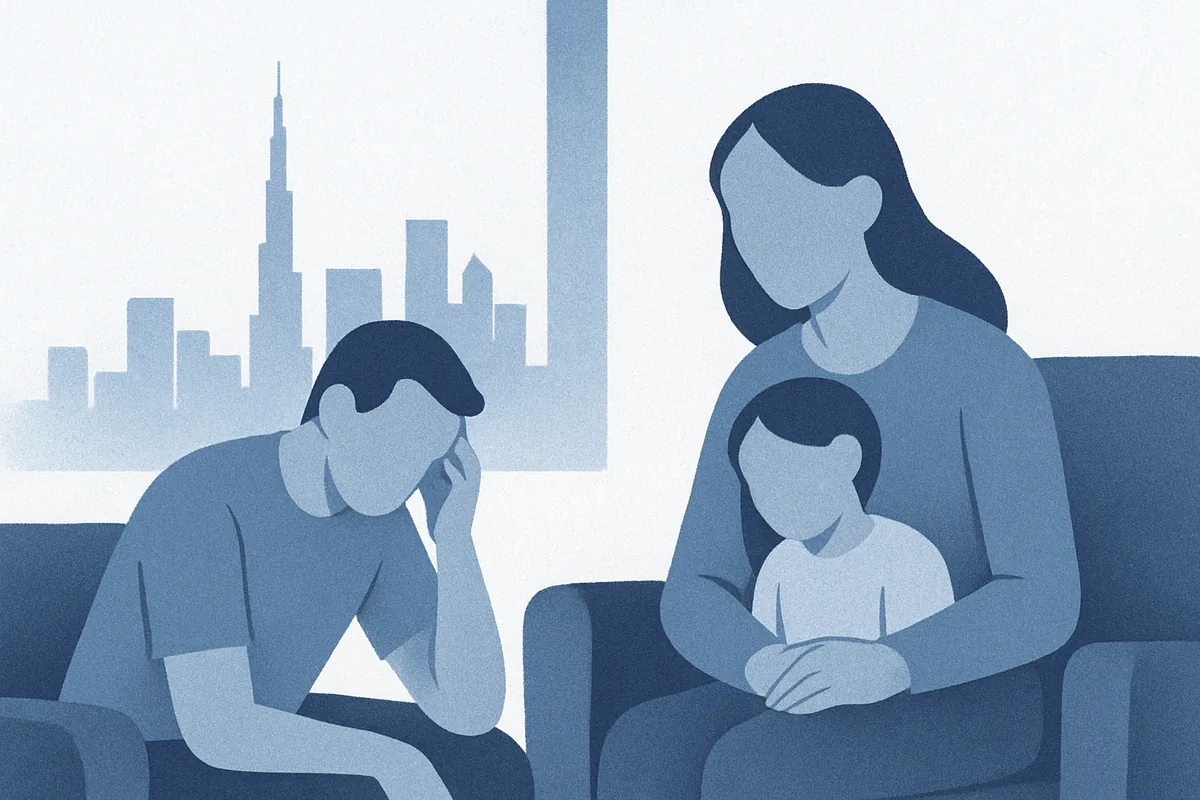
- Thurber and Walton (2012) define homesickness as distress caused by actual or anticipated separation from home: it is context-specific and home-focused, which is what distinguishes it clinically from pervasive depression.
- Depression prevalence among migrants in the Gulf region reaches 20-34.5%, substantially higher than host-national populations, with family separation, job insecurity, and social isolation as the primary drivers (Frontiers in Psychology, 2021).
- When homesickness persists beyond six weeks, spreads beyond home-related thoughts, and measurably impairs work or relationships, it may meet ICD-11 criteria for adjustment disorder, which affects 15.5-31.8% of people in migration and relocation contexts.
- Dubai's structural impermanence, including cyclical friend departures and families left behind across time zones, creates compounding risk factors that make transient homesickness harder to resolve without targeted support.
- CBT-based therapy at a DHA-regulated clinic in Dubai is an evidence-based route to distinguishing a temporary adjustment response from a diagnosable condition, and to building the skills that reduce distress in measurable ways.
Survey data from Aetna International's 2020 Expat Experiences Survey found that 33.1% of expats reported significant difficulty with missing home, and a 2021 review in Frontiers in Psychology placed depression prevalence among Gulf region migrants between 20% and 34.5%, far exceeding rates in host-national populations. These numbers matter because they tell you something important: the feeling you're describing, that persistent, low-level ache for a place you no longer live, is not a character flaw, and it is not simply weakness. It is one of the most common psychological responses to relocation, and for a meaningful proportion of people in Dubai, it does not resolve on its own.
This article has a specific focus. If you've already read broadly about expat mental health or are looking for an overview of depression among people living abroad, our expat depression in Dubai article covers that ground. What we're addressing here is the entry point that most people actually experience: not "I think I have depression," but "I miss home and I cannot shake it." The clinical question this article answers is when that feeling tips from a normal adjustment response into something that warrants professional support.
What is homesickness, and why is it so common among Dubai expats?
The most widely cited clinical definition comes from Thurber and Walton, writing in Pediatrics in 2012: homesickness is "the distress or impairment caused by an actual or anticipated separation from home." That definition is more precise than it first appears. It is not just sadness about being away. It is distress or impairment, and the cause is separation, not a generalised dissatisfaction with life. Thurber and Walton note that homesick individuals commonly experience depression-like symptoms, anxiety, and difficulty concentrating on anything that is not home-related. But the distress remains context-specific: it is tethered to the fact of being away, which is what initially distinguishes it from clinical depression.
Dubai's expat population, which comprises approximately 85-92% of the city's residents, is structurally unusual in ways that make homesickness particularly prevalent. According to the Betterhomes Future Living Report cited in Khaleej Times, average resident tenure has grown from 7.5 years to 10.5 years between 2024 and 2025. That means people are staying longer, but the culture of impermanence has not disappeared. Friends still leave. Communities still reset. And many expats maintain their closest family relationships across two, three, or four time zones, managing anniversaries, illnesses, and milestones at a distance.
A UAE-based study published in Frontiers in Psychology in 2021 found that women, unemployed migrants, and unmarried respondents reported significantly higher homesickness, psychological distress, and depressive and anxiety symptoms than their peers. Longer residence and older age were associated with lower distress. This suggests that homesickness is not simply a function of novelty. It interacts with social role, relationship status, and structural support in ways that make some people far more vulnerable than others.
At CAYA World, we regularly see clients who arrived in Dubai energised by the move, managed the first year well, and then noticed a slow accumulation of heaviness in year two or three, often triggered by a friend's departure, a family event they missed, or a period of social disconnection. This is not a delayed reaction; it reflects the compounding nature of repeated separation losses in an impermanent expat environment.
When does homesickness depression in Dubai become a clinical concern?
The distinction between normal homesickness and something more serious is not about the intensity of the feeling. Intense homesickness in the first weeks after a major relocation is expected and, within limits, healthy. The clinical question is about duration, pervasiveness, and functional impact.
ICD-11 adjustment disorder criteria offer a useful framework. Adjustment disorder is diagnosed when a person develops emotional or behavioural symptoms in response to an identifiable stressor, and those symptoms cause marked distress or significant impairment in functioning. The stressor does not have to be traumatic; relocation and prolonged family separation both qualify. Crucially, the symptoms must not be better explained by another mental disorder, and they must begin within one month of the stressor. If the stressor is ongoing, as it is when someone lives continuously away from home, the adjustment response can persist and deepen.
Research published in PMC and in a 2025 study in Scientific Reports covering Hong Kong-UK migrants found adjustment disorder prevalence ranging from 15.5% in stress-exposed adult populations to 31.8% in migration and relocation contexts. These are not small numbers. In general outpatient mental health settings, 5-20% of presentations meet criteria. For expats navigating repeated social losses and sustained family separation, the risk sits at the higher end of that range.
What we see clinically at CAYA World is that homesickness depression in Dubai often crosses into clinical territory when three things happen together: the feeling persists beyond six weeks without diminishing; it starts affecting work performance, appetite, or sleep; and the person stops being able to identify a specific trigger and begins to feel a generalised bleakness that follows them into situations unrelated to home. That shift, from "I miss my mum when I call her on Sundays" to "I can't enjoy anything and I don't know why," is the signal worth taking seriously.
If you've noticed these changes in yourself, speaking with a clinical psychologist is a reasonable next step. At CAYA World, our clinical team can help you identify whether what you're experiencing is a time-limited adjustment response or something that warrants structured support. You can reach us via WhatsApp or call to arrange an intake conversation with no obligation.
The psychological mechanisms: how missing home escalates
Understanding the mechanics of escalation helps you recognise the pattern before it becomes entrenched. Homesickness is not simply nostalgia. It activates several overlapping psychological processes that, left unaddressed, can pull a person toward full clinical depression.
The first mechanism is rumination. People who are homesick spend significant mental energy comparing their current environment unfavourably with home. They replay memories, scan their current surroundings for what is missing, and engage in counterfactual thinking: "If I were home right now, I would be..." This is not wilful negativity. It is the brain attempting to resolve a threat, in this case the perceived loss of belonging. But when rumination becomes habitual, it narrows attention, reduces problem-solving capacity, and feeds a distorted view of both the current location and the remembered home.
The second mechanism is social withdrawal. Homesick individuals often pull back from the very relationships that might buffer their distress. This happens for understandable reasons: building new friendships in Dubai takes energy that feels unavailable when you are already depleted, existing social circles here may feel temporary or shallow, and investing emotionally in people who might leave next year can feel pointless. The withdrawal makes sense in the short term but accelerates isolation in the medium term.
The third mechanism is what clinicians sometimes call identity disruption. A significant part of who we are is rooted in the social context of home: our role in our family, our cultural reference points, the version of ourselves that other people there have known for decades. In Dubai, particularly in the first few years, many expats experience a kind of social thinning. You are understood less fully, and the effort required to build depth into new relationships is constant. Over time, this erodes the sense of self-continuity that supports psychological wellbeing.
These three mechanisms interact. Rumination feeds withdrawal; withdrawal deepens identity disruption; identity disruption intensifies rumination. Cognitive behavioural therapy targets this cycle directly, helping people identify the thoughts that maintain rumination, build behavioural activation strategies that counteract withdrawal, and develop a coherent identity narrative that does not depend on being in the same place you grew up. At CAYA World, our CBT-based approach to homesickness depression in Dubai works with these specific mechanisms rather than offering generic coping advice.
Dubai-specific risk factors that make homesickness harder to shake
Not all cities create the same risk profile for expat homesickness, and Dubai has several structural features that make the experience harder to resolve without deliberate effort.
The departure cycle. Unlike cities with large, established immigrant communities where people typically settle permanently, Dubai's population turns over continuously. Friendships built over one or two years end abruptly when a colleague's contract ends or a family decides to return home. Each departure is a small grief. Over years, the cumulative weight of these repeated losses can erode a person's willingness to invest in new connections, which deepens isolation and accelerates homesickness.
Family structures spread across borders. Many Dubai expats, particularly those from South Asia, East Africa, the Philippines, and parts of Europe, maintain their core family unit in their home country and visit two or three times a year. This arrangement is financially rational but psychologically costly. Milestone events, parents' illnesses, children's first years, and family bereavements happen at a distance. Grief is processed alone or delayed until the next trip home.
The cultural invisibility of distress. Dubai's professional environment rewards positivity and forward momentum. Admitting that you miss home can feel professionally risky or personally shameful in a community where the narrative is one of opportunity and ambition. Many people, particularly men and people in senior roles, go years without naming their distress to anyone.
Gender and employment asymmetries. The 2021 UAE-based Frontiers in Psychology study found unemployed expats and women reported the highest distress. In Dubai, a significant portion of partnered expats arrive as accompanying spouses, often relinquishing their professional identity and social network simultaneously. Without the built-in social structure of a workplace, these individuals face both isolation and identity loss from the start.
Understanding these risk factors is not about cataloguing problems. It is about being precise. When homesickness is compounded by repeated social loss, family separation, professional identity disruption, and a cultural environment that discourages disclosure, it becomes something that time alone is unlikely to fix.
Wondering if It's Time to Talk to Someone?
Our specialist team at CAYA World offers comprehensive assessment and evidence-based treatment, conducted from our clinic in Palm Jumeirah, Dubai.
How to tell the difference: homesickness, adjustment disorder, and depression
These three states exist on a continuum, and the boundaries between them are not always sharp. But there are clinical distinctions that matter for deciding what kind of support is appropriate.
Transient homesickness is normal and expected in the weeks and months after a significant relocation. The dominant experience is missing specific people, places, and routines. Sadness and longing are present, but the person retains the capacity for enjoyment, maintains their usual functioning in most areas, and experiences relief or lightening when they visit home, speak to family, or find meaningful connection in Dubai. This does not require clinical intervention. It responds to social investment, routine-building, and time.
Adjustment disorder occupies the middle ground. The stressor (relocation, family separation) is identifiable, the onset of symptoms follows within a month of the stressor, and the symptoms cause marked distress or functional impairment disproportionate to what would normally be expected. Crucially, adjustment disorder is time-limited in its diagnostic framing: if the stressor resolves, symptoms should ease within six months. For expats in an ongoing situation of separation, however, the stressor does not resolve, which means adjustment disorder can persist and progressively deepen.
Clinical depression is distinguished by pervasiveness and autonomy. The low mood, anhedonia (inability to experience pleasure), fatigue, and cognitive changes are no longer tied specifically to home-related triggers. They accompany the person into every domain of life, persist regardless of positive events, and have a self-sustaining quality that does not lift when the external situation improves temporarily. A UAE government health data summary records a 25.1% depression prevalence score across UAE residents, a figure that reflects the scale of unmet mental health need across the population.
For a more comprehensive overview of how depression presents in the expat population and what full clinical assessment involves, our article on expat depression in Dubai covers the diagnostic and treatment landscape in detail. The present article focuses on the homesickness entry point: recognising when your specific experience of missing home has crossed a threshold that warrants clinical attention.
A practical self-check: ask yourself these four questions. Has the feeling persisted for more than six weeks without significant improvement? Is it affecting your work, sleep, or ability to maintain your close relationships? Have you stopped enjoying things that used to bring you pleasure, even things unrelated to home? Do you find it difficult to imagine things getting better? If you answered yes to two or more of these, a clinical assessment is worthwhile, not because the answer is necessarily a diagnosis, but because a trained psychologist can give you a precise picture of what is happening and what is most likely to help.
When to seek professional support, and what that looks like in Dubai
One of the most common things we hear at CAYA World is "I kept thinking I just needed more time." There is no fixed timeline for adjustment, but waiting passively is not the same as giving yourself time. If several months have passed, your functioning has not returned to baseline, and you are not moving toward a sense of belonging in Dubai, that is not a time problem. It is a support problem.
Professional support for homesickness depression in Dubai typically begins with a clinical assessment. A psychologist will map your symptom history, identify whether what you're experiencing meets criteria for adjustment disorder or depression, and explore the specific maintaining factors in your situation. For some people, this assessment alone is clarifying: being told "this is what this is, and it responds well to this" reduces the shame and confusion that often accompany the experience.
CBT is the primary evidence-based approach for both adjustment disorder and depression, and it is the approach our team at CAYA World uses. The work is practical. You learn to identify the specific thought patterns driving rumination, develop behavioural strategies that counteract withdrawal, and build a stable sense of identity that is not contingent on being somewhere else. For expats, CBT often incorporates work around values-based living: clarifying what matters enough to invest in here, in Dubai, right now, rather than deferring life until the circumstances feel right.
Our depression therapy service in Dubai is available to adults at any stage of the homesickness-to-depression spectrum. Sessions are confidential and conducted by our licensed psychologists at our clinic in Palm Jumeirah. If your presentation includes significant anxiety alongside the low mood, which is common in expat adjustment difficulties, our anxiety therapy service addresses both. For people navigating major life transitions alongside relocation, our life transitions therapy provides a framework that explicitly addresses the identity and belonging dimensions of significant change.
Dubai also has a first-contact resource worth knowing: the DHA Mental Health Helpline (800 111) provides free, confidential telephone support for Dubai residents as a starting point, particularly useful if you are not yet sure whether you need structured therapy.
The most important thing to know is that homesickness depression in Dubai is not something you are expected to manage alone, and it is not a failure of resilience. It is a predictable psychological response to a genuinely difficult structural situation, and it responds to the right kind of support.
Frequently Asked Questions About Homesickness and Depression in Dubai
The clearest indicator is pervasiveness: depression stops being home-specific and begins affecting every area of your life. If you have lost interest in things you used to enjoy, are experiencing persistent fatigue or sleep disruption, find it hard to concentrate at work, or feel a generalised hopelessness that follows you regardless of what you're doing, the experience has likely moved beyond normal adjustment. A clinical assessment at a DHA-regulated clinic will give you a precise picture rather than a self-diagnosis.
Homesickness is not a standalone diagnosis in ICD-11 or DSM-5, but when it causes significant distress and functional impairment in the context of relocation, it typically meets criteria for adjustment disorder. Adjustment disorder is a diagnosable condition that responds well to structured therapy. Framing it as something to push through tends to delay support and allow the maintaining factors, particularly rumination and withdrawal, to become more entrenched. Seeking help early shortens the overall duration of the difficulty.
There is no universal timeline, and the research does not support a simple "it passes after X months" claim. Thurber and Walton's framework suggests that homesickness tied to a specific, time-limited separation often eases as the person builds new connections and routines. In Dubai, where the structural triggers (family separation, departure cycles) are ongoing rather than temporary, homesickness can persist indefinitely without deliberate support. If your distress has not meaningfully reduced after two to three months, that is a signal to seek a clinical view rather than continuing to wait.
Therapy does more than time does, particularly when the maintaining factors are psychological rather than situational. CBT for homesickness and adjustment disorder teaches you to identify and modify the rumination patterns that keep distress active, develop behavioural strategies that rebuild a sense of belonging, and work through the identity disruption that accompanies major relocation. These are skills, not insights that arrive with patience. Research on CBT for adjustment disorder and depression consistently shows measurable symptom reduction within 12-16 structured sessions.
Adjustment disorder is tied to an identifiable stressor (relocation, family separation) and is expected to ease if the stressor resolves. Depression is pervasive, self-sustaining, and not anchored to a specific trigger: it persists even when things are going reasonably well. In practice, for Dubai expats whose stressor (being away from home) is ongoing, adjustment disorder can progressively deepen into depression if the maintaining factors are not addressed. A psychologist uses both clinical history and validated measures to distinguish between them, which is why a formal assessment is more useful than a checklist.
Sources and Further Reading
- Homesickness and adjustment across the life span: a call for greater attention from DSMThurber CA, Walton EA, Pediatrics (2012)
- Mental health of migrants in the Gulf Cooperation Council countries: a systematic reviewFrontiers in Psychology (2021)
- Homesickness, psychological distress, and depression among expatriates in the UAEFrontiers in Psychology (2021)
- ICD-11 adjustment disorder: prevalence in a German representative sampleSocial Psychiatry and Psychiatric Epidemiology (2018)
- Adjustment disorder in migrant populations: Hong Kong-UK studyScientific Reports (2025)
- UAE Government Ministry of Health and Prevention. Mental Health Data Summary (year as published by source)