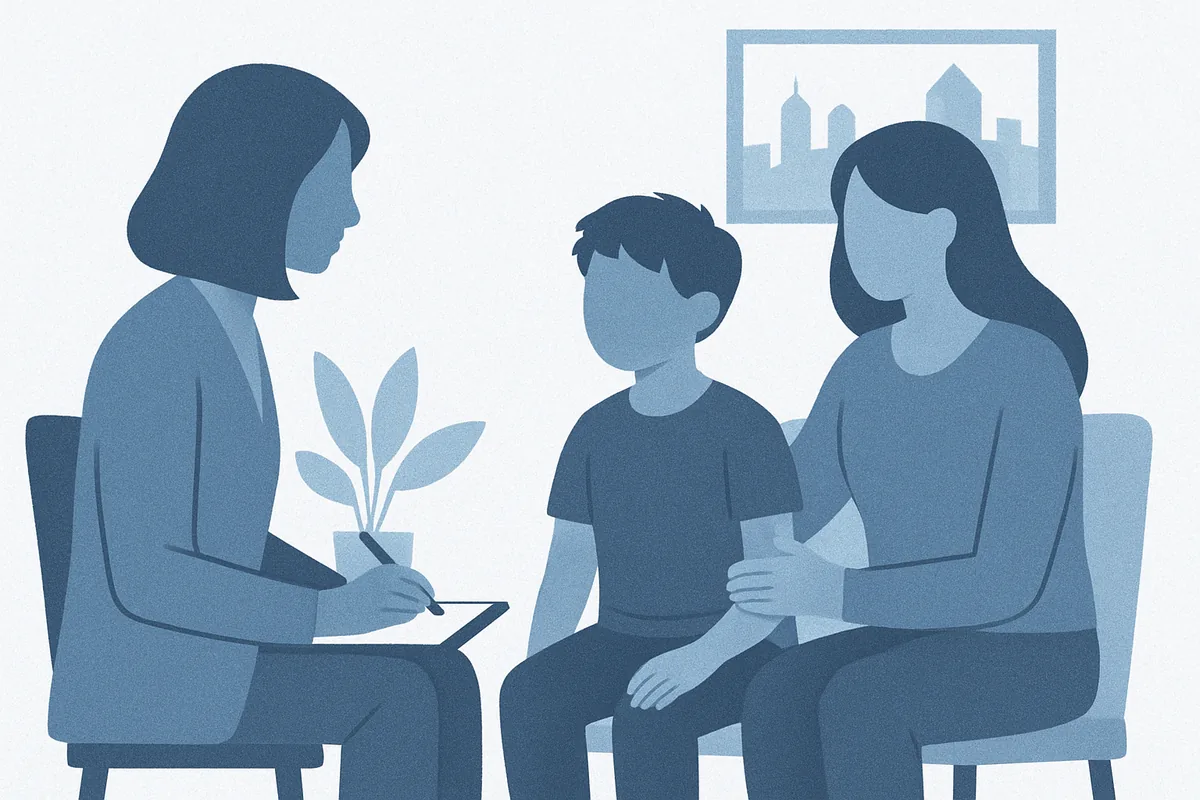
- A 2024 UAE review found 23.9% of children in the country have mental health problems, meaning roughly one in four children in Dubai classrooms may be experiencing difficulties that warrant clinical attention.
- The American Academy of Pediatrics recommends annual mental health screening from age 3, anxiety-specific screening from age 8, and depression and suicide risk screening from age 12, giving parents a clear referral threshold at each stage.
- Dubai's KHDA-regulated schools follow a structured inclusion pathway: teachers identify concerns, the school's SEND or inclusion team gathers evidence, and no external psychologist assessment can proceed without written parental consent.
- Red flags differ meaningfully by developmental stage: a toddler who loses previously acquired words warrants immediate referral, a primary-age child with three or more weeks of school refusal warrants referral, and a teenager with persistent low mood lasting more than two weeks warrants urgent clinical review.
- A formal psychological assessment report from a DHA-regulated clinic is typically required before Dubai schools can put individualised learning support plans or formal accommodations in place.
Roughly 23.9% of children in the UAE are reported to have mental health problems, according to a 2024 review published by Springer covering the region's child mental health landscape. That figure means that in a typical Dubai classroom of 25 pupils, approximately six children may be experiencing difficulties that a psychologist could meaningfully address. Yet the question most parents bring to us at CAYA World is not whether child psychology matters in the abstract; it is whether their specific child, at this specific age, actually needs it. This child psychology age guide for Dubai parents is designed to answer exactly that question, stage by stage.
Each developmental phase from birth through to the final years of secondary school carries its own normal range of behaviour and its own set of red flags that distinguish a transient phase from a pattern worth investigating clinically. The age-structured framework below draws on published developmental science, UAE-specific prevalence data, and what we observe in practice at our clinic in Palm Jumeirah. If you're wondering what to expect at a first psychology appointment itself, our separate guide on seeing a child psychologist in Dubai covers that in detail; this article focuses on the developmental decision framework that tells you when that appointment is warranted.
What does child psychology actually cover, and when does age matter?
Child psychology is the clinical assessment and treatment of emotional, behavioural, developmental, and learning difficulties across the years from infancy through late adolescence. It is not a single service with a single method. What a psychologist actually does with a two-year-old is entirely different from what happens with a fifteen-year-old, both in terms of assessment tools and the therapeutic approaches used. Age matters because the brain is not static. Neural architecture at age two, seven, and sixteen differs profoundly, and a behaviour that is completely unremarkable at one stage can be diagnostically significant at another.
At CAYA World, our clinical team evaluates children using age-appropriate instruments calibrated to developmental norms. We never apply an adult lens to a child's presentation, and we do not pathologise ordinary developmental variation. That said, the clinical literature is clear: early identification and intervention consistently produce better functional outcomes than delayed referral. The World Health Organization's 2022 report on improving children's mental and brain health estimates that approximately 7% of children aged 5-9 globally live with a diagnosable mental disorder, rising to 14% by ages 10-19. Those rates do not plateau without intervention; they compound. The case for age-appropriate, timely assessment is not about over-medicalising childhood. It is about catching the right thing at the right time.
Knowing when to seek help is harder without a structured reference point. The table below gives parents a fast orientation across the four developmental bands this guide covers.
| Age Band | Normal Developmental Range | Red Flag Threshold | Psychology Role |
|---|---|---|---|
| Toddlers (0-3) | Variable temperament, separation protest, limited language by 18 months | Loss of previously acquired words; no pointing by 12 months; persistent self-harm behaviours | Developmental screening, autism assessment, parent guidance |
| Preschool (3-5) | Magical thinking, attachment-driven anxiety, high activity, emerging peer conflict | Persistent fears that prevent normal activity for more than 4 weeks; extreme aggression; toileting regression at age 4+ | Behavioural assessment, anxiety evaluation, school-readiness input |
| Primary (6-11) | Social comparison, academic challenge, mood variability, emerging rule-awareness | 3+ weeks of school refusal; reading or writing 12+ months behind peers; persistent low mood or worry | Learning assessment, ADHD evaluation, CBT for anxiety or low mood |
| Secondary (12-18) | Identity experimentation, peer-group priority, mood shifts, risk-taking | Persistent low mood for 2+ weeks; self-harm; disordered eating; substance use; significant academic decline | Depression and anxiety evaluation, risk assessment, therapy |
Toddlers and preschoolers (ages 0-5): what's normal, what's a red flag, and what an appointment looks like
The toddler years (0-3)
Toddlerhood is developmentally loud. Tantrums, separation distress, variable sleep, and intense emotional swings are all within the normal range for a child whose prefrontal cortex is barely beginning to come online. Parents in Dubai, many of whom are raising children far from extended family and grandparent support networks, often describe feeling unmoored by toddler behaviour simply because they lack a reference point. Frequent crying, brief breath-holding episodes, and fierce protests at nursery drop-off are typical. They are not clinical concerns in isolation.
What warrants clinical attention in this age band is regression or loss. A toddler who had words at 14 months and loses them by 20 months is showing a pattern that needs immediate developmental review. A child who had begun engaging in back-and-forth social interaction and stops doing so is showing a pattern that needs assessment. The American Academy of Pediatrics (AAP) recommends annual developmental and behavioural screening from age 3, with autism-specific screening at 18 and 24 months (AAP HealthyChildren, 2023).
At CAYA World, appointments with toddlers are primarily observational and parent-led. Our clinicians spend a significant portion of the session observing the child in structured play while gathering a detailed developmental history from caregivers. We do not expect a two-year-old to describe their inner life. Our role at this stage is to evaluate developmental trajectory, identify whether an autism assessment is indicated, and give parents concrete, evidence-grounded guidance about what to watch, what to adjust, and when to return.
Preschool years (3-5)
Three to five is the age of magical thinking, big fears, and social experimentation. Preschoolers in Dubai's diverse international school environment often navigate language and cultural transitions simultaneously with early peer socialisation. Some separation anxiety at school start is expected; it typically settles within four to six weeks of the new term. Fears of monsters, the dark, or dogs are common and usually transient.
The clinical threshold at this stage is persistence and interference. A fear that prevents normal daily activity for more than four consecutive weeks, severe aggression that leads to regular peer exclusion, persistent bedwetting or soiling beyond age 4 when no physical cause has been identified, or speech that is significantly behind age expectations all warrant a referral. Parents preparing their child for a first psychological conversation may find our article on how to talk to your child about seeing a psychologist useful before the appointment.
Primary school age (6-11): child psychology at its most visible and most missed
The primary school years are the period during which psychological difficulties most often surface in a structured, observable way. Academic demands, peer comparison, and organised sports and activity schedules create a consistent external scaffold against which a child's functioning becomes visible. A child who struggles to sit still, complete written work, read at grade level, or sustain friendships will be noticed. What is frequently missed, however, is the internal experience: the child who appears composed but is carrying persistent anxiety, the child whose performance is adequate but who is working twice as hard as peers to achieve it, or the child who is socially withdrawn rather than disruptive.
School refusal is one of the primary-age presentations we see most frequently at CAYA World. Three or more consecutive weeks of morning distress, physical complaints without identifiable medical cause, and genuine inability to enter the school building is not a discipline issue. It is a clinical signal that needs structured assessment. Similarly, a child who is 12 or more months behind grade-level expectations in reading or written expression after adequate instruction warrants a psychoeducational assessment to rule out or identify a specific learning difficulty such as dyslexia or dysgraphia.
The primary school years are also when ADHD most commonly comes to clinical attention. Attention difficulties, impulsivity, and the difficulty sustaining effort on non-preferred tasks become far more visible when children are expected to sit in structured lessons for six hours a day. At CAYA World, our approach to ADHD at this age combines structured clinical interviews with validated rating scales and, where indicated, cognitive assessment. Our ADHD assessment service for children and teens follows a comprehensive, multi-informant protocol that gathers data from parents, teachers, and the child themselves.
The AAP's 2023 guidance recommends that anxiety-specific screening begins at age 8 for all children during routine health checks, reflecting growing recognition that anxiety disorders in the primary-school band are frequently under-identified until they have been present for two or more years. In practice, we often see children referred to us at age 10 or 11 with anxiety that parents can trace back to at least age 7 or 8.
Secondary school and teenagers (12-18): when adolescence looks like a disorder, and when it is one
The WHO's 2023 adolescent mental health fact sheet estimates that one in seven young people aged 10-19 globally lives with a mental disorder, with anxiety and depression among the most prevalent. In the UAE specifically, a peer-reviewed survey by Al Hosany and colleagues found that 28% of UAE adolescents met diagnostic criteria for an anxiety disorder, a figure significantly above global estimates (PMC, 2020). Against that backdrop, the tendency to attribute all adolescent distress to "typical teenage behaviour" carries real risk.
Adolescence is genuinely a period of significant and normative psychological turbulence. Identity formation, peer-group prioritisation over family, romantic relationships, and the pressure of public examinations are all developmentally expected challenges. Mood variability, irritability, and social withdrawal in the context of an identifiable stressor are not automatically clinical. The clinical question is always: how long, how severe, and how impairing?
When to refer a teenager
The threshold for clinical referral in the 12-18 band follows the two-week rule borrowed from diagnostic frameworks for depression: persistent low mood most days, most of the day, for two or more weeks, particularly when accompanied by loss of pleasure in previously enjoyed activities, sleep or appetite changes, and difficulty concentrating. This pattern warrants a clinical assessment, not watchful waiting.
Additional referral indicators in this age band include:
- Any self-harm behaviour, including cutting, burning, or hitting, regardless of stated intent
- Any expression of suicidal ideation, even when framed as hypothetical
- Significant restriction of food intake, compensatory behaviours, or marked body image distress
- A sudden and sustained decline in academic performance not explained by a specific stressor
- Regular substance use, including cannabis, which is not uncommon in Dubai's international school environment
- Complete withdrawal from peer relationships over a period of four or more weeks
At CAYA World, teenagers are seen as primary clients, not as the parents' proxy. Sessions are confidential within the limits of safety. Our clinicians work with adolescents using cognitive behavioural approaches that help young people identify the thought patterns maintaining their distress and develop practical strategies for managing them. For families navigating the secondary-school years, our detailed guide on therapy for teenagers in Dubai covers what the treatment process looks like from a teen's perspective.
Wondering if It's Time to Talk to Someone?
Our specialist team at CAYA World offers comprehensive assessment and evidence-based treatment, conducted from our clinic in Palm Jumeirah, Dubai.
The Dubai school referral pathway: what KHDA-regulated schools do, what parents must consent to, and what a school report means
This section covers material that no other published resource on child psychology in Dubai addresses in any structured way, and it is the section that parents most frequently tell us they needed before they found us.
Dubai's international schools are regulated by the Knowledge and Human Development Authority (KHDA). KHDA-regulated schools are required to maintain inclusive education practices under the SEND (Special Educational Needs and Disabilities) framework, which includes a structured pathway for identifying pupils who may need additional support. Understanding this pathway matters because it defines what happens after a teacher first raises a concern, what you as a parent are legally permitted to consent to or decline, and what a school psychological report actually unlocks in terms of formal support.
Stage 1: Concern identification and in-school review
The referral process typically begins when a class teacher notices persistent difficulties: a child consistently unable to complete written tasks at grade level, a child whose behaviour is significantly disruptive across multiple settings, or a child who appears persistently distressed. The teacher documents these observations and raises the concern with the school's inclusion coordinator or Special Educational Needs Coordinator (SENCO). At this stage, no external referral has occurred. The school gathers its own evidence: observations, reading and maths screening data, academic records, and input from other subject teachers.
Stage 2: Parental consent and external referral
This is the stage most parents do not know about. In KHDA-regulated schools, no external psychological assessment can proceed without written parental consent. The school cannot refer a child to an external psychologist, share identifying information with an outside agency, or initiate a formal assessment process without a parent or guardian signing a consent form. Parents are entitled to ask for all evidence the school has gathered before providing that consent. They are also entitled to seek an independent assessment from a clinic of their choosing, which may carry more weight in terms of outcome specificity and turnaround time than a waiting list for a school-arranged referral.
At CAYA World, we work with parents who have been approached by their child's school, and we work with parents who have identified concerns independently. Both pathways lead to the same clinically thorough assessment process. The practical difference is often speed: a parent-initiated referral typically reaches an appointment faster than the school-mediated pathway, particularly at the start of term when school-based queues are longest.
Stage 3: The assessment report and what it unlocks
Once a formal psychological assessment is completed, the written report is the document that activates formal support within the Dubai school system. A KHDA SEND report makes explicit that individualised learning support plans (sometimes called IEPs or ISPs depending on the school) require documented evidence of need, which in practice means a psychological or psychoeducational assessment report from a licensed clinician. Without that report, a school's capacity to formally allocate one-to-one support hours, extended examination time, or adapted curriculum is limited. The DHA's Mental Wealth Strategy explicitly includes school-based identification as a core pillar of the emirate's mental health infrastructure, reflecting official recognition that schools are a primary detection and referral site.
A 2013 study linked to the KHDA found that 17.5% of pupils in Dubai schools had elevated depressive symptoms, a figure that underscores why the referral infrastructure around school-based mental health identification matters at scale (KHDA Dubai mental health study, 2013). That report prompted significant policy development in Dubai schools over the subsequent decade, including the SEND framework that now governs the referral pathway described above.
How to make the call: a practical decision guide for Dubai parents
Every parent who contacts us has already been thinking about this for some time. The call is rarely impulsive; it usually follows weeks or months of observing something that doesn't quite resolve, asking around, and eventually deciding that the internal uncertainty needs an external answer. What we hear most often is: "I didn't want to over-react." That instinct is reasonable. But clinical experience at CAYA World, and the broader literature, consistently shows that the cost of under-reacting is higher than the cost of getting an assessment that concludes everything is within normal range.
If you are a Dubai expat parent, there is an additional layer. You may be far from your own parents, from the community you grew up in, and from the professional networks you might otherwise consult informally. The Dubai expat experience means that the "village" of informal second opinions is often smaller than it would be in a home country. That is a genuine structural reason why families here seek formal clinical input sooner, and there is nothing disproportionate about doing so.
A simple decision framework
Ask yourself three questions:
- Has the behaviour or difficulty persisted for more than four weeks without meaningful improvement?
- Is it impairing your child's functioning at school, at home, or socially, in a way that goes beyond occasional off-days?
- Are you, as a parent, experiencing sustained worry about it that is affecting your own wellbeing and your ability to feel confident in your parenting responses?
If the answer to any two of these three is yes, a clinical consultation is a reasonable and proportionate next step. It does not commit you to a diagnosis or a treatment plan. A first appointment with a child psychologist is fundamentally an information-gathering exercise that gives you a professional read on what you're seeing and whether it warrants formal intervention.
What to bring
Before your child's first appointment, gather any existing school reports, teacher feedback letters, and report cards from the past two years. If the school's inclusion team has completed any internal screening, ask for a copy of those results. Write down the specific behaviours that concern you, with approximate start dates, and note whether anything changed in the child's environment around that time: a house move, a school change, a family event, a new sibling. This level of detail shortens the clinical intake process considerably and gives the psychologist a much richer starting picture. For a detailed walkthrough of what the appointment process itself involves, read our guide to seeing a child psychologist in Dubai, which covers session structure, what children experience in the room, and how feedback is delivered to parents.
At CAYA World: what our child psychology service involves
At CAYA World, our team includes psychologists with US training and international clinical experience working with children from toddlerhood through late adolescence. We conduct developmental assessments, autism evaluations, ADHD assessments, psychoeducational testing, and individual therapy for anxiety, low mood, and behavioural difficulties. Assessments produce written reports that are formatted for use within the KHDA school system, and we are experienced in liaising with school inclusion teams where parents consent to that communication. Our clinic is in Palm Jumeirah and operates across the week, including appointments that work around the UAE school day.
Frequently Asked Questions About Child Psychology in Dubai
There is no minimum age. Psychologists at DHA-regulated clinics in Dubai work with children from infancy onwards, though the nature of the work changes significantly by age. Toddler appointments are primarily observational and parent-led, with the psychologist assessing developmental milestones and guiding caregivers. Formal therapy using structured techniques such as cognitive behavioural approaches typically becomes appropriate from around age 7 or 8, once a child has sufficient abstract reasoning and language to engage with those methods. Developmental and diagnostic assessments, including autism evaluations, can and should happen as early as concerns emerge.
No. Under the KHDA's SEND framework for Dubai's international schools, written parental consent is required before any external psychological assessment can proceed. The school cannot share your child's personal information with an outside clinician or initiate a formal referral without your agreement. You are also entitled to review all evidence the school has gathered before signing any consent form. Many parents choose to arrange an independent assessment through a clinic of their choice rather than waiting for the school-mediated process, which can be faster and gives you more control over who conducts the assessment and what the report covers.
Tantrums in toddlers aged 1-3 are developmentally normal and peak around age 2. They become a clinical concern when they are extremely frequent (multiple per day across several weeks), involve significant self-harm such as repeated head-banging, last unusually long (more than 25 minutes regularly), or occur in a child who is also showing other developmental concerns such as speech regression, limited eye contact, or absence of pointing and shared attention. If you are unsure, a developmental consultation with a child psychologist is a low-stakes way to get a professional read on whether what you are observing is within the typical range.
No, and for younger children, talking is rarely the primary medium at all. With toddlers and preschoolers, sessions are structured around play observation and parent interview. With primary-school-age children, sessions typically combine structured activities, drawing, or games with conversation, depending on the child's temperament and the presenting concern. With teenagers, sessions more closely resemble adult therapy, with cognitive behavioural techniques, psychoeducation, and structured skill-building exercises forming the core. Our guide to what a child psychology appointment involves covers the session structure in more detail, including how feedback is delivered to parents at the end of each appointment.
Not always at the earliest stages, but a formal psychological assessment report is typically required for the school to put structured, individualised support in place. Dubai schools operating under the KHDA SEND framework can implement informal classroom adjustments based on teacher observation alone. However, for formal accommodations such as extended examination time, a learning support assistant, or an individualised education plan with documented targets, schools generally require written evidence from a DHA-licensed clinician. A psychoeducational or psychological assessment report from a qualified external psychologist is the standard document that unlocks those provisions within the Dubai school system.
Psychoeducational assessments measure cognitive ability, academic achievement, and learning processes. They identify specific learning disabilities such as dyslexia or dyscalculia, attention difficulties, and the gap between a child's intellectual potential and actual school performance. In Dubai, the resulting report is the standard document schools require to unlock formal accommodations under the KHDA SEND framework.
Child therapists use age-appropriate techniques: play-based observation and parent guidance for toddlers, structured activities and drawing for primary-age children, and cognitive behavioural therapy (CBT) for older children and teenagers. The approach is matched to the child's developmental stage, language ability, and the specific concern being addressed.
Sources and Further Reading
- Child and Adolescent Mental Health in the UAESpringer (2024)
- Mental Health Study in Dubai SchoolsKnowledge and Human Development Authority, Dubai (2013)
- Anxiety disorders among UAE adolescentsAl Hosany et al., PMC/PubMed (2020)
- Adolescent Mental Health Fact SheetWorld Health Organization (2023)
- How Regular Mental Health Screenings for Children Can Make a DifferenceAmerican Academy of Pediatrics / HealthyChildren.org (2023)
- Improving the Mental and Brain Health of Children and AdolescentsWorld Health Organization (2022)
- SEND in Dubai Schools ReportKnowledge and Human Development Authority (2020)