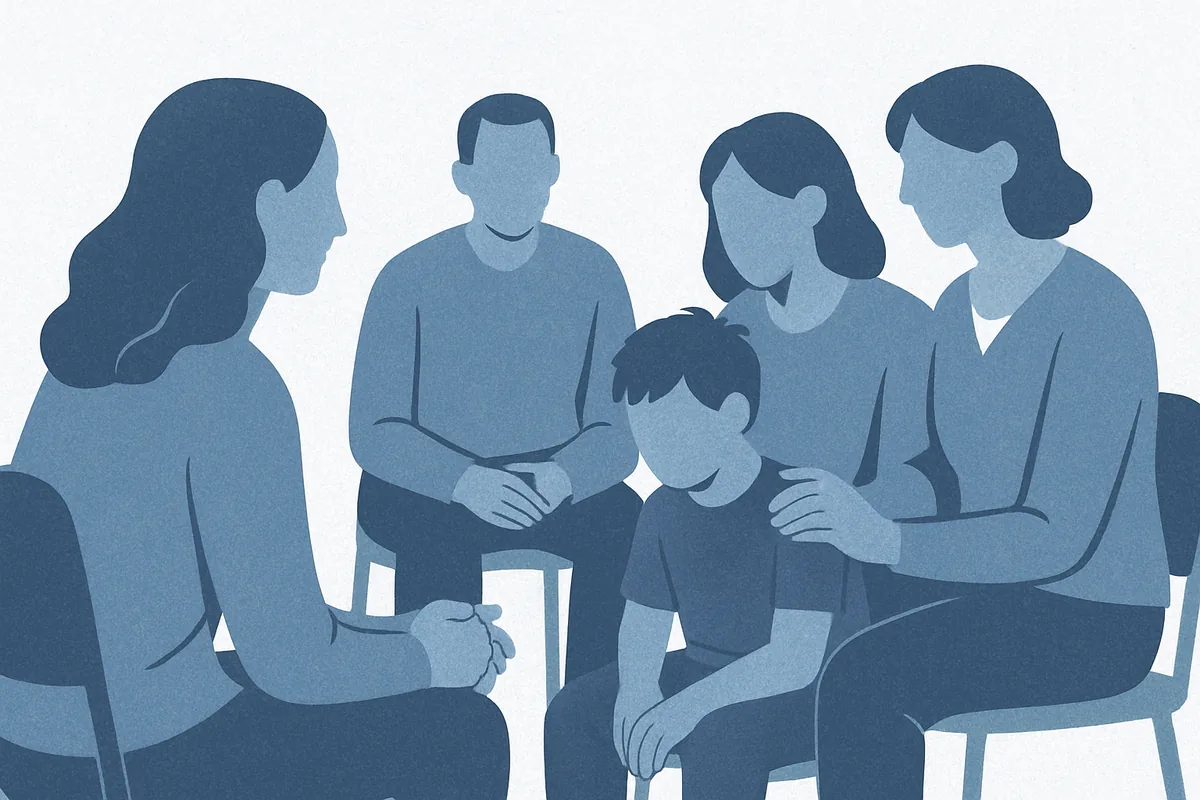
- A 2024 study found that 94.6% of parents of autistic children showed significant stress levels, substantially higher than parents of typically developing children, making peer connection a clinically meaningful protective factor.
- Perceived social support is the single strongest predictor of reduced parenting burden in autism families, according to a 2018 systematic review in PMC.
- Dubai families can access a range of support formats: government-backed initiatives like Dubai Health's Blue Café, nonprofit family clubs at the Dubai Autism Center, parent-led networks like Ausome Family Journey, and free professional-facilitated Zoom groups.
- Peer support groups are valuable for reducing isolation and sharing practical strategies, but they cannot replace clinical assessment, therapy planning, or treatment for co-occurring conditions such as anxiety or sleep difficulties.
- Newly diagnosed families in Dubai can begin by exploring what the diagnosis means clinically, then map community and therapy options, our autism therapy team at CAYA World works alongside peer networks, not in place of them.
The World Health Organization estimates that autism affects approximately 1 in 127 people globally (WHO, 2023), and in the UAE, rates of 20 to 29 per 10,000 children have been reported, though comprehensive national registry data remains limited (PwC GCC Autism Report, 2024). For families in Dubai who have recently received a diagnosis, one of the most immediate questions is not only about therapy or school, but about community: where do we find other families who understand what this is like? Autism support groups in Dubai have grown considerably over the past decade, spanning government-backed platforms, nonprofit family clubs, parent-led WhatsApp and Facebook networks, and professionally facilitated online groups. This guide maps those options honestly, explains what the evidence says about why peer connection matters for parent wellbeing, and draws a clear line between what community can provide and where clinical input becomes necessary.
If your family has just come through a diagnosis and you are still working out what happens next, our articles on autism diagnosis next steps in Dubai and what autism is and how it presents cover those foundations. This article picks up at the stage where many families find themselves a few weeks later: ready to connect with others and build a longer-term support structure.
Why autism support groups matter: what the research says about parent wellbeing
The emotional load of raising an autistic child is measurable, not anecdotal. A 2024 controlled clinical study published in PubMed found that 94.6% of parents of children with autism showed significant stress levels, substantially higher than parents of typically developing children (Gomes et al., 2024). A 2025 meta-analysis found that 41.1% to 45.8% of parents of autistic children reported mental health difficulties, compared to approximately 20% in the general population, more than double the rate (PubMed, 2025). These are not marginal differences. They reflect the genuine weight of navigating systems, advocating constantly, and often doing so without adequate support.
What the evidence also shows is that social support is one of the most powerful protective factors available to these families. A 2018 systematic review in PMC found that perceived social support was the strongest and most consistent negative predictor of parenting burden in families of autistic children, meaning the more supported a parent feels, the lower their overall burden. This is not a soft finding. It is the single clearest modifiable factor identified across the literature. A 2021 systematic review published in Child: Care, Health and Development found that peer support programs for parents of autistic children improved wellbeing and quality of life, with moderate certainty of evidence (Wiley, 2021).
In Dubai specifically, there is an added layer: the city's expat population turns over rapidly. Families build relationships, develop trusted informal networks, and then watch those networks dissolve when friends relocate to Singapore or London or Toronto. This churn makes formal, organised support communities more important here than in more geographically stable cities. A parent in Amsterdam or Sydney can rely on a long-standing informal peer network built over a decade. In Dubai, that continuity often has to be deliberately constructed.
What types of autism support groups exist in Dubai?
It helps to understand the landscape before choosing where to invest your time and energy. Autism support groups in Dubai fall into four broad categories, each serving a different need.
Government and hospital-initiated platforms
These are typically well-resourced, carry institutional backing, and offer structured content alongside community access. They tend to be more formal in tone, with moderated forums, webinar programmes, and clear safeguarding. They are a good starting point for families who want credible information alongside peer connection.
Nonprofit family support clubs
Established organisations with a long track record in Dubai run structured family programmes, workshops, and advocacy networks. These tend to have clear membership processes, calendared events, and a mix of peer and professional input. They are particularly useful for families who want to engage with the wider autism advocacy ecosystem in the UAE.
Parent-led community networks
Grassroots groups, often organised through WhatsApp, Facebook, or in-person meet-ups, are built entirely by families for families. They are less formal, faster-moving, and often the best source of hyper-local practical intelligence: which clinics have the shortest waiting lists, which schools have the most inclusive classrooms, which therapists are currently accepting new clients. The information can be uneven in quality, but the lived-experience depth is genuine and valuable.
Professional-facilitated parent groups
These are structured support sessions, usually run by a psychologist or trained facilitator, that combine peer connection with guided discussion and psychoeducation. They sit between clinical therapy and pure peer support, offering more structure than a parent-led group while remaining accessible and low-cost or free. For parents who are experiencing significant distress, this format often provides the most useful bridge before or alongside individual therapy.
Key autism support communities and organisations in Dubai
The following organisations and initiatives represent the main formal touchpoints for autism support in Dubai as of 2025. This is not an exhaustive directory, and the landscape continues to develop, but these are the organisations with the longest track records, the clearest contact points, and the most consistent programming.
Dubai Autism Center
Founded in 2001, the Dubai Autism Center (DAC) is the UAE's largest autism-focused nonprofit. Beyond its clinical and educational services, the DAC runs a Family Support Club that brings parents and caregivers together for workshops, social events, and peer sharing sessions. The Center concluded its 19th Annual Awareness Campaign in May 2025 and has signed memoranda of understanding with the Dubai Health Authority to train staff in special needs schools. For families seeking connection to the broader UAE autism advocacy ecosystem, the DAC is one of the most established entry points. Their contact details and current programme schedule are available at dubaiautismcenter.ae.
Blue Café by Dubai Health
Launched in 2024 and originating from Al Jalila Children's Hospital, the Blue Café initiative is a government-backed autism community platform offering microlearning resources, webinars, and a virtual community forum for parents and caregivers. Plans for a physical café location are in development, with proceeds intended to fund autism research. Blue Café represents one of the more structured government-facing community formats available in Dubai, and its virtual forum is accessible to families regardless of their location within the emirate. More information is available through dubaihealth.ae.
Ausome Family Journey (AFJ)
AFJ is a parent-led network that spans Dubai, Abu Dhabi, and the Northern Emirates. Founded and run by families of autistic children, it organises meet-ups, parent forums, and online discussions, with a particular emphasis on connecting newly diagnosed families with those who are further along in their experience. The network has been featured in Gulf News and represents one of the most active grassroots community options in the UAE. For families who have recently received a diagnosis and want to speak with parents who have navigated the same systems, AFJ is often one of the most immediately useful places to start.
If your child has been recently diagnosed and you are looking for structured clinical support alongside community connection, our team at CAYA World can help you understand what a therapy plan should look like at each developmental stage. Learn more about our autism therapy services in Dubai and how we work with families from the point of diagnosis onward.
Online communities and informal networks for Dubai autism families
Beyond formal organisations, several online communities provide the kind of rapid, practical information that formal groups cannot always deliver in real time.
CANDID
CANDID is a closed Facebook group for parents and caregivers of children with additional needs in Dubai. The group's privacy settings mean discussions remain within the community, which encourages more candid conversation about sensitive topics: navigating school admissions for children with an autism diagnosis, managing insurance claims for therapy, finding therapists who work well with specific presentations. The group's strength is exactly what its name implies. The limitation is that information is unverified and peer-sourced, so clinical guidance should always be cross-checked with a licensed clinician.
Lighthouse Arabia's online parent support group
Lighthouse Arabia, a Dubai-based mental health clinic, runs a free and confidential online autism parent support group via Zoom for parents of children aged 5 to 18. This sits in the professional-facilitated category: it is structured, facilitated by a clinician, and provides psychoeducational content alongside peer sharing. It is one of the few free, professionally facilitated options in Dubai and is worth exploring for families who want more structure than a parent-led group but are not yet ready for or in need of individual clinical support.
WhatsApp community groups
Numerous informal WhatsApp groups operate across Dubai, often organised by area, school, or child age-range. These are typically invitation-based and discovered through other parents rather than via public listings. They function as real-time information networks: parents share appointment cancellations, recommend therapists, flag changes to KHDA school inclusion policies, and offer practical solidarity when things are difficult. Their limitation is the same as all informal peer networks: the quality of clinical information varies, and advice is driven by personal experience rather than evidence. They supplement formal support; they do not replace it.
Wondering if It's Time to Talk to Someone?
Our specialist team at CAYA World offers comprehensive assessment and evidence-based treatment, conducted from our clinic in Palm Jumeirah, Dubai.
What peer support cannot replace: when clinical input matters
Peer support is genuinely valuable. The evidence is clear on that. But it has defined limits, and understanding those limits helps families invest in the right resources at the right time.
A parent-led support group can tell you which schools have strong inclusion programmes. It cannot tell you whether your child's difficulty with transitions is driven by anxiety, sensory processing differences, or an undetected co-occurring condition. A community forum can validate your exhaustion and give you practical strategies that worked for someone else's child. It cannot conduct a cognitive assessment, interpret a psychological evaluation, or develop a structured therapy plan tailored to your child's specific profile.
The clinical situations that require professional input rather than peer advice include the following:
- A child who has received an autism diagnosis but not yet had a full psychological evaluation that maps their cognitive profile, adaptive functioning, and any co-occurring conditions
- A child whose anxiety, sleep difficulties, or challenging behaviour has intensified to the point where it is significantly affecting daily functioning or family life
- A parent whose own mental health has deteriorated to the point of persistent low mood, significant anxiety, or breakdown in coping, this is clinically common and clinically treatable
- Families navigating a disagreement with a school about educational needs, accommodations, or an Individual Education Plan, where professional documentation is required
- A child approaching a significant transition: starting school, moving from primary to secondary, or approaching adulthood, each of which may require updated assessment and revised planning
At CAYA World, we see families at all of these points. Some arrive at their first session with years of peer support behind them and a clear sense of community but a specific clinical question that the community cannot answer. Others arrive having done everything via peer networks and only recently recognising that their child needed structured therapy months or years earlier. Both are understandable paths. The aim of laying out this distinction is not to steer families away from community, but to help them recognise when community and clinical support need to run in parallel.
How CAYA fits alongside the autism community in Dubai
At CAYA World, we do not position ourselves as a replacement for peer communities. We position ourselves as the clinical layer that runs alongside them. Parents who are embedded in their autism community often arrive at our clinic with a sophisticated understanding of their child's profile, hard-won over years of advocacy. That knowledge is valuable and we build on it, not over it.
What we add is structured clinical assessment, evidence-based therapy delivered by our licensed psychologists, and the professional documentation that Dubai's school and regulatory systems require. Our team works with autistic children and their families across developmental stages, from early childhood through adolescence. We also work with parents directly when the wellbeing data described above becomes a lived reality: when the stress levels are not just measurable but are affecting a parent's ability to function, to be present, or to sustain the advocacy their child needs.
Our approach to autism therapy draws on cognitive-behavioural frameworks adapted for the specific needs of autistic children and adolescents, with goals that are set collaboratively with families and reviewed at regular intervals. We work in alignment with Dubai schools and the KHDA inclusion framework where relevant, providing clinical reports that feed directly into Individual Education Plans and accommodation requests. Our autism assessment service in Dubai can also clarify a diagnosis, expand on an existing one, or identify co-occurring conditions that a screening-level assessment may have missed.
Dr. Nour Al Ghriwati, Co-Founder and Chief Clinical Psychologist at CAYA World, has published peer-reviewed research in child and adolescent psychology. She and the broader CAYA clinical team have worked extensively with families navigating the Dubai autism landscape, which means we understand not just the clinical dimensions of autism but the specific logistical and systemic context families face here: the school admission processes, the DHA-regulated clinical pathway, the insurance landscape, and the challenges of building a support network in a city with high population turnover.
For families who are building their support structure from the ground up, we recommend thinking in three layers simultaneously. The peer community layer provides solidarity, practical local knowledge, and the validation of shared experience. The organised nonprofit layer provides advocacy, awareness resources, and family programming. The clinical layer provides assessment, therapy, and professional documentation. All three serve different functions. All three are worth investing in.
Frequently Asked Questions About Autism Support Groups in Dubai
Yes. Several free options exist. Lighthouse Arabia runs a free, confidential online autism parent support group via Zoom for parents of children aged 5 to 18, facilitated by a clinician. The Blue Café initiative from Dubai Health offers a free virtual community forum and webinar programme. Parent-led groups such as Ausome Family Journey and community Facebook groups like CANDID are also free to join. The Dubai Autism Center's Family Support Club has its own membership and event structure, so fees may apply for specific programming.
A peer support group is run by parents for parents. Discussion is driven by shared lived experience, practical advice, and mutual solidarity. There is no clinical facilitation and no structured agenda, though some groups invite guest speakers. A professionally facilitated group is led by a psychologist or trained facilitator who guides discussion, provides psychoeducational content, and ensures the group stays constructive and safe. Facilitated groups are particularly useful for parents managing significant stress or distress, because the clinical oversight means emotional difficulties can be acknowledged and appropriately signposted rather than left unaddressed.
Start with two things in parallel: understanding the diagnosis clinically and finding your peer community. For the clinical side, a follow-up appointment with the psychologist or team who conducted the assessment is the first step; ask specifically about co-occurring conditions, cognitive profile, and what therapeutic support is recommended. For community, Ausome Family Journey and the Dubai Autism Center's Family Support Club are both well-established starting points for newly diagnosed families. Our article on autism diagnosis next steps in Dubai covers the practical pathway in more detail.
Absolutely, and you should. Most Dubai autism support communities are built substantially by expat families who are themselves here for finite periods. Groups like Ausome Family Journey and the CANDID Facebook community are majority-expat in composition. The transience of Dubai's population is precisely why these communities tend to be actively welcoming to newcomers: everyone understands that the window is limited and that connection is worth making quickly. Many families also find that online communities remain useful even after relocating, providing continuity of peer connection.
If your child has been diagnosed but not yet had a comprehensive psychological assessment mapping their cognitive profile and any co-occurring conditions, a clinical evaluation is a worthwhile next step regardless of how well-connected you are in the community. Beyond that, seek clinical input if your child's anxiety, sleep, behaviour, or daily functioning has changed significantly; if you are struggling with your own mental health to the point that it is affecting daily life; or if your child is approaching a major transition such as starting school or moving to secondary level. Peer support and clinical care serve different functions and work best together.
Sources and Further Reading
- Autism spectrum disorders fact sheetWorld Health Organization (2023)
- Parental stress in autism: a controlled clinical study (Gomes et al.)PubMed (2024)
- Mental health problems in parents of children with ASD: prevalence meta-analysisPubMed (2025)
- Social support as a predictor of parenting burden in autism families: systematic reviewPMC (2018)
- Peer support programs for parents of autistic children: a systematic reviewChild: Care, Health and Development, Wiley (2021)
- Elevating Autism Care in the GCC for Meaningful Change. PwC GCC Autism Report (2024)