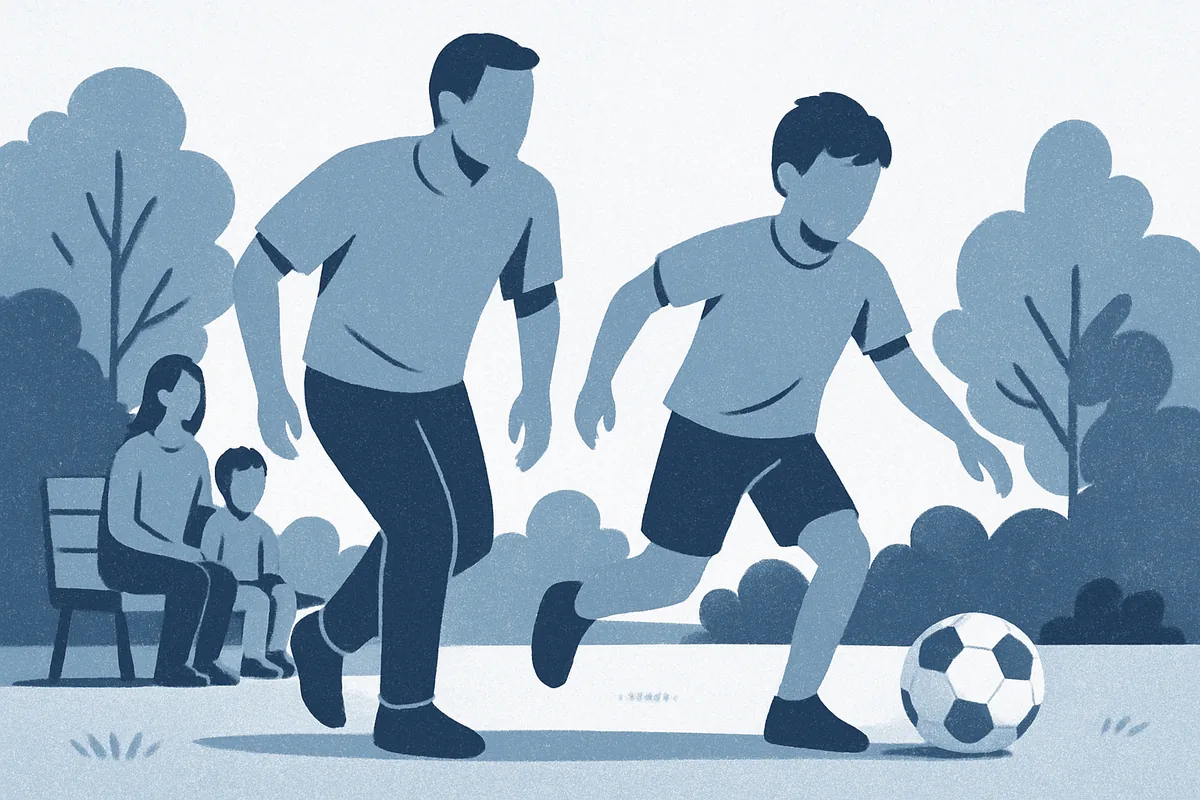
- Aerobic exercise raises dopamine and norepinephrine in the prefrontal cortex, the same neurotransmitters targeted by ADHD medication, making physical activity one of the most evidence-backed non-pharmacological tools for improving focus in children with ADHD.
- A 2023 meta-analysis of 24 studies involving 914 children found that physical activity interventions produced significant improvement in inhibitory control, with a standardised mean difference of -0.50, meaning measurable gains in the ability to pause, filter, and redirect attention.
- Sports with a predictable structure, immediate feedback, and clear individual skill progression, such as swimming, martial arts, and gymnastics, tend to suit children with ADHD more reliably than open-play formats, though temperament and interest should guide the final choice.
- Dubai's extreme summer heat (June through September, regularly exceeding 40 degrees Celsius) makes year-round indoor sports, including swimming academies, martial arts gyms, and indoor gymnastics, the practical default for ADHD-supportive exercise in the city.
- Exercise does not replace ADHD assessment or therapy, but structured physical activity, combined with evidence-based intervention, produces better outcomes than either approach alone for most children.
When a child takes stimulant medication for ADHD, the drug works by increasing dopamine and norepinephrine availability in the prefrontal cortex, the part of the brain responsible for attention, impulse control, and working memory. Aerobic exercise does the same thing. That is not a wellness claim; it is neuropharmacology. For parents asking whether sport can genuinely help their child with ADHD sports exercise children focus better at school, the short answer is yes, and the evidence behind that answer has grown substantially in the last five years.
This article is not a general ADHD management guide. It is specifically about physical activity as a brain-based intervention: why it works, what the research shows, which sports suit children with ADHD most reliably, and how to make it practical in Dubai's climate. If you are also looking at broader behavioural strategies at home, our related article on ADHD home support strategies for Dubai parents covers that ground separately.
At CAYA World Clinic in Palm Jumeirah, our clinical team, led by Dr. Nour Al Ghriwati, works with children with ADHD and their families every week. One of the most consistent findings in our clinical experience is that children who have structured physical activity built into their week, not as a reward but as a non-negotiable routine, tend to manage attention and emotional regulation more effectively. The science explains why.
Why does exercise help children with ADHD? The neuroscience explained
ADHD is fundamentally a condition of underactivation in specific neural circuits, particularly the fronto-striatal network, which governs inhibitory control, working memory, and the ability to sustain attention over time. The prefrontal cortex, which acts as the brain's executive director, relies on adequate levels of dopamine and norepinephrine to function well. In children with ADHD, these neurotransmitter systems are less efficient than in neurotypical peers.
Aerobic exercise triggers an acute and measurable increase in both dopamine and norepinephrine across the central nervous system. It also elevates brain-derived neurotrophic factor (BDNF), sometimes called the brain's fertiliser, which supports synaptic connectivity and the long-term structural changes associated with improved learning and memory. The prefrontal cortex is particularly responsive to BDNF. In practical terms, a child who has completed 20 to 30 minutes of vigorous aerobic activity arrives at a learning task with a brain that is biochemically primed to attend, inhibit impulses, and hold information in working memory.
This is not a temporary or marginal effect. Research using neuroimaging has shown that regular aerobic exercise produces structural changes in the caudate nucleus and prefrontal cortex in children with ADHD, regions that are typically smaller or less active in this population. The implication is that sustained physical activity does not just provide a short-term attention boost; over months, it may contribute to meaningful changes in how the ADHD brain is organised.
Dr. Nour Al Ghriwati often explains to families at CAYA World that medication and exercise are working on the same underlying neurochemistry, which is why combining the two consistently outperforms either alone. Exercise is not an alternative to a properly designed treatment plan. It is a component of one.
The role of routine and motor learning
Beyond neurochemistry, sport contributes something else that matters for children with ADHD: predictable structure and immediate, concrete feedback. Many children with ADHD struggle in open-ended, low-structure environments because those environments demand the very executive functions that ADHD disrupts. A sport with clear rules, defined roles, and a coach providing immediate corrective feedback creates an external scaffolding for attention that a classroom or homework table does not. The child does not have to generate their own regulation. The environment generates it for them.
Motor learning itself also draws on many of the same cognitive systems involved in attention and working memory. Practising a swimming stroke, a martial arts kata, or a gymnastics sequence requires the child to hold multi-step instructions in working memory, inhibit competing movements, and shift attention between body position and outcome. That practice, repeated across hundreds of training sessions, builds the very circuits that ADHD disrupts.
What does the research say about ADHD, sports, and exercise in children?
The evidence base for exercise as an ADHD intervention has strengthened considerably in the last decade. It now includes multiple systematic reviews, meta-analyses, and randomised controlled studies involving thousands of children.
A 2024 systematic review and meta-analysis published in Frontiers in Psychology found that aerobic exercise significantly improved executive functioning in children aged 6 to 12 with ADHD. The gains were most consistent for inhibitory control, cognitive flexibility, and working memory, three of the four core executive functions that ADHD impairs. Notably, improvements were observed across a range of exercise types and durations, suggesting that the key ingredient is sustained aerobic activity rather than any single sport format.
A 2023 meta-analysis of 24 studies involving 914 participants found that physical activity interventions produced significant improvement in inhibitory control, reporting a standardised mean difference of negative 0.50 (95% CI: negative 0.71 to negative 0.29). That effect size is clinically meaningful. It sits in the moderate range, comparable in scale to some non-stimulant pharmacological interventions.
A further systematic review and meta-analysis of 18 studies involving 627 children and adolescents with ADHD, published in Child: Care, Health and Development (Wiley), found that structured physical exercise improved inattention, executive function, physical fitness, and mental health outcomes. The authors noted that structured formats, with instructor-led sessions providing clear goals and immediate feedback, produced stronger effects than unstructured free play.
A 2024 network meta-analysis published in PubMed found that aquatic exercise was specifically beneficial for attention and cognitive flexibility in children with ADHD, while perceptual-motor training, which includes activities such as martial arts and gymnastics, showed superiority for working memory gains. This is one of the first analyses to directly compare exercise types rather than pooling them, and it has important implications for sport selection.
Closer to home, a 2024 UAE University pilot study evaluated a five-week Taekwondo-inspired programme for children aged 8 to 10 with ADHD in the UAE. Despite the small sample size (four participants), the pilot reported improvements in attention, impulsivity, executive functioning, and social functioning. It is the first UAE-based sport intervention data for children with ADHD, and while the preliminary scale means results should be interpreted cautiously, it is consistent with the broader international literature on martial arts and ADHD.
The World Health Organization recommends that children and adolescents, including those with neurodevelopmental conditions such as ADHD, accumulate at least 60 minutes per day of moderate-to-vigorous aerobic physical activity, with vigorous and muscle-strengthening activities incorporated on at least three days per week. Most children with ADHD fall well short of this target, which means there is frequently meaningful room to improve focus and self-regulation through increased structured activity before any more complex intervention is needed.
If you have questions about whether your child's current ADHD management plan is as effective as it could be, our team at CAYA World is happy to talk through it. A brief intake conversation with a CAYA specialist, over WhatsApp or phone, can help you figure out whether a more structured assessment or therapy package would add value alongside the strategies you already have in place.
Which sports tend to suit children with ADHD, and why?
Not all sports are equally suited to the ADHD profile, and the reason is structural rather than about difficulty level. Children with ADHD tend to thrive in environments that provide clear, immediate feedback; defined individual goals within a session; high movement intensity; and low wait time. They tend to struggle in formats with long periods of standing around, complex social negotiation mid-play, or unclear roles.
Swimming
Swimming is one of the most frequently recommended sports for children with ADHD, and the 2024 network meta-analysis data on aquatic exercise supports that clinical consensus. The pool environment provides rich sensory feedback on body position, the bilateral, rhythmic nature of swimming strokes engages both hemispheres simultaneously, and lane-based training means the child has a defined space and a clear individual task. Sessions are high-intensity by nature, which maximises the dopamine and norepinephrine response. The relative absence of social distraction during individual lap work also reduces the executive-function load that team sports require.
Martial arts
Martial arts, particularly Taekwondo, Karate, and Brazilian Jiu-Jitsu, have a strong evidence base for ADHD. The structured belt progression system gives children with ADHD a concrete, visible, and achievable sequence of goals, which maps well onto the motivational architecture of the ADHD brain, which responds more strongly to immediate and tangible rewards than to long-term abstract ones. Instructors in martial arts settings typically provide frequent, direct, individual feedback. The requirement to memorise and execute sequences (katas or forms) gives working memory a specific workout. The physical contact and proprioceptive input in many martial arts styles also appear to provide a regulatory function for some children with ADHD, particularly those who also have sensory-processing needs.
Gymnastics and movement-based disciplines
Gymnastics, indoor climbing, and parkour formats share a common feature that suits ADHD: each skill is broken into small, discrete, masterable steps. A child can experience multiple micro-successes within a single session. Indoor climbing in particular has gained clinical interest because it combines aerobic intensity with spatial problem-solving and requires sustained, directed attention to the immediate task of the next move. Failure to attend has immediate, concrete consequences, which provides a powerful natural feedback loop.
Team sports: when they work and when they do not
Team sports are not off the table for children with ADHD, but they require more careful matching. High-movement, high-contact team formats, such as football, basketball, and rugby, suit children with ADHD who have the social appetite for group play and whose ADHD profile leans more toward hyperactivity than inattention. Cricket, baseball, and similar sports with long waiting periods between actions tend to be harder, because the low-activity phases create exactly the conditions in which ADHD symptoms become most visible.
The quality of the coach matters enormously in team settings. A coach who understands ADHD, provides brief and specific instructions, uses positive behavioural reinforcement, and assigns the child a clear, active role within the team structure can make a team sport work beautifully. The same sport with a coach who relies on extended verbal instruction, values stillness, or responds to ADHD-related behaviours punitively can make the experience counterproductive. This brings us to the question of coach communication, which we address in the section below.
Wondering if It's Time to Talk to Someone?
Our specialist team at CAYA World offers comprehensive assessment and evidence-based treatment, conducted from our clinic in Palm Jumeirah, Dubai.
How to find the right sport for your child with ADHD in Dubai
Dubai presents a specific logistical reality that parents need to plan around. From June through September, outdoor temperatures regularly exceed 40 degrees Celsius and humidity makes midday and afternoon outdoor activity unsafe for children. This is not a minor inconvenience; it means that for approximately four months of the year, outdoor sport is functionally unavailable during most accessible hours. Year-round indoor sport provision is therefore the practical default for ADHD-supportive exercise in Dubai, and fortunately the city has it in abundance.
Indoor sport options in Dubai suited to children with ADHD
Swimming academies are among the most accessible options, with high-quality indoor pools available across the city. Many offer structured coaching programmes from age five upward, with skill-based progression tracks that suit the ADHD temperament well.
Martial arts gyms offering Taekwondo, Karate, and Brazilian Jiu-Jitsu are widely distributed across Dubai's residential clusters, including Arabian Ranches, JVC, Al Barsha, and the Palm. Most run weekday afternoon and weekend sessions, timed for after-school attendance.
Multisport Club Dubai offers structured multi-discipline sessions for children aged three to twelve, giving families the opportunity to trial different movement formats before committing to a single sport. Indoor gymnastics centres provide structured skill development in a high-feedback environment. Pinpoint Fitness, with locations at Festival City, Al Furjan, and Arabian Ranches 2, offers indoor parkour and obstacle courses that many children with ADHD find intensely engaging.
For children with ADHD alongside other neurodevelopmental needs, Dubai Inclusive Sports Club and Senses Foundation are noted local resources for adaptive sport. UAE Sports for All-registered clubs, including The Little Champions Fitness Center and Young Icons Sport Academy, offer structured, coach-led indoor formats designed with developmental needs in mind.
What to look for in a sports programme for a child with ADHD
Before enrolling, it is worth asking the programme coordinator a few specific questions. How large are the coaching groups? Smaller ratios mean more individual attention and feedback. How does the coach handle distraction or impulsive behaviour during sessions? Does the programme use visible, concrete goal-setting, such as belt levels, skill badges, or timed challenges? Is there a trial session available before a term commitment?
At CAYA World, we often help families think through sport selection as part of a broader ADHD support plan. If your child has had an ADHD assessment with us, their psychologist can share specific recommendations about which sport formats are likely to align with their particular attention and regulation profile.
Supporting your child with ADHD in sport: tips for coaches and parents
Even the best-matched sport can become a source of frustration if the adults around the child do not understand how ADHD presents in a sport setting. Children with ADHD in sport may appear to not be listening when they are; they may respond impulsively during drills; they may struggle to wait their turn; they may disengage during long explanatory segments; and they may react more strongly than expected to criticism or losing. None of these are defiance or poor character. They are the ADHD profile expressing itself under the particular demands of a group sport environment.
Practical guidance for coaches
- Give instructions one step at a time. Lengthy multi-part instructions delivered before a drill begins are frequently lost for children with ADHD. Break the instruction into its first step, let the child begin, then add the next component.
- Use brief, specific, positive language. "Good, elbow up" is more useful than "You need to remember to keep your technique consistent."
- Give the child an active, named role in group activities. Children with ADHD function better when they have a defined job rather than a waiting role.
- Front-load sessions with the high-intensity physical component before detailed skill instruction. A child who has had 15 minutes of vigorous aerobic activity is better equipped to listen and process than one who has been asked to sit and receive instruction first.
- Use physical proximity rather than raising your voice across the space when redirecting. A quiet word close to the child is more effective and less stigmatising than calling them out in front of peers.
- Celebrate effort and incremental improvement explicitly. The ADHD brain responds strongly to immediate positive feedback; do not wait for a perfect performance to acknowledge progress.
What parents can do before and after sessions
Before the session, keep transitions brief and consistent. A clear, predictable departure routine from home reduces the executive-function load before activity even begins. Avoid lengthy reminders about behaviour on the drive over; save the preparation conversation for a calm moment at home, not the car park.
After the session, ask about one specific thing that went well rather than a broad "how was it?" Children with ADHD often struggle to retrieve and articulate a session's events globally. A specific question, "Did you get to try the new move you were working on?" gives their working memory a hook to retrieve the experience.
Talking with the coach directly and proactively about your child's ADHD is one of the most effective things a parent can do. You do not need to disclose a full clinical history. A brief, practical conversation that names two or three specific things the coach can do, such as breaking instructions into steps and providing immediate positive feedback, is usually enough. Many coaches are willing and grateful for the guidance; they simply have not been given it before. If you would find it useful to have a structured coaching conversation about how to navigate these discussions, our article on parent coaching for ADHD in Dubai covers the approach in detail, and our parenting therapy and support service at CAYA World can provide one-to-one guidance.
When physical activity is well-matched to the child's profile, embedded in a consistent weekly routine, and supported by adults who understand the ADHD brain, it functions as a genuine clinical asset. For many families we work with, the shift from inconsistent weekend exercise to four structured weekly sessions in a suitable sport produces observable changes in a child's ability to settle to homework, manage frustration, and sustain attention, within a matter of weeks. If you would like support structuring a plan that includes sport alongside evidence-based ADHD therapy for children and teens, our team at CAYA World is here to help.
Frequently Asked Questions About ADHD Sports and Exercise in Dubai
The World Health Organization recommends at least 60 minutes of moderate-to-vigorous aerobic activity per day for children, and this guideline applies to children with ADHD. Research suggests that even a single 20 to 30-minute session of aerobic exercise produces acute improvements in attention and inhibitory control lasting one to two hours. For sustained, structural benefit to executive function, consistent activity across four to five days per week over eight to twelve weeks appears to be the threshold at which measurable gains in attention and working memory become reliably detectable in the research literature.
Individual sports, such as swimming, martial arts, gymnastics, and tennis, tend to be better matched to the ADHD profile because they offer clear personal skill goals, immediate individual feedback, and less reliance on the child regulating their behaviour within a complex social group mid-activity. That said, team sports can work well for children with ADHD who have a strong social motivation and whose profile includes significant hyperactivity. The quality and style of the coach is often more decisive than the sport format itself. A well-matched team sport with an ADHD-informed coach can outperform a poorly structured individual programme.
No. Exercise is a valuable component of ADHD management, not a replacement for assessment-led treatment. For children with moderate to severe ADHD, medication and structured behavioural or cognitive intervention remain first-line evidence-based approaches. Exercise works through overlapping neurochemical pathways, which is why combining it with other treatments produces better outcomes than exercise alone. Think of physical activity as a high-yield, low-risk addition to a comprehensive plan, not a standalone alternative. If your child has not had a formal ADHD assessment, that is the right first step before building a treatment strategy around any single intervention.
During Dubai's summer months (June through September), outdoor sport is unsafe for children during most daytime hours, making indoor options essential. Swimming academies, indoor martial arts gyms (Taekwondo, Karate, Brazilian Jiu-Jitsu), indoor gymnastics centres, and indoor parkour facilities are the most ADHD-suited indoor formats available across Dubai. Multisport Club Dubai offers multi-discipline indoor sessions for children aged three to twelve. Many of these run year-round, Monday through Saturday, with after-school and weekend slots. Choosing a facility within a short drive of home or school significantly reduces the likelihood that the routine will break down during a busy week.
Keep the conversation brief, specific, and practical. You do not need to share a full clinical history. Identify two or three concrete strategies the coach can use, for example: give instructions one step at a time; provide immediate positive feedback after a good attempt; assign your child an active named role in group drills. Frame the conversation around helping the coach get the best from your child rather than asking the coach to manage a problem. Most coaches respond positively to specific, actionable guidance. If you find these conversations difficult or want to prepare for them, our parenting therapy and support service at CAYA World can walk you through how to have them effectively.
Sources and Further Reading
- Aerobic exercise and executive function in children with ADHD aged 6-12Frontiers in Psychology (2024)
- Physical activity interventions and inhibitory control in children with ADHD: meta-analysis of 24 studiesPMC / PubMed (2023)
- Structured physical exercise and ADHD outcomes in children and adolescents: systematic review and meta-analysis of 18 studiesChild: Care, Health and Development, Wiley (2023/2024)
- WHO guidelines on physical activity and sedentary behaviour for children and adolescentsWorld Health Organization (2020)
- Network meta-analysis of exercise types and cognitive outcomes in children with ADHD: aquatic exercise and perceptual-motor training. PubMed (2024)
- Taekwondo-inspired intervention programme for children with ADHD in the UAE: pilot study (n=4). UAEU ScholarWorks (2024)
- DSM-5-TR: Diagnostic and Statistical Manual of Mental Disorders, Fifth Edition, Text Revision. American Psychiatric Association (2022)