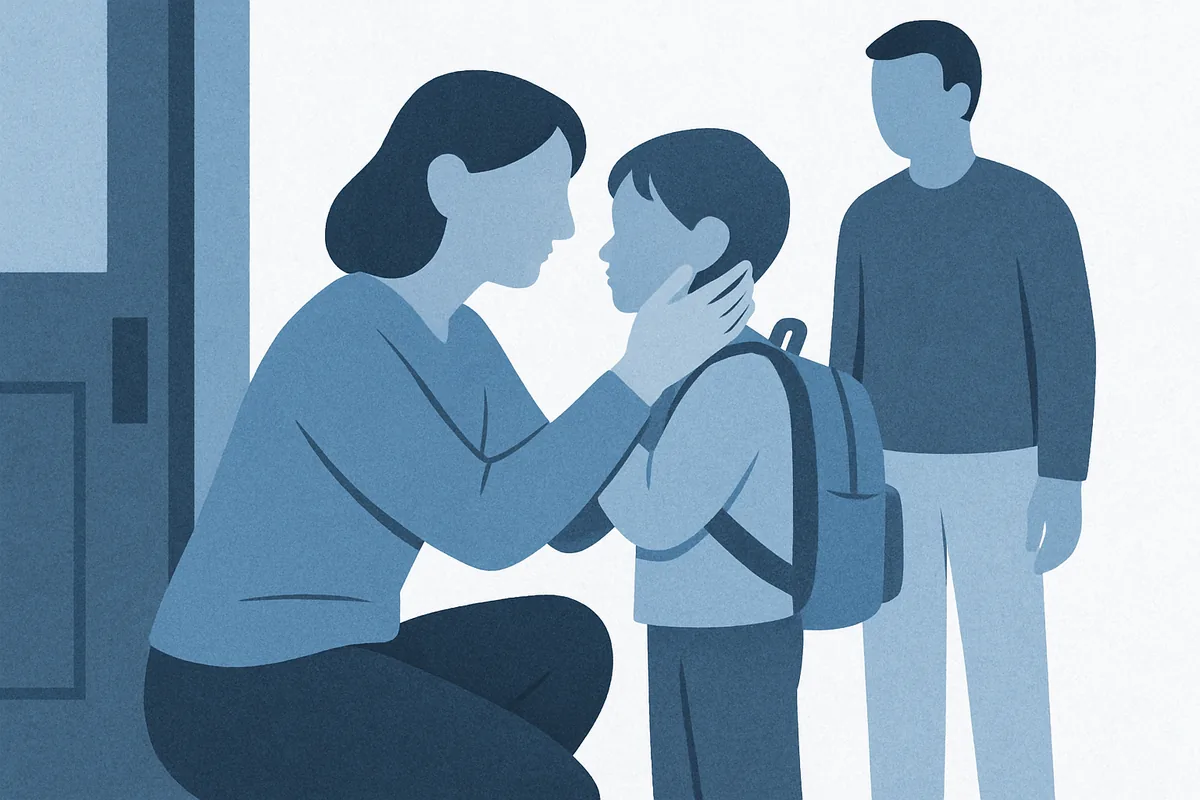
- Separation Anxiety Disorder (SAD) affects approximately 4% of children and accounts for around 50% of all anxiety-related mental health referrals in childhood, making it the most common childhood anxiety disorder (StatPearls, 2023).
- Normal separation protest peaks around age 18 months to 3 years and fades with consistent caregiving; a DSM-5 diagnosis of SAD requires symptoms lasting at least 4 weeks in children and causing significant impairment in daily functioning.
- A 2020 UAE peer-reviewed study found anxiety disorder prevalence among school-aged children in the UAE was 28%, more than four times the global pooled rate of 6.5%, with children in households employing a live-in maid scoring significantly higher on separation anxiety measures.
- Parental accommodation behaviours, such as staying through every drop-off, repeatedly returning to collect a distressed child, or allowing home avoidance, maintain and intensify SAD rather than soothe it; graduated exposure with CBT addresses this cycle directly.
- CBT alone achieves approximately 60% treatment response for childhood SAD; for children with moderate to severe presentations, a clinical referral to a licensed psychologist is the appropriate next step rather than waiting for the child to grow out of it.
Separation Anxiety Disorder affects approximately 4% of children in community samples and accounts for roughly 50% of all anxiety-related mental health referrals in childhood, making it the most common anxiety disorder we see in young children (StatPearls, NCBI, 2023). Yet the majority of parents who bring a tearful toddler to a Dubai nursery every morning are not looking at a disorder. They are watching a developmental process unfold exactly as it should.
The clinical challenge, and the one this article addresses directly, is knowing which picture you are looking at. This article focuses specifically on children aged 1 to 7, covering the clinging, crying, and desperate goodbyes that happen at drop-off. That presentation is different in character and cause from the flat-out school refusal seen in older children aged 8 and above, which is addressed separately in our article on school refusal in Dubai children. If your child is sobbing at the nursery gate rather than refusing to leave the house, read on.
At CAYA World, Dr. Nour Al Ghriwati and the clinical team work regularly with Dubai families navigating exactly this question. The goal here is to give you the clinical framework parents need: what normal looks like, what clinical Separation Anxiety Disorder (SAD) looks like, what Dubai's unique family and school context contributes, and what effective treatment actually involves.
What is separation anxiety in children, and when is it normal?
Separation anxiety is a biologically normal response. From an evolutionary standpoint, a young child who protests loudly when a caregiver leaves is doing precisely what survival requires: signalling distress to bring the attachment figure back. The attachment system, described in detail by John Bowlby and later measured empirically by Mary Ainsworth, produces protest behaviours that peak in the second year of life and are expected to gradually diminish as the child develops object permanence (the understanding that a parent who leaves will return) and regulatory capacity (the ability to tolerate distress without immediate caregiver presence).
Normative separation anxiety typically follows this arc: distress begins to appear reliably around 6 to 8 months of age as the infant recognises the primary caregiver as distinct and irreplaceable, intensifies through the toddler years with a peak between approximately 14 and 18 months, and begins to resolve meaningfully by age 3. By age 4 to 5, most children can separate from a parent for nursery or preschool with brief protest that settles within 5 to 15 minutes of the caregiver's departure. Temporary re-emergence of separation distress after a holiday, illness, family change, or international move is also normal and does not automatically signal clinical concern.
What matters clinically is not the presence of protest but its intensity, duration, and functional impact. A three-year-old who cries at drop-off and then joins in the nursery activity within ten minutes is behaving developmentally appropriately. A five-year-old who cannot settle after an hour, develops physical symptoms such as stomach aches or headaches on school mornings, refuses to sleep alone, or has repeated nightmares about harm befalling a parent is showing a different pattern entirely.
At CAYA World, we often see parents who have been reassured for months that their child will "grow out of it," only to arrive at an assessment with a child who is now six or seven and whose distress has intensified rather than faded. The question is never whether some anxiety is present; it is whether that anxiety is tracking the developmental trajectory or departing from it.
What does separation anxiety disorder look like? DSM-5 signs for Dubai parents
The DSM-5-TR defines Separation Anxiety Disorder as developmentally inappropriate and excessive fear or anxiety concerning separation from attachment figures. To meet diagnostic criteria, a child must show at least three of the following eight features:
- Recurrent excessive distress when anticipating or experiencing separation from home or from major attachment figures
- Persistent and excessive worry about losing major attachment figures or about possible harm to them (illness, injury, death)
- Persistent and excessive worry about experiencing an untoward event (getting lost, being kidnapped, having an accident) that causes separation from an attachment figure
- Persistent reluctance or refusal to go out, away from home, to school, or elsewhere because of fear of separation
- Persistent and excessive fear or reluctance about being alone or without major attachment figures at home or in other settings
- Persistent reluctance or refusal to sleep away from home or to go to sleep without being near a major attachment figure
- Repeated nightmares involving the theme of separation
- Repeated complaints of physical symptoms (headaches, stomachaches, nausea, vomiting) when separation from major attachment figures occurs or is anticipated
Crucially, the DSM-5 requires that these symptoms persist for at least four weeks in children, cause clinically significant distress or impairment in social, academic, or other areas of functioning, and are not better explained by another disorder. A child going through a two-week adjustment after starting a new nursery does not meet criteria. A child who has shown these patterns consistently for three months, who cannot attend nursery without extreme distress, and whose sleep is significantly disrupted every night may well do so.
It is also worth noting what SAD is not. It is not defiance. It is not manipulation, though protest behaviours can look that way to an exhausted parent at 7:30 in the morning. The anxiety is real, physiologically driven, and not something the child is choosing. Understanding this is the first step in responding to it effectively, because responses that treat separation distress as wilful behaviour tend to make it worse over time.
Our article on child anxiety versus normal worry explores the broader question of when children's worries cross into clinical territory, which may be useful alongside this piece if your child's anxiety extends beyond separation contexts.
The age windows that matter: developmental norms vs. clinical concern
Age is the single most important filter when assessing separation anxiety. The same behaviour that is entirely expected at 18 months is a clinical signal at 6 years. The table below summarises the developmental norms and the thresholds at which clinical concern is warranted across the age range most commonly seen in Dubai nurseries and primary schools.
| Age range | Normal presentation | Clinical concern threshold |
|---|---|---|
| 6 to 18 months | Stranger wariness, cries when primary caregiver leaves, settles with secondary caregiver within minutes | Failure to settle with any familiar caregiver; extreme, prolonged distress with all separations |
| 18 months to 3 years | Intense protest at separation, clings at drop-off, may have brief tantrums; settles within 15 to 20 minutes | Inability to settle at nursery after 4 or more weeks; physical symptoms on nursery mornings; significant night-time disturbance persisting beyond 4 weeks |
| 3 to 5 years | Brief protest at drop-off, mild distress, recovers quickly once parent is gone; may ask about parent but engages in activities | Persistent refusal to engage in nursery or preschool; daily physical complaints without medical cause; requires extended parental presence to sleep every night; symptoms not reducing after 4 weeks |
| 5 to 7 years | Minimal separation distress; may express preference to stay home but complies; brief reunion-seeking behaviours after school | School avoidance driven by separation fear (distinct from conduct-driven refusal); repeated somatic complaints; nightmares about harm to parent; cannot sleep without a parent present; significant peer and academic impairment |
The age window of 5 to 7 years is particularly important in Dubai's educational context. Year 1 in British-curriculum international schools (typically age 5 to 6) involves a significant structural transition from play-based EYFS to more formal classroom settings. Children whose separation anxiety was borderline in nursery sometimes show clear clinical symptoms at this transition point. This is not regression in the developmental sense; it is the existing anxiety being exposed by increased demand.
Dr. Nour Al Ghriwati notes that in clinical practice, the most common referral pattern at CAYA World for this age group involves a child who managed nursery with mild difficulty but who struggles significantly at Year 1 or Year 2 entry, often coinciding with a family relocation, a change in the home caregiving arrangement, or the arrival of a sibling.
How parental accommodation keeps separation anxiety going
This is the section most parents find hardest to read, and it is also the most clinically important. Parental accommodation refers to the ways in which a parent adjusts their behaviour to reduce a child's anxiety in the short term. It feels like the compassionate thing to do. Staying a little longer at drop-off, coming back to collect a distressed child early, allowing co-sleeping every night to prevent bedtime meltdowns, skipping birthday parties because the child cannot bear to go without a parent: all of these responses reduce the child's distress in the moment.
The problem is that accommodation also prevents the child from learning that separation is survivable. In CBT terms, the child never completes the anxiety arc: the feared situation (separation) is avoided before anxiety has the chance to peak and naturally reduce. The brain learns the opposite of what you need it to learn. Each successful avoidance strengthens the neural pathway that says "separation is dangerous; avoidance is the right strategy."
Research consistently shows that higher levels of parental accommodation are associated with greater child anxiety severity and poorer treatment outcomes. This is not a statement about parenting quality; it is a statement about the mechanism of anxiety maintenance. Loving, attentive parents accommodate because it works in the short term. The clinical task is to show parents why short-term relief produces long-term entrenchment and to give them a structured alternative.
Common accommodation patterns we see at CAYA World include:
- Extended or repeated drop-off routines (30 or more minutes of reassurance-giving before leaving)
- Returning to the nursery or school when notified the child is upset, rather than waiting for the child to settle
- Allowing the child to stay home on days they express strong distress about going
- Sleeping in the child's room or bringing the child into the parental bed every night to prevent bedtime anxiety
- Cancelling social plans or activities that require the child to be with another caregiver
- Providing continuous reassurance ("I'll be back at 12, I promise, nothing will happen to me") without graduated withdrawal of that reassurance
Recognising accommodation is not about blame. It is about identifying the specific behaviours that a parent coaching programme and CBT exposure work will target together. Parent coaching at CAYA World teaches caregivers how to respond to their child's distress in ways that validate the emotion without reinforcing the avoidance. This is a learnable skill, and most parents find it genuinely changes how they experience the drop-off themselves, as well as how their child responds.
If you are noticing several of these patterns in your own routine and your child's anxiety has not improved over four or more weeks, talking to a specialist is a reasonable next step. A CAYA psychologist can do a brief intake conversation over WhatsApp or phone to help you understand whether a structured assessment and parent coaching programme fits your situation, with no commitment required. Learn more about our anxiety therapy service in Dubai for children and families.
Wondering if It's Time to Talk to Someone?
Our specialist team at CAYA World offers comprehensive assessment and evidence-based treatment, conducted from our clinic in Palm Jumeirah, Dubai.
How separation anxiety children Dubai treatment works: CBT and parent coaching
The evidence base for treating childhood SAD is clear. Cognitive behavioural therapy (CBT) achieves approximately a 60% treatment response rate for children with SAD when delivered as a standalone intervention. Where presentations are moderate to severe or where CBT alone produces partial response, combining CBT with medication (typically an SSRI such as sertraline, prescribed by a child psychiatrist) raises response rates to approximately 81% (StatPearls, NCBI, 2023). For most children in the 3 to 7 age range presenting with SAD of mild to moderate severity, CBT with concurrent parent coaching is the first-line treatment.
What does CBT actually look like for a four- or five-year-old? It is not sitting in a chair talking about feelings. At CAYA World, our CBT sessions for young children are structured around play-based activities, stories, and developmentally appropriate metaphor. The core components are:
- Psychoeducation for parents and child: teaching both that anxiety is a false alarm signal, not a real danger signal, and that the body's response to separation (racing heart, stomach upset, tears) is uncomfortable but not harmful
- Building a feelings vocabulary: young children often cannot name anxiety; building this vocabulary through games and picture-based tools gives them a way to communicate their experience instead of only acting it out
- Cognitive restructuring (adapted for age): for children aged 5 and above, identifying "worry thoughts" (Mummy will get hurt, I will never see her again) and generating more accurate, coping-oriented alternatives ("Mummy always comes back, even when I feel scared")
- Graduated exposure hierarchy: the most evidence-based component. The child and therapist collaboratively build a ladder of separation situations from least to most anxiety-provoking, and the child practises them in sequence, staying in the situation long enough for anxiety to reduce naturally without the parent rescuing
- Parent coaching sessions: typically run in parallel with the child's sessions, teaching parents how to conduct the exposure practices at home and at school, how to give contingent praise for brave behaviour, and how to reduce accommodation systematically rather than suddenly
An example exposure ladder for a 5-year-old with nursery drop-off SAD might begin with "parent waves goodbye from the classroom door" at the bottom rung, progress through "parent says goodbye at the main school entrance," then "parent drops off at the school gate," and ultimately "child enters the school building with the teacher and does not watch parent walk away." Each step is practised repeatedly until anxiety at that step reduces to a manageable level before the next rung is introduced. Progress is gradual, predictable, and explicitly celebrated.
At CAYA World, our parent coaching component is woven directly into the treatment structure. We do not ask parents to implement exposure without support; we run dedicated parent sessions alongside the child's therapy so that the approach is consistent across home, nursery, and school. For families in Dubai where there may also be a nanny or grandparent involved in care, we extend that coaching to include additional caregivers where relevant, because inconsistency across caregivers is one of the fastest ways to stall progress.
One important point for parents: the treatment works best when started before patterns are deeply entrenched. Approximately one-third of untreated childhood SAD cases persist into adulthood, where the same underlying anxiety expresses itself as panic disorder, generalised anxiety, or adult separation difficulties in close relationships. Early, well-structured treatment is not overreacting; it is preventing a much more costly developmental trajectory. You can explore our parent coaching and support service if you want to start with the parent-focused component before committing to a full child assessment.
What Dubai's nursery and school context adds to the picture
Dubai's educational and family context creates specific factors that can amplify separation anxiety beyond what clinicians would see in a typical Western sample. Understanding these factors does not mean pathologising normal expat life; it means calibrating expectations and interventions to the actual environment the family is in.
A 2020 peer-reviewed study published in BMC Pediatrics (Al Ghaferi et al.) found that anxiety disorder prevalence among UAE school-aged children was 28%, more than four times the global pooled estimate of 6.5%. Children under 16 scored significantly higher on separation anxiety measures than older adolescents in the same sample. Crucially for Dubai families, the study found that households with a live-in maid showed significantly higher child separation anxiety scores than households without one. The researchers suggested that caregiver multiplicity, where the child's day-to-day care is distributed across a parent, a nanny, and possibly other adults, may complicate the child's attachment map and raise baseline separation anxiety.
This finding will resonate with many Dubai families. In a city where full-time live-in help is common, young children often have close, warm relationships with a nanny as well as their parents. When a nanny leaves the family (extremely common given the transient nature of Dubai's workforce), or when the family relocates and the childcare arrangement changes entirely, a child who was already managing borderline separation anxiety may tip into clinical presentation.
Dubai's international school landscape adds further complexity. KHDA-regulated nurseries are expected to follow phased transition programmes at the start of the academic year, typically involving a gradual entry process over one to three weeks. However, no standardised separation anxiety protocol is mandated across all schools and nurseries, meaning the quality and length of that transition support varies considerably. Some schools handle this with significant clinical awareness; others regard prolonged settling as a sign that the parent should simply leave more decisively. Neither is inherently wrong, but parents whose children are struggling deserve to understand that the school's approach is one variable among several, not the only lever available.
Expat families in Dubai also face compound relocation stressors. A child arriving mid-year into a new nursery, in a new country, with a changed home environment, and possibly with reduced access to an extended family network that provided supplementary secure-base relationships in the previous country, is facing a separation-related stress load that is qualitatively different from a child who has been in the same nursery since birth. Clinical context requires clinical calibration: we assess the child's anxiety in light of the full environmental picture, not simply against a single cut-score on a rating scale.
At CAYA World, Dr. Nour Al Ghriwati and the clinical team are experienced with the Dubai expat family context. Assessments for children with suspected SAD take into account the child's relocation history, caregiving arrangements, and the specific transition demands of their school, because these variables directly shape the treatment approach and the pace of exposure work.
Frequently Asked Questions About Separation Anxiety in Children in Dubai
For a three-year-old, some drop-off protest is developmentally expected and does not by itself indicate a disorder. The key question is what happens after you leave. If your child settles within 10 to 20 minutes and engages in nursery activities, the pattern is within normal range. If your child cannot settle for most of the session, shows daily physical symptoms like stomach aches on nursery mornings, or the distress has not reduced at all over four or more weeks of consistent nursery attendance, a conversation with a child psychologist is worthwhile.
Without structured intervention, SAD does not reliably resolve on its own. Approximately one-third of untreated cases persist into adulthood, where the same anxiety mechanism drives panic disorder, excessive worry in close relationships, or difficulty functioning independently. Even for children who appear to "grow out" of it without formal treatment, avoidance patterns established in early childhood can shape social and academic functioning for years. The earlier CBT and parent coaching are introduced, the shorter and less disruptive the treatment course typically is.
CBT for young children aged 3 to 7 is play-based and collaborative, not confrontational. Sessions use stories, games, and age-appropriate activities to build an understanding of anxiety and a vocabulary for feelings. The exposure component, which is the most evidence-based part of treatment, does involve practising brief separations in a graduated way. The child always starts with the least anxiety-provoking step on their personal "bravery ladder" and moves up only when anxiety at each step has reduced. No child is forced into a step before they are ready, and brave behaviour is always acknowledged and celebrated.
In the short term, staying longer or collecting a distressed child early reduces their immediate distress. In the medium and long term, it strengthens the anxiety by confirming that separation is threatening and avoidance is the correct response. This is called parental accommodation, and it is one of the main maintenance factors for SAD in children. It does not mean you are failing as a parent; it means you are responding instinctively to your child's distress signal. A parent coaching programme teaches you how to validate your child's emotions while responding in ways that build their tolerance for separation rather than eroding it.
By age 5 to 6, most children can separate for school with brief, manageable protest that does not interfere with their ability to function. Separation anxiety that persists beyond this window with significant intensity, lasts at least four weeks, and causes impairment (school avoidance, disrupted sleep, daily somatic complaints, or significant social restriction) meets the DSM-5 threshold for Separation Anxiety Disorder and warrants clinical assessment. Age alone is not the only marker; the level of impairment and the failure of the distress to reduce over time are equally important signals.
Sources and Further Reading
- Separation Anxiety DisorderStatPearls, NCBI (2023)
- Prevalence of anxiety disorders among school-aged children and adolescents in the UAEAl Ghaferi et al., BMC Pediatrics (2020)
- Diagnostic and Statistical Manual of Mental Disorders, Fifth Edition, Text Revision (DSM-5-TR). American Psychiatric Association (2022)
- Separation Anxiety Statistics and FactsThe Recovery Village (2023)
- Choate ML, Pincus DB, Eyberg SM, Barlow DH. Parent-Child Interaction Therapy for treatment of separation anxiety disorder in young children. Cognitive and Behavioral Practice (2005). American Psychological Association