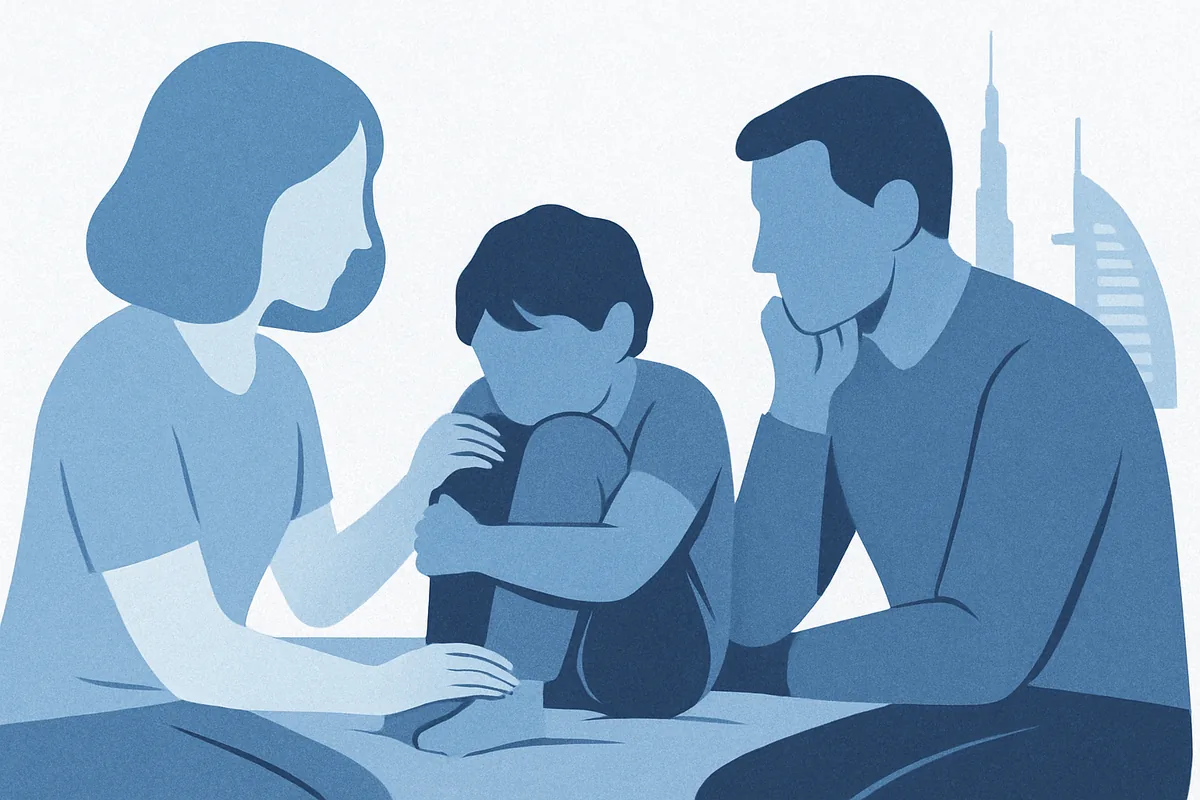
- Between 95 and 97% of parents of anxious children engage in at least one accommodating behaviour, such as answering repeated reassurance questions or avoiding anxiety-triggering situations on their child's behalf, according to Storch et al. (2015).
- Parental accommodation accounts for up to 50% of the association between child anxiety severity and functional impairment, making it one of the most clinically significant factors keeping anxiety locked in place.
- A randomised controlled trial published in 2019 found that a parent-only programme targeting accommodation reduction, known as SPACE, produced equivalent reductions in child anxiety as child-focused CBT, demonstrating that parenting behaviour is a primary lever for change.
- Approximately 28% of UAE adolescents meet diagnostic criteria for an anxiety disorder, more than three times the global pooled estimate of around 7%, with Dubai school-age children showing clinically significant symptoms at a rate of 18.4%.
- CBT-informed parenting strategies, including warm acknowledgement of fear without confirmation of danger and structured graduated exposure, produce measurable reductions in avoidance and anxiety frequency within 8 to 16 weeks when applied consistently.
With August approaching and a new school term less than six weeks away, many Dubai parents are already noticing it: the stomach complaints at bedtime, the questions that loop endlessly, the child who was fine in June and now isn't. Childhood anxiety peaks sharply around school transitions, and in Dubai, where academic pressure is high and expat family life brings its own particular stressors, the September return can feel like a countdown clock for families who know what's coming.
This article is specifically about parenting behaviour: what you do at home that genuinely helps your anxious child build resilience, and what the clinical evidence shows many parents are doing out of love that is, unfortunately, keeping anxiety in place. If you want to understand whether what your child is experiencing is anxiety or typical worry, or how child anxiety therapy works as a clinical process, those questions are addressed in separate resources. Here, the focus is on you, the parent, and the daily choices that shape your child's relationship with fear.
At CAYA World, we work with anxious children and their families every day. The clinical concept at the centre of that work is parent accommodation, and understanding it changes everything.
Why parenting an anxious child in Dubai feels so hard
Dubai is not an easy environment in which to raise a child with anxiety. The city's school system is intensely competitive. Exam performance, extracurricular achievement, and university placement carry enormous social weight, both for children and for the parents around them. Expat life adds layers that families in their home countries rarely face: frequent relocations, absence of extended family networks, children navigating friendships across cultures, and parents managing all of this while building a career in a demanding professional environment.
Population data reflects these pressures. A population-based study published in PMC found that approximately 28% of UAE adolescents meet diagnostic criteria for an anxiety disorder. The global pooled estimate for the same age group is around 7%. Dubai-specific prevalence data cited by DHA researchers puts clinically significant anxiety symptoms in school-age children at 18.4%, with rates highest in academically competitive school settings. These are not wellness-blog statistics. They are clinical findings, and they tell you something important: the environment your child is growing up in is genuinely harder in measurable ways.
That context matters because it explains why parenting an anxious child in Dubai is particularly exhausting. You are trying to help a child who is struggling, inside a system that doesn't slow down for struggling children. Every instinct you have as a parent says: protect them. Make it easier. Get them through today.
Those instincts are not wrong. They are rooted in love and in acute perception of your child's distress. The problem is that clinical research shows they can lock anxiety in place when they take a specific form. Understanding that form is the first step toward doing something different.
At CAYA World, we find that most parents arrive having already tried a range of strategies at home. Many are resourceful, well-read, and deeply committed. What they often haven't encountered is a clear explanation of why the most emotionally intuitive responses to their child's fear are the ones most likely to be counterproductive.
What is parent accommodation, and why it keeps anxiety alive
Parent accommodation is the clinical term for any parenting behaviour that helps a child avoid or escape the situations, feelings, or sensations that trigger their anxiety. It is not neglect. It is not bad parenting. It is, in most cases, the most caring response a parent can imagine in the moment. That is precisely what makes it so common and so difficult to change.
A study by Storch et al. (2015) found that between 95 and 97% of parents of clinically anxious children report engaging in at least one accommodating behaviour, with 97% of mothers and 88% of fathers reporting accommodation. Read that figure again: nearly every parent of an anxious child is doing this. It is the norm, not the exception, and it speaks to how powerful the pull toward accommodation is.
The mechanism that makes accommodation harmful is well understood. Anxiety is maintained by avoidance. When a child faces a feared situation and escapes it, their nervous system records: I got out, therefore I am safe. The threat signal is never corrected. The anxiety survives. When a parent facilitates that escape, they are, without intending to, confirming to the child's brain that the feared thing was genuinely dangerous and that escape was the right response.
A 2020 peer-reviewed study found that family accommodation mediates up to 50% of the association between child anxiety severity and functional impairment. In practical terms: half of the reason anxious children struggle at school, in friendships, and at home can be traced back to accommodation patterns, not to the anxiety itself. This is not a marginal factor. It is one of the most clinically significant levers in the entire picture.
Higher levels of accommodation also predict poorer response to treatment. A child who enters therapy for anxiety while accommodation at home remains unchanged tends to make slower progress than a child whose parents have shifted their behaviour alongside the clinical work. The Child Mind Institute's Children's Mental Health Report (2018) identified accommodation reduction as a primary clinical intervention target precisely because of this finding.
The goal of understanding accommodation is not to make parents feel guilty. It is to give you clinical information that most parents are never given, because without it, you cannot make a genuinely informed choice about how to respond to your child.
The most common accommodating behaviours Dubai parents recognise in themselves
Accommodation takes many forms. Some are obvious; others feel so natural that it takes a moment to recognise them as accommodation at all. We have grouped the most common patterns we see at CAYA World into three categories.
Reassurance provision
This is the most universal form of accommodation. Your child asks, "What if something bad happens on the school trip?" and you answer, "Nothing bad will happen, I promise." It feels like exactly the right thing to say. The problem is that within a few hours, your child asks again. Then again before bed. Then the following morning. Each answer you provide temporarily reduces their distress, which is why they keep asking. But the anxiety is not being processed. It is being managed by you, rather than by your child's own developing coping system. In clinical terms, you have become an external regulator for an internal state that needs to become self-regulated.
Avoidance and modification of family routines
This includes driving your child to school on days they say they cannot face the bus, skipping social events your child finds overwhelming, allowing a child who says they feel sick every Sunday night to stay home on Mondays, or changing family plans to prevent your child from encountering a feared situation. Each individual instance feels proportionate and kind. The cumulative effect is a child whose world is slowly being shaped around their anxiety rather than them being helped to move through it.
Participating in rituals and checking behaviours
In children with obsessive or health-related anxiety, accommodation often involves participating in rituals (checking the door with them, confirming that their hands are now clean enough) or providing specific scripted reassurances that the child insists upon. In separation anxiety, it may mean texting your child repeatedly during the school day to confirm you are alive. Again, each instance reduces their distress in the short term. Over time, it teaches them that they cannot tolerate the uncertainty without your help.
At CAYA World, we never ask parents to stop accommodating overnight. The clinical approach is gradual, planned, and always developed collaboratively. What matters first is recognising the pattern.
What actually helps when parenting an anxious child
The CBT-informed parenting approach replaces accommodation with a set of specific behaviours. These are not vague encouragements. They are concrete, learnable responses that change what your child's nervous system learns from each anxiety-triggering situation.
Acknowledge the feeling without confirming the threat
There is a critical difference between validating your child's emotional experience and validating their threat appraisal. "I can hear that you are scared right now. That makes sense" is validation. "You're right to worry, the test could go badly" confirms the threat and amplifies the anxiety. "Nothing bad will happen" is a factual claim you cannot guarantee, and your child knows this at some level, which is why they keep asking. The more effective response names the feeling explicitly, communicates that you believe they can handle it, and does not offer a certainty you do not possess. "That feels really scary. And I know you can do hard things" is a short, complete response that validates without accommodating.
Model tolerance of uncertainty
Children regulate their anxiety in part by reading their parent's nervous system. When a parent becomes visibly anxious about a child's anxiety, the child receives a secondary signal: this must be genuinely dangerous, because my parent is worried too. Practising calm, matter-of-fact responses to your child's fear, even when you feel worried internally, is one of the highest-impact things you can do. This is not about suppressing your feelings. It is about learning to present a regulated signal in the moments your child needs one.
Replace open-ended reassurance with time-limited check-ins
If your child asks the same reassurance question repeatedly, a structured response can interrupt the loop. Agree on a specific time to talk about their worry (after dinner, not at bedtime), and gently redirect them to that agreed time when they raise it before. This is not dismissal. It is a structured approach to teaching your child that the worry can wait, a skill anxiety actively undermines.
Our parenting therapy and support service at CAYA World walks parents through these strategies in structured sessions, with role-play and real-time coaching, because reading about them and implementing them under pressure are two very different experiences. If you're finding that these approaches feel difficult to put into practice at home, a brief consultation can help you identify specifically where the pattern is getting stuck.
Wondering if It's Time to Talk to Someone?
Our specialist team at CAYA World offers comprehensive assessment and evidence-based treatment, conducted from our clinic in Palm Jumeirah, Dubai.
Graduated exposure: the evidence-based approach anxious children need from parents
Graduated exposure is the core mechanism by which anxiety is reduced in evidence-based treatment. It involves deliberately and systematically facing feared situations in a planned, step-by-step sequence, starting with situations that provoke mild anxiety and progressing toward situations that provoke more. The key word is graduated. This is not flooding. It is not telling a child to face their worst fear immediately. It is a structured climb, built on success at each rung.
Parents play an indispensable role in this process at home, particularly for younger children. The clinical evidence for this is strong. A randomised controlled trial published in 2019 tested the Supportive Parenting for Anxious Childhood Emotions programme, known as SPACE, a parent-only treatment designed to reduce accommodation and support graduated approach. The programme produced reductions in child anxiety equivalent to child-focused CBT, without the child being the direct target of treatment at all. This finding underscores something clinicians have long understood: parenting behaviour is not a side factor in child anxiety. It is a central treatment target.
You do not need to implement a formal exposure protocol independently at home. In fact, doing so without guidance can sometimes backfire if the hierarchy is poorly constructed or if the child does not have the coping tools to manage their distress during exposure. But you can start with the underlying principle: gently and consistently encouraging your child toward situations they find difficult, rather than away from them.
Building an exposure ladder at home
A simple version of an exposure ladder involves identifying a specific anxiety (school drop-off, for instance) and listing the steps that would lead, gradually, toward the feared endpoint. Step one might be arriving at the school gate together. Step two, walking to the classroom door. Step three, going in independently while you wait outside for two minutes. Step four, you leave after a quick goodbye at the classroom. Each step is practised until the anxiety has reduced by at least half before the next step is attempted. Progress is praised specifically, not generically. "You walked into school today even though it felt scary" lands differently than "you did great."
What to do when your child refuses
Refusal is expected. It is part of the process, not a signal that the approach is wrong. The clinical guidance is to hold the plan calmly, acknowledge the distress, and not negotiate away the target step entirely. Offering a small modification (staying for two minutes rather than five) is different from abandoning the exposure. Consistency across days matters more than perfection on any single day.
At CAYA World, parents who are working on graduated exposure with their children can check in between sessions to troubleshoot refusals in real time. The goal is to help parents feel confident enough in the approach that they can hold it under pressure, because the moments when a child is most distressed are exactly the moments when accommodation is most tempting.
When parenting strategies aren't enough: seeking professional support in Dubai
Most anxious children benefit when their parents shift from accommodation toward the strategies described above. Some children need more than this. Knowing when to bring in a professional is not a parenting failure. It is accurate clinical judgment.
A referral to a child psychologist is appropriate when:
- Your child's anxiety has been present for more than four weeks and is not responding to changes in your parenting approach.
- The anxiety is causing significant impairment at school, in friendships, or in family life, meaning it is not just uncomfortable but functionally limiting.
- Your child is refusing school, not eating, having panic attacks, or engaging in repetitive checking or avoidance rituals that are escalating in frequency.
- Your child is describing intrusive thoughts, expressing hopelessness, or saying they want to hurt themselves.
- You are finding it impossible to reduce accommodation despite understanding why it matters, often because the emotional pull is too strong to manage alone.
That last point is important and often underdiscussed. Parents are not outside the system. You have your own history with anxiety, your own nervous system, and your own pain in watching your child suffer. A clinical psychologist working with an anxious child almost always works with the parents in parallel, because the parenting shift is genuinely hard and deserves structured professional support, not just a reading list.
The Dubai Health Authority's 2025 Standards for Mental Health Services explicitly mandate that care plans for children with anxiety must include both CBT and family involvement, recognising that parent coaching is a core treatment ingredient, not an optional add-on. This reflects the same clinical evidence base described throughout this article.
For children who need structured anxiety therapy, CAYA World offers evidence-based assessment and CBT-based treatment delivered by our clinical team in Palm Jumeirah. Our approach always includes a parent component, because we know from the research that it makes outcomes substantially better.
If your child's anxiety is predominantly school-linked, our team has specific experience with the pressures of Dubai's school environment, both within the KHDA-regulated system and in the international school sector. We work collaboratively with schools where appropriate, and we are familiar with the particular stressors of expat family life that Dubai parents navigate.
If you're not yet sure whether what your child is experiencing warrants a formal assessment, the article on distinguishing childhood anxiety from typical worry gives a practical framework for making that call. And if you've read this far and recognise yourself in the accommodation patterns described above, that recognition is useful clinical information, not a reason for self-blame. You now know something that 95% of parents of anxious children were never told.
If you are in Dubai and you are watching a child you love struggle with anxiety, our team at CAYA World can help you figure out the right next step. A brief intake conversation over WhatsApp or phone costs nothing and carries no commitment. It is simply a way to understand your situation more clearly.
Frequently Asked Questions About Parenting an Anxious Child in Dubai
In the short term, yes, it often does. When accommodation is reduced, anxiety typically spikes briefly before it begins to fall. This is the expected pattern, not a sign that the approach is wrong. The spike happens because the child's distress is no longer being managed externally. What follows, when the child learns that they can tolerate the discomfort without the feared outcome occurring, is a genuine, experience-based reduction in anxiety. The goal is not to remove discomfort immediately but to help your child learn, through repeated experience, that they can handle it. Doing this gradually and with warm, consistent support significantly reduces the spike.
The clinical distinction is whether your response helps your child approach a feared situation or helps them avoid it. Validating your child's feelings, sitting with them while they are distressed, and helping them identify coping strategies are all forms of support that do not constitute accommodation. Answering reassurance questions that your child asks repeatedly, making decisions that reshape family life around what your child will and won't tolerate, and allowing avoidance of situations they could safely face are forms of accommodation. The question to ask yourself is: does what I am doing help my child engage with what they fear, or help them escape it?
This is one of the most common dilemmas we hear at CAYA World. Collecting your child each time the school calls reinforces both the school's response and your child's escape from the anxiety-triggering environment. Where possible, work with the school counsellor to develop a plan that allows your child to remain at school with graduated support, rather than being collected as the default response. This involves specific agreements about what the school will do when your child reports distress, and clear communication that early collection is reserved for genuine physical illness, not anxiety. A psychologist can support you in having that conversation with the school.
Graduated exposure can begin as early as four or five years old, though the language used and the structure of the hierarchy need to match the child's developmental stage. With younger children, the exposure is typically embedded in play and led almost entirely by the parent, with the psychologist coaching the parent on how to structure it. Older children and adolescents can be much more actively involved in identifying their fear hierarchy and tracking their own progress. There is no upper age limit. Adults use graduated exposure in therapy too. The principle is universal; the implementation is age-matched.
If your child's anxiety has been significantly affecting their daily life, school attendance, friendships, or sleep for more than four weeks, a clinical assessment is appropriate. You do not need to exhaust all parenting strategies first. Seeking support earlier produces better outcomes than waiting until the anxiety is entrenched. If you have already made changes to your accommodation patterns and are not seeing any shift after four to six weeks of consistent effort, that is also a clear signal that the child needs direct clinical support alongside the parenting changes. Getting a psychologist involved does not mean handing the problem over. It means adding clinical expertise to what you are already doing.
Sources and Further Reading
- Family accommodation of child and adolescent anxiety: Prevalence, consequences, and treatment implicationsStorch et al., Journal of Child and Adolescent Psychopharmacology (2015)
- Family accommodation mediates the association between anxiety severity and functional impairment in children with anxiety disordersPeer-reviewed study, PMC (2020)
- Randomised controlled trial of SPACE: A parent-based treatment for child anxietyLebowitz et al., Journal of the American Academy of Child and Adolescent Psychiatry (2019)
- Prevalence of anxiety disorders among adolescents in the UAE: a population-based studyPMC (2020)
- Children's Mental Health Report. Child Mind Institute (2018)
- Standards for Mental Health Services 2025. Dubai Health Authority
- DHA-referenced prevalence data on clinically significant anxiety in Dubai school-age children. Dubai Health Authority (2023)