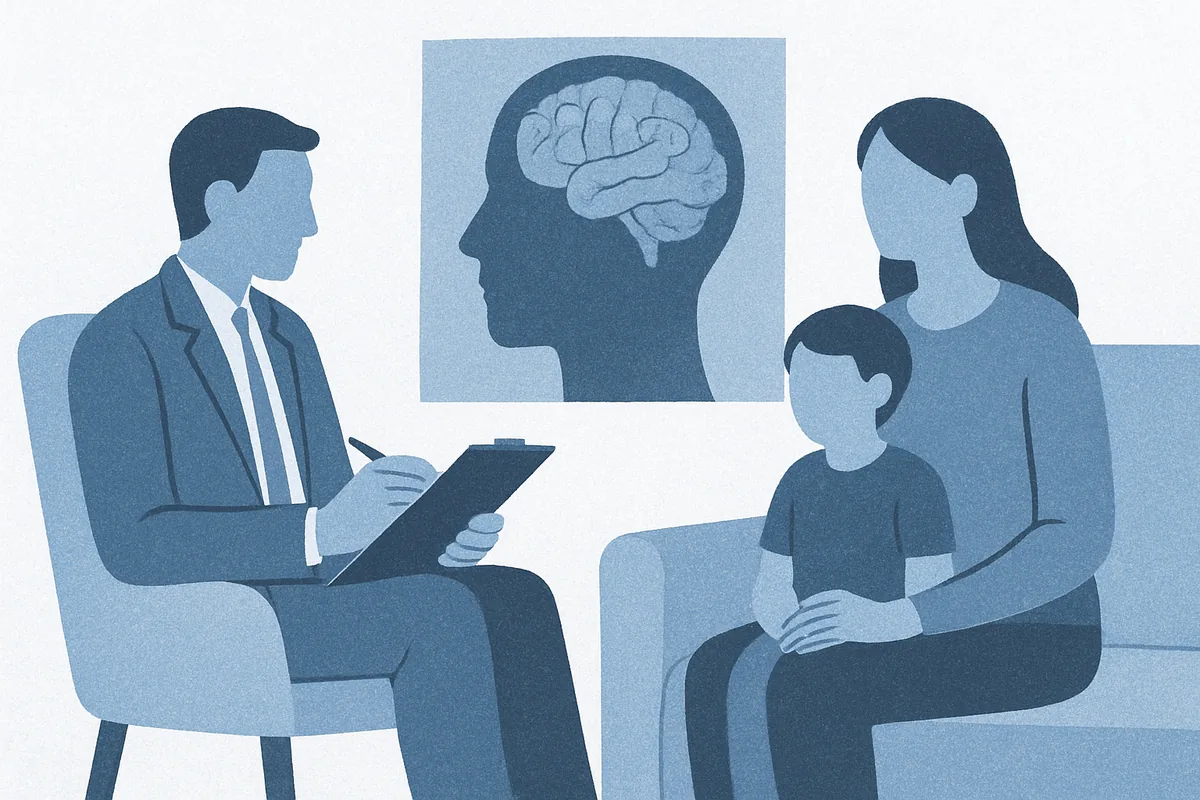
- A neuropsychological assessment evaluates a broader range of cognitive functions than a psychoeducational assessment: where psychoeducational testing focuses on learning ability and academic skill, neuropsychological assessment maps memory, executive function, processing speed, language, and visuospatial ability to identify brain-behaviour relationships tied to medical or neurological causes.
- Key clinical indications for neuropsychological assessment include suspected mild cognitive impairment, post-COVID brain fog (affecting approximately 25% of long COVID patients at 3+ months post-infection), traumatic brain injury follow-up, pre-surgical cognitive baseline, and complex presentations where a standard psychoeducational report has been inconclusive.
- A 2024 UAE cohort study found that 48.7% of 533 patients developed long COVID, with 46.6% still reporting persistent symptoms beyond one year, making post-COVID cognitive referral one of the most common drivers of neuropsychological assessment referrals in Dubai at present.
- Reports from neuropsychological assessments conducted by DHA-licensed clinical psychologists are accepted by Dubai schools under KHDA oversight as the basis for educational accommodations, including extra time and learning support plans.
- At CAYA World, neuropsychological assessments typically span two to four sessions and result in a detailed written report covering diagnosis, cognitive profile, and specific recommendations for schools, treating physicians, or workplace accommodations.
Most parents and adults in Dubai who seek psychological testing have heard of psychoeducational assessment: the structured process that examines how a child learns, where their academic skills sit relative to their cognitive ability, and whether conditions such as ADHD or dyslexia explain their difficulties at school. What far fewer people know is when that process is not enough, and when a full neuropsychological assessment is the appropriate next step. The short answer: psychoeducational testing asks "how does this person learn?"; a neuropsychological assessment asks "how is this person's brain functioning, and why?" If you have already read about psychoeducational testing at CAYA World and are wondering whether your situation calls for something more comprehensive, this article is written specifically for that question.
What is a neuropsychological assessment?
A neuropsychological assessment is a structured clinical evaluation that uses standardised psychometric tests to characterise the full range of a person's cognitive abilities. It examines how different brain systems are working: attention and concentration, learning and memory, language processing, executive functions such as planning and inhibition, processing speed, and visuospatial skills. The aim is not simply to produce a score. The aim is to build a profile of cognitive strengths and weaknesses that can be linked to a clinical presentation, a medical event, or a developmental pattern, and to use that profile to guide diagnosis and treatment.
Neuropsychological assessments are conducted by clinical psychologists with specialist training in brain-behaviour relationships. At CAYA World, Dr. Nour Al Ghriwati and our clinical team carry out evaluations for children, adolescents, and adults, drawing on internationally validated test batteries and interpreting results within Dubai's multilingual, multicultural context. That last point matters more than it might seem: a test normed exclusively on a monolingual English-speaking population can produce misleading results when applied to an Arabic-English bilingual child or an adult who completed their education in a language other than the one being tested. Selecting the right tools and applying culturally sensitive interpretation is a core skill in this work.
In clinical practice, neuropsychological assessment sits at the intersection of psychology, neurology, and psychiatry. It does not diagnose neurological conditions such as a tumour or a lesion on its own; that requires neuroimaging. What it does is characterise the functional impact of brain conditions on cognition and behaviour, and it can identify cognitive change that precedes, or runs alongside, a neurological or medical diagnosis. When a neurologist, a rehabilitation physician, or a psychiatrist wants to know how a patient's brain is actually performing across cognitive domains, a neuropsychological evaluation is the tool they reach for.
Neuropsychological assessment vs psychoeducational assessment: what is the difference?
This is the question that prompts most referrals to our clinic, and it deserves a precise answer rather than a reassuring one. Both assessments use cognitive testing. Both produce written reports. Both can inform school accommodations. They are not, however, interchangeable, and choosing the wrong one means getting the wrong answer to the wrong question.
Psychoeducational assessment is designed to evaluate learning ability in the context of academic performance. It typically combines measures of intellectual ability (IQ testing, often using the WISC-V for children or the WAIS-IV/WAIS-V for adults) with standardised achievement tests that measure reading, writing, and mathematics. The central question is whether a gap exists between a person's cognitive potential and their actual academic skill, and whether that gap is explained by a learning disability, ADHD, or another neurodevelopmental condition. It is the correct first-line assessment for a child struggling at school whose teacher or school counsellor has flagged learning concerns. If you are at the beginning of that process, our article on cognitive assessment for children in Dubai sets out what to expect.
Neuropsychological assessment casts a wider net. It includes the cognitive testing that psychoeducational assessment uses, but extends beyond it to evaluate multiple cognitive domains in greater depth, particularly those affected by medical conditions, neurological events, or acquired injury. Where a psychoeducational assessment might flag that a child has a working memory deficit consistent with ADHD, a neuropsychological assessment would characterise that working memory deficit in detail: how it compares across verbal and visual modalities, how it interacts with processing speed and executive function, and how the overall pattern fits a particular clinical picture. When a diagnosis is already known and the question is "what is the cognitive impact?", or when an initial psychoeducational report has returned an inconclusive or complex profile, neuropsychological assessment is the appropriate next step.
A useful rule of thumb: if the primary concern is school performance and there is no known medical or neurological history, a psychoeducational assessment is usually the right starting point. If there is a medical history relevant to brain function, the concern involves an adult, or a previous assessment has not adequately explained what is observed clinically, a neuropsychological evaluation is indicated. Our clinical team at CAYA World can help you determine which path is appropriate during an initial intake conversation.
What does a neuropsychological assessment measure in Dubai?
Neuropsychological assessment maps cognition across multiple domains. The specific domains evaluated depend on the referral question: a post-COVID assessment prioritises attention, processing speed, and memory; a pre-surgical baseline covers the full cognitive spectrum; a dementia screen centres on memory encoding and executive function. Below are the core domains that form the backbone of most adult and paediatric batteries.
| Cognitive Domain | What it assesses | Common clinical relevance |
|---|---|---|
| Intellectual ability (IQ) | General cognitive capacity across verbal, perceptual, and fluid reasoning | Baseline reference for interpreting all other domain scores |
| Attention and concentration | Sustained, selective, divided, and alternating attention | ADHD, TBI, post-COVID brain fog, anxiety disorders |
| Learning and memory | Encoding, retention, and retrieval of verbal and visual information | MCI, early dementia, TBI, depression |
| Executive functions | Planning, cognitive flexibility, inhibition, working memory, problem-solving | ADHD, frontal-lobe injury, autism spectrum conditions |
| Language and verbal ability | Naming, fluency, comprehension, repetition | Left-hemisphere injury, aphasia, language-based learning disabilities |
| Visuospatial and visuoconstructional skills | Spatial perception, visual organisation, figure reproduction | Right-hemisphere injury, Alzheimer's, Parkinson's disease |
| Processing speed | Rate at which simple cognitive tasks are completed accurately | TBI, depression, multiple sclerosis, ageing |
| Sensorimotor functions | Fine motor speed, grip strength, laterality | Stroke, TBI, Parkinson's disease |
At CAYA World, we select the specific tests within each domain based on the referral question, the client's age, their language background, and what prior clinical information is available. This means a neuropsychological assessment is not a fixed checklist. It is a clinician-guided selection process, and the interpretation of any individual score depends on how it sits within the full profile.
Social-emotional and behavioural functioning are also routinely assessed as part of the process, through structured rating scales completed by the client, parents, or teachers. Cognitive performance does not exist independently of mood: moderate-to-severe depression reliably suppresses processing speed and memory retrieval in ways that can mimic early cognitive impairment if mood state is not accounted for.
Who needs a neuropsychological assessment? Key referral indications
Not every concern about memory, attention, or learning requires a neuropsychological evaluation. But several clinical situations do, and knowing them can save months of diagnostic uncertainty.
Post-COVID cognitive concerns ("brain fog"). This is, at present, one of the most frequent drivers of neuropsychological referral in Dubai. A 2024 UAE cohort study found that long COVID affected 48.7% of 533 patients, with 46.6% still reporting persistent symptoms beyond one year post-infection, including cognitive complaints such as difficulty concentrating, word-finding problems, and short-term memory lapses (Al Ramahi et al., PMC, 2024). A meta-analysis published in 2025 found that the pooled prevalence of cognitive impairment in long COVID is approximately 25% at three or more months post-infection, with brain fog reported by around 30% of patients across studies (PubMed meta-analysis, 2025). A neuropsychological assessment provides an objective characterisation of which cognitive domains are affected and to what degree, which is essential for clinical management and for supporting workplace or academic accommodations.
Traumatic brain injury (TBI). Research indicates that approximately 65% of patients with moderate-to-severe TBI experience long-term cognitive problems, and up to 15% of mild TBI patients report persistent deficits (PMC, 2014). Neuropsychological assessment is used at multiple stages of TBI management: acutely to establish a post-injury baseline, during rehabilitation to track recovery, and later to characterise residual impairments that affect daily function, work, or school.
Memory concerns and suspected mild cognitive impairment (MCI). Mild cognitive impairment affects approximately 23.7% of adults aged 65 and older globally, based on a 2024 meta-analysis (PMC, 2024). In the UAE, dementia prevalence is estimated at 4.09% among people aged 60 and above (PMC Arab-world review, 2023), and 1,285 Emiratis were formally diagnosed with Alzheimer's disease in Abu Dhabi alone in 2024. When a person or their family notices memory decline, word-finding difficulty, or changes in daily functioning, neuropsychological assessment can determine whether the pattern is consistent with normal ageing, MCI, or an early dementia syndrome, and can establish a cognitive baseline for monitoring change over time.
Pre-surgical cognitive baseline. Before certain neurosurgical procedures, particularly those involving the temporal or frontal lobes, neuropsychologists conduct baseline assessments so that post-surgical cognitive function can be measured against a pre-operative reference point.
Complex or inconclusive psychoeducational results. When a child or adolescent has already completed a psychoeducational assessment but the results have not explained the observed difficulties, or when the profile is atypical and does not fit cleanly into ADHD or learning disability categories, a neuropsychological evaluation provides the additional domain coverage needed to reach a clearer formulation.
Adult ADHD with complex presentation. When an adult presents with attention and executive function concerns alongside a history of head injury, significant anxiety or depression, or possible learning disability, a full neuropsychological battery is preferable to a standard ADHD-focused assessment. It allows the clinician to disentangle overlapping contributions from multiple sources.
Wondering if It's Time to Talk to Someone?
Our specialist team at CAYA World offers comprehensive assessment and evidence-based treatment, conducted from our clinic in Palm Jumeirah, Dubai.
What tools and tests are used in a neuropsychological assessment?
The battery selected for any neuropsychological assessment depends on the referral question, the client's age, and their language and cultural background. That said, several internationally validated instruments appear consistently across paediatric and adult evaluations.
For intellectual ability, the Wechsler scales are the most widely used: the WISC-V (Wechsler Intelligence Scale for Children, Fifth Edition) for children aged 6 to 16, and the WAIS-IV or WAIS-V (Wechsler Adult Intelligence Scale) for adolescents aged 16 and above and adults. These produce an overall Full Scale IQ alongside composite scores for verbal comprehension, visual-spatial ability, fluid reasoning, working memory, and processing speed.
Memory is assessed using instruments such as the Wechsler Memory Scale (WMS-IV), the California Verbal Learning Test (CVLT-3), or the Rey Auditory Verbal Learning Test (RAVLT). These capture not only how much material a person recalls but how they encode, consolidate, and retrieve it over time, distinctions that are clinically meaningful when differentiating between ADHD-related memory difficulties and early dementia.
Executive function is assessed through batteries such as the Delis-Kaplan Executive Function System (D-KEFS), which covers verbal fluency, concept formation, inhibition, and cognitive flexibility across multiple subtests. For adult cognitive screening, instruments such as the Montreal Cognitive Assessment (MoCA) and the Repeatable Battery for the Assessment of Neuropsychological Status (RBANS) provide efficient domain coverage and are sensitive to the early cognitive changes associated with MCI and dementia.
Attention is assessed both through performance measures (such as continuous performance tests, where the person must respond to specific targets over a sustained period) and through clinician-rated and self-rated scales. The combination is important: rated scales capture real-world functional impact, while performance measures provide an objective record that is not subject to recall bias.
Our process at CAYA World follows the assessment framework described in detail in our article on the child psychological assessment process in Dubai: an initial intake session to gather history and clarify the referral question, one to three standardised testing sessions depending on the battery required, and a feedback session at which the clinician walks the client and their family through the results and report findings in plain terms.
What does a neuropsychological assessment report include, and how is it used in Dubai?
A neuropsychological report is a clinical document, not a score printout. When done properly, it tells a coherent story about a person's cognitive functioning: where they perform well relative to expectations, where significant weaknesses exist, and how the overall pattern relates to their presenting concerns and clinical history.
The structure of the report typically covers: background and referral reason; relevant medical, developmental, and educational history; behavioural observations during testing; test results by domain (presented both as scores and as clinical interpretation); a diagnostic formulation where warranted; and a section of specific, actionable recommendations. That last section is the most practically important part of the document for families, schools, and referring clinicians.
In the Dubai context, reports from DHA-licensed clinical psychologists are accepted by schools operating under KHDA oversight as the basis for educational accommodations. These can include extended time on examinations, rest breaks, reduced distraction settings, or the development of an Individual Education Plan (IEP). The report must clearly state the clinical basis for each recommendation, the tests used, and the clinician's licence details. Our team at CAYA World ensures that every report meets the documentation standards expected by Dubai schools and by referring DHA-licensed practitioners.
For adult clients, the report serves a different set of downstream uses. A post-COVID or TBI report is typically shared with the client's neurologist, psychiatrist, or rehabilitation physician and forms the basis for a treatment or management plan. A dementia-screening report may inform decisions about driving, independent living, or legal capacity. An adult ADHD report with neuropsychological depth is accepted by employers and higher-education institutions as the clinical basis for workplace or academic accommodations.
One point worth emphasising: a neuropsychological report is a living document in the sense that findings can and should be revisited. If a client completes a rehabilitation programme, their medication changes, or a significant period of time passes, a follow-up assessment allows the clinician to measure cognitive change against the original baseline. This is particularly relevant for TBI recovery and for monitoring MCI over time.
For clients whose concerns centre specifically on learning and academic performance, our psychoeducational testing service in Dubai offers a streamlined pathway designed around school-based referral questions. Both psychoeducational and neuropsychological assessments are conducted by our clinical team at CAYA World, and we can help you determine which approach fits your situation before any testing begins.
Frequently Asked Questions About Neuropsychological Assessment in Dubai
Psychoeducational testing focuses on the relationship between cognitive ability and academic achievement, and is designed to identify learning disabilities, ADHD, and related conditions that affect school performance. A neuropsychological assessment covers those areas but extends significantly further: it evaluates memory encoding and retrieval, executive function depth, language processing, visuospatial skills, and processing speed in ways that are sensitive to neurological and medical causes of cognitive difficulty. If the school is flagging learning concerns with no known medical history, psychoeducational testing is usually the right first step. If there is a medical or neurological history, or if a previous psychoeducational report returned an inconclusive profile, a neuropsychological evaluation is more appropriate.
Yes. A cognitive baseline assessment after COVID illness is a type of neuropsychological evaluation specifically designed to characterise the cognitive domains affected by post-COVID syndrome and to document the severity of any impairment. Research published in 2025 found that approximately 25% of long COVID patients show measurable cognitive impairment at three or more months post-infection, with brain fog reported by around 30% across studies. A baseline assessment gives your treating physician an objective profile of where your cognition currently sits, which is essential for monitoring recovery and for supporting any workplace or educational accommodations you may need during that time.
A full neuropsychological assessment at CAYA World typically spans two to four sessions across two to three weeks. The first session is an intake interview: the clinician gathers developmental, medical, and educational history, clarifies the referral question, and selects the appropriate battery. Testing sessions last two to three hours each, with breaks built in, and involve a mix of verbal, paper-based, and computerised tasks. After scoring and interpretation, a feedback session walks the client and, where relevant, their family through the report findings and recommendations. The total time from first session to report delivery is usually two to four weeks, depending on the complexity of the battery.
Insurance coverage for neuropsychological assessment in Dubai varies considerably by insurer, plan tier, and the clinical indication on the referral. Some plans cover psychological assessment when referred by a licensed physician, particularly when the indication is a medical condition such as TBI or post-COVID syndrome. Others require pre-authorisation. We recommend contacting your insurer directly before booking to confirm coverage under your specific plan. Our administrative team at CAYA World can assist with the documentation insurers typically require to process a pre-authorisation request for a clinical assessment.
Yes. Reports from DHA-licensed clinical psychologists are accepted by Dubai schools operating under KHDA oversight as the clinical basis for educational accommodations, including extended time on examinations, rest breaks, reduced-distraction exam settings, and Individual Education Plans (IEPs). The report must clearly document the tests administered, the clinician's licensing details, and specific recommendations tied to the assessment findings. At CAYA World, we write our reports with school submission in mind: the recommendations section is explicit, actionable, and cross-referenced to the test data that supports it, so school counsellors and learning support coordinators can action the findings directly.
Sources and Further Reading
- Long COVID in a UAE cohort: persistent symptoms and cognitive complaintsAl Ramahi et al., PMC (2024)
- Pooled prevalence of cognitive impairment and brain fog in long COVIDPubMed meta-analysis (2025)
- Global prevalence of mild cognitive impairment in adults aged 65+: meta-analysisPMC (2024)
- Dementia prevalence in the Arab world including UAE estimatesPMC Arab-world review (2023)
- Alzheimer's disease diagnoses in Abu Dhabi, 2024Economist Impact / PMC (2024-2025)
- Long-term cognitive outcomes following traumatic brain injuryPMC (2014)
- Dementia: global epidemiology and neuropsychological approaches to diagnosisPMC neuropsychology review (2022)