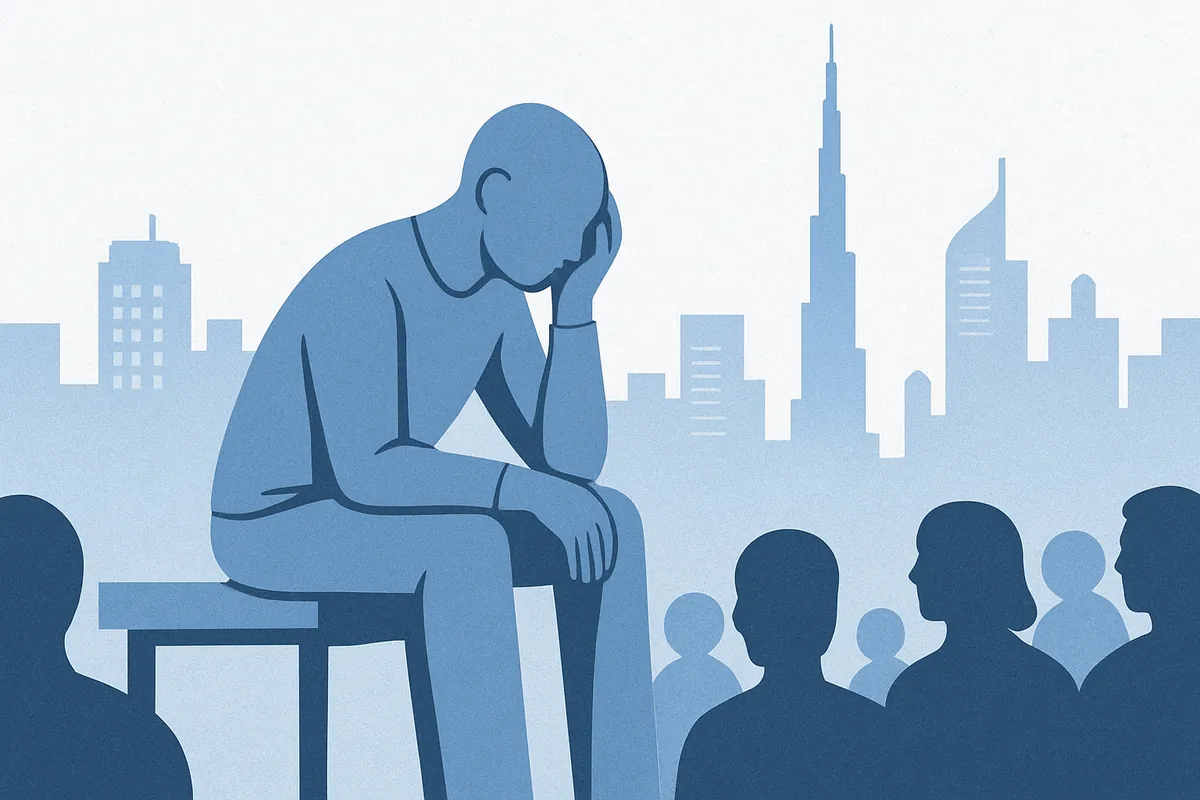
- A 2024 Gallup-linked UAE workplace report found that 26% of UAE employees felt lonely daily, a rate that exceeds many Western comparators and falls disproportionately on non-Emiratis and private-sector workers.
- Loneliness is clinically defined as the distressing gap between the social connection a person has and the connection they want, meaning a packed social calendar does not protect against it.
- Loneliness and depression are bidirectional: loneliness predicts later depressive episodes, and depression deepens perceived isolation, meaning each condition amplifies the other if left unaddressed.
- The U.S. Surgeon General's 2023 advisory quantifies the physical health risk of chronic social disconnection as equivalent to smoking 15 cigarettes per day, including elevated risk of heart disease, stroke, and dementia.
- Cognitive behavioural therapy addresses the negative thought patterns that sustain loneliness, such as social threat appraisal and withdrawal behaviours, and is the evidence-based first-line approach when loneliness has become persistent or has shifted into clinical depression or anxiety.
The loneliness expat Dubai mental health paradox is genuinely strange to live inside. You have WhatsApp groups for every social occasion. You have colleagues, brunches, gym classes, and networking events. You are, by most external measures, surrounded. And yet, lying awake at 2 a.m. in an apartment that still doesn't quite feel like home, the ache of genuine isolation is impossible to argue away. According to a 2024 UAE workplace wellbeing report compiled using Gallup methodology, 26% of UAE employees reported feeling lonely every single day. That is not a niche complaint. It is one in four people around you.
This article is not a logistics guide to making friends in Dubai, and it is not a list of apps to download. It is a clinical explanation of why loneliness happens the way it does in this particular city, how it progresses into depression and anxiety if ignored, and what the evidence actually says about what helps. At CAYA World, we see this pattern consistently in the adults and families who come to us: people who arrived in Dubai full of energy, who built a life here by every visible metric, and who find themselves quietly falling apart in ways they can't easily name to anyone around them.
Why is loneliness so common among expats in Dubai?
Expatriates make up approximately 88 to 89 percent of the UAE's population. That figure is remarkable, and its consequences for social life are profound. When almost everyone around you is also a newcomer, almost everyone is also managing the same fragile social arithmetic: building connections from scratch, knowing those connections may dissolve the moment someone's visa situation changes or a company relocates. The structural transience of expat life in Dubai is not incidental to loneliness. It is one of its primary engines.
Friendships here carry an invisible expiry date. You invest weeks and months getting to know someone well enough to call them a real friend, and then they leave. Or you leave. This cycle, repeated over years, does something specific to the psychology of social investment. Many long-term Dubai residents describe a gradual reluctance to invest deeply in new relationships, because the ROI keeps turning negative. The defences that protect you from repeated loss also prevent you from forming the kind of connection that actually resolves loneliness.
Layered on top of that is what might be called the Dubai social performance culture. The city is not short of social events. But a great many of those events reward surface-level presentation over genuine self-disclosure. Talking about salary, real estate, holidays, and career moves is easy. Talking about missing your mother, feeling like an outsider, or questioning whether you made the right choice in coming here is considerably harder. The social scripts available in Dubai's expat networking culture are largely aspirational and achievement-oriented, which leaves relatively little oxygen for the kind of honest, mutual vulnerability that builds lasting connection.
The Abu Dhabi Quality of Life Study, which surveyed 65,203 UAE adults, found that non-Emiratis, people aged 15 to 29, women, and private-sector employees all reported significantly higher loneliness and emotional distress than their Emirati counterparts. These groups represent the majority of Dubai's working expat population. The data confirms what many residents feel but rarely say aloud: loneliness here is not a personal failure. It is a predictable outcome of the environment.
What is loneliness, really? The clinical definition that expats in Dubai need to understand
Loneliness is not the same as being alone. Solitude can be restorative; loneliness is distressing. The clinical definition, developed across decades of research including the landmark work of John Cacioppo at the University of Chicago, frames loneliness as the aversive experience of a gap between the social connection a person has and the connection they desire. That gap is subjective and cognitive, not purely circumstantial. A person can be surrounded by people and still lonely if none of those connections feel meaningful, reciprocal, or safe enough for genuine self-disclosure.
This matters enormously for expats in Dubai, because it punctures the assumption that social busyness is a remedy. Being busy is not the same as being connected. Attending a rooftop gathering with forty people you know superficially does not close the gap that loneliness is measuring. The gap it measures is the distance between the connection you have and the connection you need, and surface-level social contact often leaves that gap exactly where it was.
Researchers distinguish between two components of loneliness that present differently and require different responses. Social loneliness is the absence of a social network: feeling like you don't have enough people in your life. Emotional loneliness is the absence of intimate connection: feeling like none of the people in your life truly know or understand you. Many Dubai expats report high levels of social busyness alongside acute emotional loneliness, which is precisely why standard advice to "put yourself out there more" often fails to help. They are already out there. The problem is depth, not quantity.
The World Health Organization estimates that approximately 1 in 6 people globally (16%) experience loneliness, with rates of 17 to 21% among people aged 13 to 29. Dubai's expat demographic skews heavily toward that younger adult age band, and the structural factors described above amplify baseline rates considerably. At CAYA World, the loneliness presentations we see most often involve people who have been in Dubai for one to three years: long enough for the novelty to have worn off, but not long enough to have built the kind of deep roots that buffer against isolation.
How loneliness differs from homesickness, and why the distinction matters
Loneliness and homesickness overlap, but treating them as the same thing leads to strategies that help one and miss the other entirely. Homesickness is fundamentally about loss and displacement: the yearning for a specific place, set of relationships, and sense of belonging that existed before migration. It tends to be most acute in the first six to twelve months after arrival, it often diminishes with time as the new environment becomes more familiar, and it responds well to increasing contact with home (video calls, visits, maintaining rituals from the place you came from).
Loneliness, by contrast, is not resolved by contact with the old life. A person who is deeply lonely in Dubai can speak to family back home every day and still feel the ache of disconnection. That is because loneliness is measuring the quality of present-tense connection in the environment where you are living now. Calling home meets a different need. It soothes the loss, but it does not build the here-and-now relational depth that loneliness requires.
The confusion between the two states leads many expats to focus exclusively on maintaining their home-country relationships as a solution to what is actually a loneliness problem requiring local investment. That investment feels risky in Dubai's transient environment, which is precisely why so many people stay stuck: the solution to the problem (deeper local connection) feels too costly given the environment's impermanence. Recognising whether you are primarily experiencing homesickness, loneliness, or both is genuinely useful clinically, because it focuses intervention where it will actually work. At CAYA World, our team's initial conversations with clients often include exactly this kind of differentiation, before any formal treatment planning begins.
How loneliness progresses to depression and anxiety: the clinical pathway
Loneliness does not stay still. Left unaddressed over months, it tends to move along a predictable clinical pathway that many expats don't recognise until they are well inside it. The progression is neither inevitable nor irreversible, but understanding it explains why acting early matters.
The first stage involves what researchers call social threat appraisal: the brain of a chronically lonely person begins to interpret ambiguous social signals as threatening or rejecting. A colleague who doesn't reply quickly to a message feels like a snub. Being left out of an invitation feels like confirmation of unworthiness rather than simple scheduling. This perceptual shift is not irrational or dramatic. It is a well-documented cognitive adaptation to chronic social pain, but it creates a self-reinforcing cycle: perceived threat leads to withdrawal, withdrawal reduces opportunities for connection, and reduced connection deepens the loneliness.
As this cycle continues, the overlap with clinical depression becomes significant. A peer-reviewed 2021 review in PMC confirmed that loneliness and depression are bidirectional: loneliness predicts later depressive episodes, and depression deepens the subjective experience of loneliness. Each condition amplifies the other. Sleep deteriorates. Motivation to initiate social contact drops. Activities that once felt enjoyable start to feel effortful. The person who was once energetic and socially engaged finds themselves declining invitations, spending increasing time alone, and telling themselves that the social contact wouldn't have been meaningful anyway.
Anxiety is a parallel track. Prolonged social deprivation heightens the nervous system's baseline activation. Re-entering social situations after a period of withdrawal can feel genuinely frightening rather than simply uncomfortable, which reinforces avoidance. The result is a person who wants connection, fears the process of seeking it, and interprets their own fear as further evidence that something is wrong with them.
The physical health consequences are severe enough to warrant clinical attention in their own right. The U.S. Surgeon General's 2023 advisory on the epidemic of loneliness quantified the health risk of chronic social disconnection as equivalent to smoking 15 cigarettes per day. A 2022 PMC meta-analysis in the Holt-Lunstad lineage found that chronic loneliness is associated with a 26% increased risk of premature mortality, alongside elevated risk of heart disease, stroke, and dementia. Loneliness is not a mood problem that becomes serious only if it tips into diagnosable depression. It is a health risk in its own right, with the same clinical weight as recognised physical risk factors.
If you have been feeling isolated in Dubai for more than a few weeks and recognise some of what's described above, a brief conversation with a clinical psychologist can help you understand where you are on this pathway. Our team at CAYA World offers confidential initial consultations by phone or WhatsApp, with no commitment to ongoing therapy required. Reach out at +971 4 572 3755 and we'll help you get oriented.
Wondering if It's Time to Talk to Someone?
Our specialist team at CAYA World offers comprehensive assessment and evidence-based treatment, conducted from our clinic in Palm Jumeirah, Dubai.
What helps with loneliness, and what makes it worse
There is a significant gap between what people are commonly advised to do about loneliness and what the evidence actually supports. Understanding that gap is important, because ineffective strategies don't just fail to help. Several of them actively worsen the condition they're aimed at treating.
What the evidence says actually helps
The most robust evidence points to interventions that address the quality of connection rather than its quantity. Increasing the number of social interactions without changing their depth tends to produce temporary relief at best. What changes loneliness is reciprocal, consistent, emotionally honest engagement with at least one other person. The research consistently shows that even one genuinely intimate relationship provides significant protection against the health consequences of loneliness.
Cognitive behavioural therapy (CBT) has the strongest evidence base for loneliness that has become entrenched. CBT specifically targets the social threat appraisal patterns described above: the tendency to interpret neutral or ambiguous social information as hostile or rejecting. It teaches you to identify the automatic thought ("they didn't reply because they don't like me") and test it against evidence before acting on it. In cases where loneliness has progressed to clinical depression or anxiety, our depression therapy and anxiety therapy services at CAYA World use CBT-based approaches structured specifically around the patterns that maintain social withdrawal and disconnection.
Consistency and low-stakes contact matter more than event-based socialising. Research on friendship formation, including the landmark work of Jeffrey Hall at the University of Kansas, suggests that close friendship requires around 200 hours of contact. In Dubai, most expat socialising happens in group settings at irregular intervals. The cumulative contact time with any one person rarely reaches the threshold for genuine closeness. Deliberately creating consistent, low-stakes contact with one or two people (a regular coffee, a weekly walk) is more effective at building the depth loneliness requires than attending a variety of group events.
Volunteering and structured community involvement also have solid evidence behind them, for a specific reason: they provide repeated contact with the same people around a shared purpose. Both elements (repetition and shared context) are conditions that accelerate the formation of genuine connection. In Dubai, organisations like the Emirates Red Crescent, community-run sports leagues, and neighbourhood parenting groups provide these conditions in a city where organic community formation is otherwise slow.
What reliably makes loneliness worse
Passive social media consumption is one of the most consistent amplifiers of loneliness in the research literature. Scrolling through curated images of other people's social lives activates social comparison processes that deepen the subjective sense of exclusion. Active use of social media (posting, direct messaging, genuine two-way exchange) has a more neutral or mildly positive effect, but passive consumption reliably worsens mood and perceived isolation.
Alcohol is another risk that deserves direct acknowledgement in the Dubai context, where social drinking is both widely available and heavily embedded in expat social culture. Alcohol provides short-term relief from social anxiety and the discomfort of loneliness, which makes it an appealing and socially normalised coping mechanism. The clinical problem is that it reliably deepens depressive symptoms, disrupts sleep, and removes the motivation to pursue the kind of genuine connection that actually resolves loneliness. At CAYA World, we see a consistent pattern: expats who gradually increase their alcohol use during periods of isolation, framing it as social participation, find that it accelerates rather than relieves their distress.
Life transitions therapy can be particularly valuable for expats at a crossroads, whether that's a first year in Dubai, a relationship breakdown, or the departure of a close friend. Our life transitions therapy service provides a structured space to process those losses and plan concretely for rebuilding connection, rather than simply weathering the isolation and hoping it resolves on its own.
When loneliness becomes a clinical concern: signs that therapy is indicated
Loneliness exists on a spectrum. At its milder end, it is an uncomfortable signal: a prompt to invest differently in relationships. At its more severe end, it meets criteria for clinical intervention as part of a depressive or anxiety disorder. The difficulty is that the transition between these states is gradual and often invisible to the person going through it. Several signs indicate that the loneliness you're experiencing has crossed into territory where professional support is not just helpful but genuinely indicated.
Duration is a primary indicator. Loneliness lasting longer than two to three months without improvement despite effort to address it suggests an entrenched pattern rather than a situational adjustment. When the people around you would be surprised to learn how bad things feel inside, the gap between internal experience and external presentation has become clinically significant.
Changes in sleep, appetite, and energy are important to track. These are not symptoms of loneliness per se. They are symptoms of the depression that loneliness is driving. When the low mood associated with isolation starts producing disrupted sleep, reduced appetite, persistent fatigue, or a loss of interest in things that previously mattered, the clinical threshold has been crossed and a structured psychological assessment is warranted.
Social avoidance that has become self-sustaining is another clear indicator. When the withdrawal is no longer a choice but feels like the only option; when the idea of initiating contact with someone feels overwhelmingly difficult rather than merely uncomfortable; when you are turning down invitations not because you prefer solitude but because the anxiety about social interaction has become prohibitive, that pattern requires therapeutic intervention to interrupt.
Recurring thoughts about leaving Dubai, not because you have a clear plan or positive reason to go but because you can't imagine things improving where you are, are worth taking seriously. This is distinct from the healthy process of reflecting on whether Dubai is the right place for your life. It is the hopelessness about connection in the present environment that loneliness, when progressing to depression, generates.
At CAYA World, our clinical team works with expats at each point on this spectrum: from people who recognise early warning signs and want to address them before things deteriorate, to people who have been quietly struggling for months or years and are finally ready to name what has been happening. A formal assessment is not always the right starting point. Sometimes a focused intake conversation is enough to clarify what kind of support would actually help.
Frequently Asked Questions About Loneliness and Expat Mental Health in Dubai
Yes, and the clinical explanation is straightforward. Loneliness measures the gap between the connection you have and the connection you need, not the number of social interactions you accumulate. Emotional loneliness, the absence of deep, reciprocal, mutually honest relationships, can persist through a full social calendar. Dubai's expat environment is particularly prone to producing high-frequency, low-depth social contact, which is why many residents describe full weeks but profound emptiness. If this resonates, the issue is quality of connection, not quantity, and standard advice to socialise more is unlikely to resolve it.
Homesickness centres on longing for a specific place, set of people, and sense of belonging that existed before you moved. It tends to ease with time and with increased contact with home. Loneliness is the distress of inadequate connection in your current environment. It does not ease through calls home because those address a different need. Depression is a clinical condition that may develop from prolonged loneliness: it includes persistent low mood, disrupted sleep and appetite, fatigue, and loss of interest in activities that previously felt meaningful. If your low mood is accompanied by these physical and functional symptoms and has lasted more than two weeks, a clinical assessment is the appropriate next step, not more self-management.
The evidence is unambiguous. The U.S. Surgeon General's 2023 advisory quantified chronic social disconnection as carrying a health risk equivalent to smoking 15 cigarettes per day. A 2022 meta-analysis found chronic loneliness associated with a 26% increased risk of premature mortality. Loneliness is independently associated with elevated risk of heart disease, stroke, and dementia, independent of depression. These are not soft psychological effects. They reflect the biological consequences of sustained activation of the stress response system, disrupted sleep, and reduced immune function. Treating loneliness as a serious health concern, not a mood issue to push through, is clinically justified.
Invest in one relationship rather than many. Research on friendship formation consistently shows that genuine closeness requires repeated, low-stakes contact over time, not large one-off social events. Identify one person in your existing network with whom you'd like a closer connection, and create a consistent, regular reason to see them: a weekly walk, a standing coffee. Simultaneously, limit passive social media use, which the research reliably shows deepens the sense of exclusion rather than relieving it. If you have been feeling isolated for more than a few weeks, speaking to a clinical psychologist is a productive step, not a last resort. Early intervention changes the trajectory significantly.
Seek professional support when: loneliness has persisted for more than two to three months without meaningful improvement; you are sleeping poorly, eating differently, or have lost interest in activities you previously enjoyed; social avoidance is beginning to feel compulsive rather than chosen; or you notice a persistent gap between how things look from the outside and how they actually feel. Cognitive behavioural therapy is the evidence-based first-line psychological approach for loneliness that has become entrenched or has progressed to depression or anxiety. A clinical psychologist can assess where you are on the spectrum and recommend a structured course of sessions tailored to your specific pattern, rather than general wellbeing advice.
Sources and Further Reading
- UAE workplaces: loneliness now more common, study findsThe National News / Gallup UAE Workplace Wellbeing Report (2024)
- Loneliness and emotional distress among UAE adults: Abu Dhabi Quality of Life StudyPubMed (2023–2024)
- Social isolation and loneliness as risk factors for mortalityPMC meta-analysis, Holt-Lunstad lineage (2022)
- Social connection linked to improved health and reduced risk of early deathWorld Health Organization (2025)
- Our Epidemic of Loneliness and Isolation: The U.S. Surgeon General's Advisory on the Healing Effects of Social Connection and CommunityU.S. Department of Health and Human Services (2023)
- The bidirectional relationship between loneliness and depression: a systematic reviewPMC peer-reviewed review (2021)