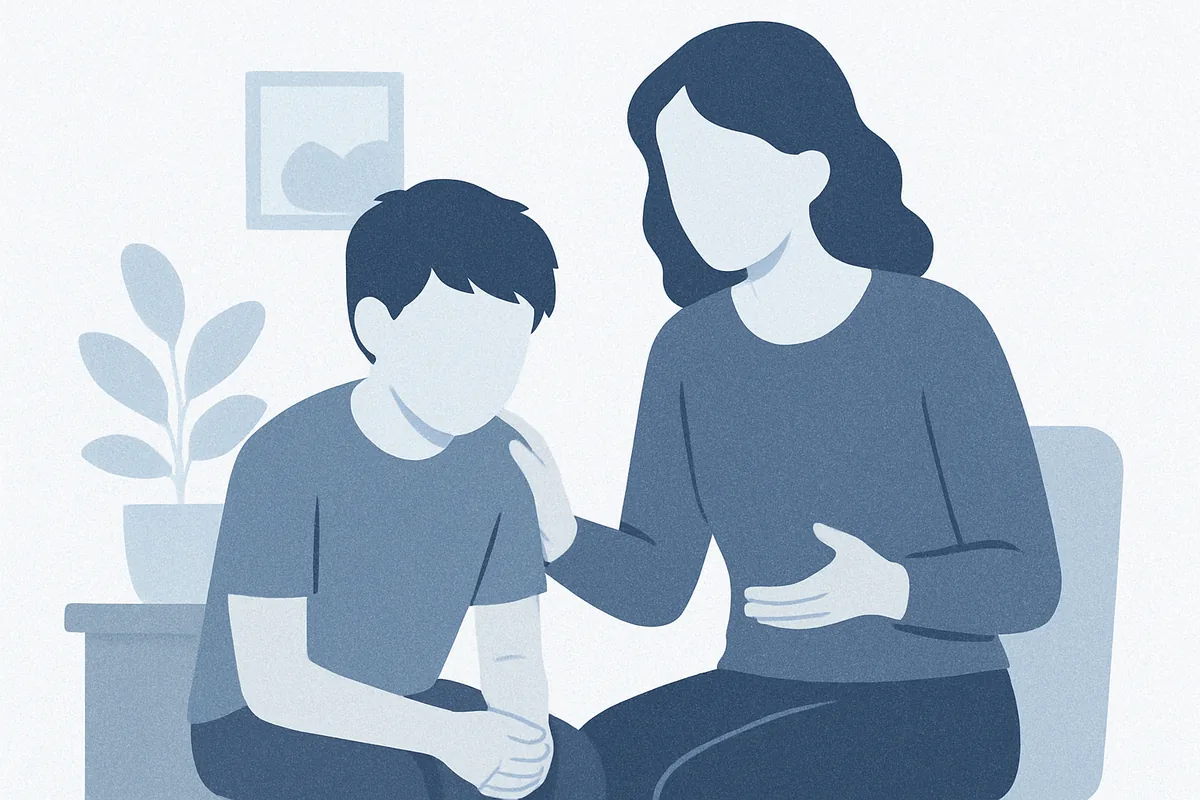
- Research published in 2023 found that higher self-stigma in youth with ADHD correlates significantly with lower self-esteem (r = -0.387), which means the language parents use during the disclosure conversation has a direct, measurable impact on long-term self-worth.
- Children as young as 5 or 6 can understand a straightforward brain-difference explanation; withholding the diagnosis until adolescence is consistently associated with worse identity outcomes and greater shame.
- In Dubai, parents must submit the formal psychological assessment report to the school's SENCO before the academic year begins for KHDA-mandated IEP support to be activated within the first 30 school days, which means the home conversation and the school conversation need to happen in close sequence.
- 78% of children with ADHD have at least one co-occurring condition, most commonly anxiety or behavioural difficulties, so the disclosure conversation often needs to address more than one challenge rather than framing ADHD as the single complete explanation.
- At CAYA World, Dr. Nour Al Ghriwati recommends framing ADHD as a brain that works at a different speed and intensity, not a broken brain, giving children a concrete, non-deficit explanation they can repeat to themselves when things feel hard.
A 2023 meta-analysis covering MENA-region studies placed the pooled ADHD prevalence in the UAE at 9.2%, higher than the global estimate of 7.2 to 8.0% (Journal of Epidemiology and Community Health, 2023). Despite those numbers, the how-to-tell-child ADHD diagnosis conversation is one most Dubai parents approach without any script at all. They know the assessment is done. They have the report in their hands. They just do not know what to say first.
The answer to that question is simpler than most parents expect. You say: "We found out something important about how your brain works. Your brain is not broken. It just works differently from some other kids' brains, and now that we know that, we can help it work better." That is the opening. Everything else builds from it.
This guide walks through the full conversation: why it matters, what to say at each age, how to field the hard follow-up questions, what mistakes to avoid, and what comes next for your child's education in Dubai. Dr. Nour Al Ghriwati, Co-Founder and Chief Clinical Psychologist at CAYA World Clinic, has guided hundreds of families through this conversation and shaped the clinical framework behind this article.
Why Telling Your Child About Their ADHD Diagnosis Matters, and When to Do It
Some parents delay. They want to protect their child from a label, or they worry the diagnosis will become a self-fulfilling prophecy. That instinct is understandable. But the clinical evidence runs in the opposite direction.
A 2023 study indexed on PubMed found that higher self-stigma in youth with ADHD correlates significantly with lower self-esteem, with a correlation coefficient of -0.387, and with meaningfully worse quality of life (PMC, 2023). Self-stigma, critically, is not caused by knowing the diagnosis. It is caused by a child carrying an unexplained sense that something is wrong with them, without a framework for understanding why. A child who struggles to sit still, loses things constantly, and hears corrections from teachers all day will build their own explanation for those experiences. Without a clinical frame from parents, that explanation is almost always "I am bad" or "I am stupid." The diagnosis replaces that harmful story with an accurate one.
The question of when also has a clear clinical answer. As soon as the assessment is complete and confirmed, tell your child. There is no developmental stage at which children are too young to hear a brain-difference explanation. Children as young as five or six process this well when the language is matched to their age. Adolescents who are told for the first time at thirteen or fourteen frequently feel betrayed: "Why didn't you tell me sooner? That would have explained so much."
In Dubai, timing carries an additional practical urgency. KHDA regulations require private schools to develop an Individual Education Plan (IEP) within the first thirty school days for any student with a formal DSM-5 ADHD diagnosis, but only once parents have submitted the full psychological assessment report to the school's SENCO. That submission needs to happen before the academic year begins, ideally by the end of July. A family that delays the home conversation often delays the school submission, which in turn loses the IEP window for that entire year. The disclosure at home and the disclosure to school are not separate events on separate timelines. In Dubai, they are tightly linked.
At CAYA World, we routinely schedule a brief parent-coaching session between assessment completion and the family disclosure conversation. That session is not compulsory, but parents who use it report feeling significantly more prepared, particularly around fielding the harder follow-up questions that come after the initial explanation.
How to Tell Your Child They Have ADHD: The Core Principles
Before you get into age-specific language, there are five principles that hold across every age group and every family context.
Lead with the brain, not the behaviour. ADHD is a difference in how the brain regulates attention, impulse, and activity. Frame it that way from the start. "Your brain finds it harder to slow down" is more accurate and less stigmatising than "you have trouble concentrating." The behaviour is a symptom. The brain is the level where the explanation lives.
Use concrete analogies, not abstract medical language. The word "neurodevelopmental" means nothing to a seven-year-old and not much more to a twelve-year-old. A car engine that runs fast, a radio picking up too many stations at once, a superpower that works best with the right conditions: these images land. The analogy you choose matters less than the fact that it is concrete and non-deficit.
Separate the diagnosis from effort and character. Many children immediately hear "I have ADHD" as "that is why I am lazy" or "that is my excuse." Address that head-on. "This does not mean you do not try hard. It means your brain has to work harder than some other brains to do some things. That is not fair. And now we know it, we can do something about it."
Keep the first conversation short. You do not need to explain co-occurring anxiety, medication pathways, IEP accommodations, and KHDA requirements in one sitting. Cover the core message, check your child's understanding, and stop. There will be follow-up questions over days and weeks. That is normal and healthy. The first conversation only needs to open the door.
Make it a beginning, not a verdict. The disclosure is not a closed statement. It is the start of a longer family conversation. Say explicitly: "You can ask me anything about this. Any time. I want to keep talking about it." Children who feel they can return to the topic process the information far better than children who receive it as a finished fact.
For families in Dubai's expat communities, one additional consideration matters. In close-knit school networks, the fear that a diagnosis label will travel across school transitions or affect friendships is a real and clinically reported barrier. Be honest with your child about who the information will be shared with, why (the school needs to know to support you), and what they can choose to say or not say to friends. Giving children some agency over their own story reduces the sense that the diagnosis is something being done to them.
Explaining an ADHD Diagnosis by Age Group
The core message stays the same across all ages. The vocabulary, the level of detail, and the child's emotional processing capacity change substantially. The table below offers a practical reference for language calibration by developmental stage.
| Age Band | Core Language to Use | Typical Child Response | What to Expect Next |
|---|---|---|---|
| Ages 5 to 7 | "Your brain works really fast and sometimes it races ahead. That makes some things harder. We are going to get help for that." | Curious, relatively matter-of-fact, may ask one or two questions then move on | Questions resurface over days; watch for how they talk about themselves at school |
| Ages 8 to 10 | "You have something called ADHD. It means the part of your brain that puts on the brakes finds it harder to slow down. You are not lazy. Your brain is working really hard." | May ask "does that mean I am different?"; some relief; possible quiet withdrawal to process | May tell friends unprompted; follow up within 24 to 48 hours to check in |
| Ages 11 to 13 | "The assessment confirmed something called ADHD. This explains a lot of what you have been experiencing. It is a real, biological difference in how your brain regulates focus and impulse. It is not about intelligence or character." | Greater emotional reaction; may feel relief and anger simultaneously; "why didn't you tell me sooner?" | Wants information, wants to understand, may research independently; keep the conversation open |
| Ages 14 and up | "I want to share the assessment results with you directly, not summarise them for you. ADHD is a well-understood condition and there is a strong evidence base for what helps. Let us look at this together." | Adolescents often respond with either significant relief or significant resistance; identity questions become central | Involves them in treatment decisions; discuss medication, therapy options, and school accommodations together |
Ages 5 to 7. Keep it simple, concrete, and positive. Children this age do not need a clinical explanation. They need to know two things: their brain is different, not damaged, and help is coming. A useful frame at this age is the "racing engine" analogy. "Some brains are like engines that idle slowly. Your brain is like an engine that runs really fast. That is amazing in some ways and really hard in others. We are going to learn how to drive it better." Leave the door open for questions and do not be surprised if the child goes back to playing within two minutes. Young children process in fragments, not in one sitting.
Ages 8 to 10. Children in this band have more developed self-awareness and are starting to compare themselves consciously with peers. They may already know something is different and may have absorbed negative messages from teachers or classmates. Use the actual word ADHD, explain it briefly, and address the "am I weird?" question before it forms. "Lots of kids have ADHD. Some of the most interesting, creative, driven people in the world have ADHD. It does not define you. It explains some things, and knowing it helps us help you." The ADHD assessment process will have produced specific information about your child's profile. Sharing age-appropriate pieces of that, such as "the assessment showed your working memory is really strong, which is why you are so good at remembering facts," builds a balanced picture alongside the challenges.
Ages 11 to 13. This is arguably the most emotionally loaded age window for disclosure. Children at this stage are forming their identities actively. The diagnosis can feel like an attack on that forming identity, or it can feel like a profound explanation of years of unexplained difficulty. Many young people at this age report that hearing the diagnosis was a relief: "I thought I was just dumb." That relief is worth naming. "Does this explain some of what you have been experiencing?" is often a useful question to ask during the conversation.
Ages 14 and up. Adolescents deserve to be treated as participants in the process, not recipients of information. Show them the assessment report. Explain what each section means. Involve them in the next-step conversation, including whether they want to discuss medication, whether they want to tell close friends, and how they want the school to handle accommodations. Research consistently shows that adolescents who have agency in their ADHD management show better treatment adherence and better outcomes over time.
If you are concerned about your child's reaction, or if your child has a co-occurring condition that makes the disclosure more complex, the clinical team at CAYA World offers family consultation sessions specifically designed around this conversation. You do not need to navigate it alone.
How to Answer the Hard Questions: 'Am I Broken?' and 'Why Me?'
Every parent dreads these. They come in different forms depending on the child's age, but the underlying fears are consistent: Am I defective? Did I cause this? Is this permanent? Will this ruin my life? Having clear, honest, non-dismissive answers prepared matters enormously.
"Am I broken?" Answer directly. "No. Your brain is not broken. It is built differently. A brain with ADHD is not a damaged version of a brain without ADHD. It is a different neurological profile. Some things are harder. Some things, frankly, are easier. We are going to work with how your brain actually is, not try to make you into someone you are not." Avoid hollow reassurances like "everyone is different." That is true but it does not answer the question. Answer the question.
"Why me? Did I do something wrong?" Be explicit. "ADHD has nothing to do with anything you did or did not do. It has nothing to do with how hard you tried or whether you were good. It is genetic, which means it runs in families, and it was part of how your brain developed before you were even born." If ADHD runs in your family, this is a good moment to say so. "Your uncle has ADHD. I have some of it too. It is not a flaw. It is a family pattern." Parental self-disclosure, where relevant, reduces stigma significantly.
"Will I always be like this?" Be honest and future-focused. "ADHD does not go away the way a cold goes away. But the way it affects your life changes enormously as you build skills, as we find the right support, and as you learn more about how your own brain works. Many adults with ADHD lead incredibly full, successful lives. The key is understanding your brain and building strategies around it." Note that CDC data from 2024 confirms that 78% of children with ADHD have at least one co-occurring condition. If your child has anxiety or a learning difference alongside ADHD, be open about that too, at an age-appropriate level. "The assessment also showed that your brain sometimes gets into a worry loop. That is a separate thing we are going to address."
"Will my friends find out?" This question matters enormously to children in Dubai's school communities, where social networks are dense and school moves are frequent. Be clear about the practical reality. "We are going to tell your school so they can support you properly. That means your teacher and the SENCO will know. You get to decide who else knows. You are in charge of your own story."
At CAYA World, Dr. Nour Al Ghriwati works with children directly after the disclosure conversation to process their reactions and build a personally meaningful framework for understanding their ADHD. Many children find it helpful to have an adult outside the family to talk to, someone who knows the clinical picture but is not their parent.
If you would like to talk through your child's assessment results and prepare for the disclosure conversation, our team at CAYA World is ready to help. Send us a WhatsApp message or call us on 04-572-3755. A brief intake conversation costs nothing and gives you a clear sense of whether a parent-coaching session would help.
Wondering if It's Time to Talk to Someone?
Our specialist team at CAYA World offers comprehensive assessment and evidence-based treatment, conducted from our clinic in Palm Jumeirah, Dubai.
Common Mistakes Parents Make When Disclosing an ADHD Diagnosis
These are the patterns that come up most often in the sessions Dr. Nour holds with families in the weeks following a disclosure. None of them make a parent a bad parent. They are the natural defaults when this conversation has not been prepared for.
Waiting for the "right moment" indefinitely. There is no perfect moment. You do not wait until your child is calm, until school is out, until things settle down. You create a moment. A quiet weekend afternoon, no phones, no siblings interrupting, low-stakes atmosphere. Waiting tends to be fear in disguise.
Over-explaining everything in one sitting. Parents sometimes offload the entire assessment report, the school accommodation plan, the medication decision, and the therapy options in a single conversation, because they feel relief that the secret is finally out. The child cannot absorb all of that. The first conversation has one job: land the core message. Everything else unfolds over time.
Using the diagnosis as an explanation for specific past events. "That is why you got in trouble in Year 3" or "that is why you lost your place on the football team" retroactively reframes the child's history through a diagnosis lens. This can feel invalidating rather than clarifying. Keep the disclosure forward-looking. "Now that we understand your brain better, here is how things can change."
Reacting emotionally in ways that signal catastrophe. Children read their parents' emotional register closely. If a parent cries, or speaks in a hushed grave tone, or treats the conversation as a solemn event, the child absorbs the message that this is a tragedy. Keep your tone matter-of-fact, warm, and solution-oriented. You can process your own complicated feelings about the diagnosis with a therapist or trusted friend, separately.
Framing ADHD as an excuse rather than an explanation. "This is why school is hard" is different from "this is an excuse for when school is hard." The first is a clinical explanation. The second is a future opt-out, and children know the difference. Be clear that the diagnosis explains; it does not excuse. "Knowing your brain needs extra support does not mean we stop expecting you to try. It means we make sure you have what you need so trying is actually possible."
Forgetting that siblings are watching. Other children in the family will notice that something significant has happened. If they are not included in some version of the conversation, they fill the gap with their own interpretations. A brief, age-appropriate explanation for siblings, "We found out about how [child's] brain works and we are getting support for it," prevents rumour and resentment.
What to Do Next: From Family Conversation to Dubai School Accommodations
The kitchen-table conversation is step one. In Dubai, the steps that follow have specific timelines attached to them, and missing them has real consequences for your child's academic support.
Submit the psychological assessment report to the school's SENCO. In Dubai's KHDA-regulated private schools, ADHD accommodations, including IEP development, extended time, preferential seating, modified assignment formatting, and access to the SENCO for pastoral support, are only formally activated when the school has a copy of the full psychological assessment report. This is not a discretionary process. The KHDA requires schools to develop an IEP within the first thirty school days for students with a confirmed DSM-5 diagnosis, provided the report is on file before the academic year begins. Submit by end of July at the latest.
Request an IEP meeting in writing. Do not assume the school will initiate this. Email the SENCO directly, attach the report, and request a meeting to discuss IEP goals within the first two weeks of term. Keep records of that correspondence.
Consider the timing of any treatment decisions relative to the school year. If medication is being discussed with a psychiatrist, the start of a new school year offers a natural observation window for teachers to report back on changes in focus and behaviour. ADHD therapy for children in Dubai alongside or in place of medication typically uses cognitive-behavioural approaches to build executive function skills, organisational strategies, and emotional regulation. Starting that work during the school term means skills can be practised in context immediately.
Return to the conversation at home regularly. This is not a one-off disclosure. New school years, new challenges, puberty, social changes, and academic pressures will all bring ADHD back into focus. Build it into your family's ordinary language. "Your brain works this way, we know how to support it, let us talk about what is coming up." That normalisation is one of the most powerful things a parent can do.
For families navigating both the disclosure conversation and the school accommodation process simultaneously, our back-to-school guide for children with ADHD in Dubai covers the KHDA IEP timeline, the SENCO communication process, and classroom accommodation requests in detail. It is designed as a practical companion to this article.
The DHA has also established specialist ADHD clinics at Primary Healthcare Centres across Dubai, including Al Mizhar, Al Barsha, and Nad Al Hammar, signalling growing institutional recognition of ADHD as a clinical priority in the UAE. That infrastructure matters: it means your child has both private and public-sector support pathways available.
Frequently Asked Questions About Telling Your Child About Their ADHD Diagnosis in Dubai
Tell your child as soon as the assessment is confirmed, regardless of age. Children as young as five can understand a brain-difference explanation when the language is matched to their developmental level. Delaying until adolescence is consistently associated with greater shame and worse identity outcomes. There is no clinical justification for waiting, and in Dubai's school context, early disclosure also allows earlier access to KHDA-mandated IEP support, which is only activated once the assessment report is submitted to the school's SENCO.
Emotional reactions are normal and healthy. Upset may signal relief, grief, confusion, or anger at not having been told sooner. Do not rush to resolve the emotion. Sit with it. Say: "It makes sense that you feel that way. I want to hear what you are feeling." Avoid minimising ("it is not a big deal") or overwhelming with reassurance before the child has had space to react. If your child's distress is intense or persistent for more than a week, a session with a child psychologist can help them process the diagnosis in a structured clinical setting.
Use brain-based language rather than behaviour-based language. "Your brain regulates attention and impulse differently" is more accurate and less identity-threatening than "you have trouble concentrating." Pair the challenge with a concrete strength wherever possible. Normalise ADHD using real prevalence data: a 2023 meta-analysis found ADHD prevalence in the UAE at 9.2%, meaning several children in your child's class likely share a similar neurological profile. Confirm that the diagnosis explains; it does not define. Return to this framing every time the topic comes up.
You are not legally required to disclose to the school, but your child cannot access KHDA-mandated IEP accommodations without a formal report on file. In practical terms, without school notification your child sits in an unsupported classroom environment while carrying a known and treatable condition. Most clinical guidance recommends disclosure to the school's SENCO, with submission of the full psychological assessment report, before the academic year begins. You can discuss with the SENCO what information is shared more broadly with classroom teachers and what remains confidential.
Tell your child before any treatment begins. Starting therapy or medication without explaining why is disorienting and can feel punitive. A child who understands their diagnosis participates more actively in treatment, including CBT-based skills work, and shows better adherence when medication is involved. The disclosure gives context to everything that follows. It also gives your child agency: "Now that we know how your brain works, here are some options for making it easier. Let us talk about which ones feel right." Involving your child in those decisions, at an age-appropriate level, improves outcomes.
Sources and Further Reading
- ADHD Prevalence in the MENA Region: Pooled Meta-AnalysisJournal of Epidemiology and Community Health, Springer (2023)
- Self-Stigma, Self-Esteem, and Quality of Life in Youth with ADHDPMC / PubMed (2023)
- ADHD Data and StatisticsCenters for Disease Control and Prevention (2024)
- Global Prevalence of ADHD in Children Aged 3-12: Umbrella Meta-AnalysisBMJ Open (2023)
- ADHD Clinics Introduced by Dubai Health AuthorityGulf News (2020)
- Diagnostic and Statistical Manual of Mental Disorders, Fifth Edition (DSM-5). American Psychiatric Association (2013)
- Talking with Your Child About ADHD. CHADD (Children and Adults with Attention-Deficit/Hyperactivity Disorder)