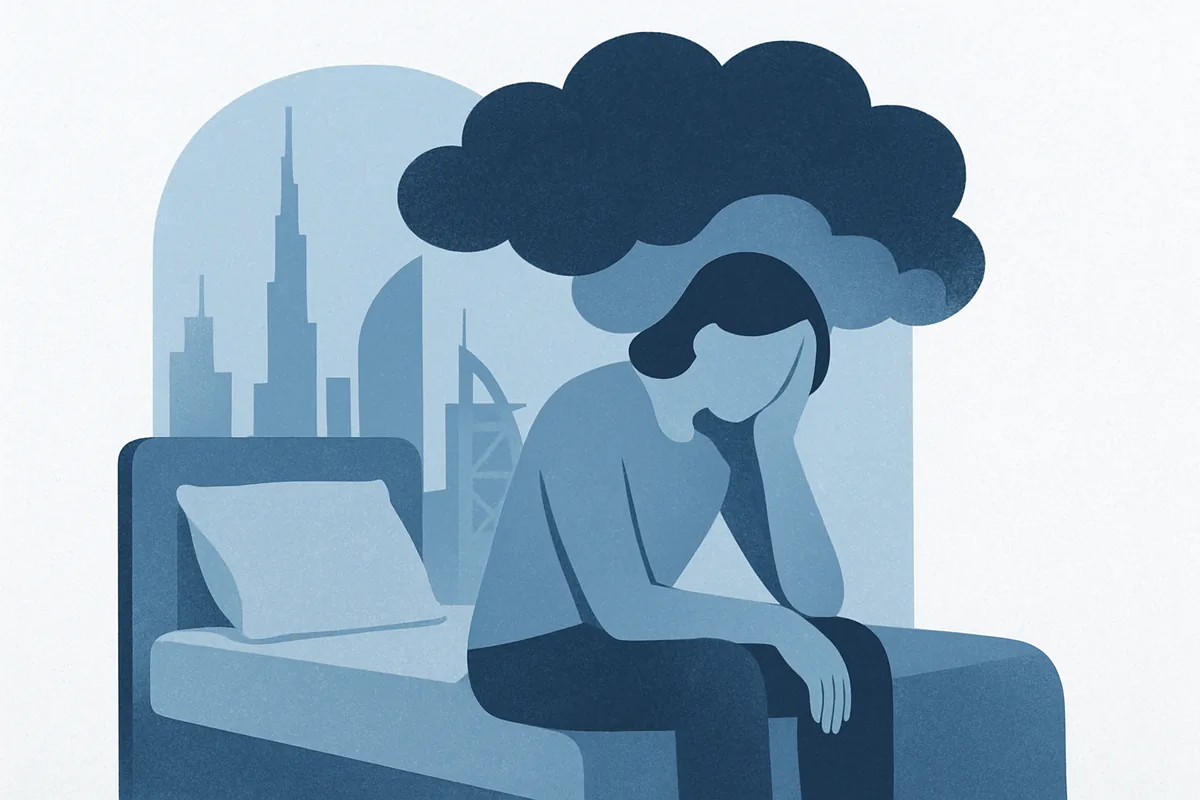
- Health anxiety is clinically distinct from generalised anxiety, its defining engine is the somatic preoccupation loop: a body sensation triggers catastrophic interpretation, which drives reassurance-seeking, which provides only brief relief before the cycle restarts.
- CBT for health anxiety achieves a 66% pooled response rate and 48% remission rate in published meta-analyses, with benefits maintained at eight-year follow-up, making it the most evidence-supported treatment available.
- Dubai's frictionless private healthcare system, same-day specialist access, no referral gatekeeping, mandatory insurance coverage, can inadvertently sustain the reassurance-seeking loop, extending the condition rather than resolving it.
- Illness anxiety disorder (IAD) and somatic symptom disorder (SSD) are related but clinically distinct DSM-5 diagnoses requiring different treatment emphases; accurate assessment determines which applies.
- A clinical assessment at a DHA-regulated psychology clinic in Dubai typically involves structured interview, validated questionnaires (HAI-18, PHQ-15), and a review of help-seeking history, the starting point before any CBT programme begins.
Health anxiety, formally classified in the DSM-5 as illness anxiety disorder or somatic symptom disorder, depending on the clinical picture, is not the same as generalised anxiety, and it is not the same as being sensibly attentive to your body. Its defining feature is a specific, self-reinforcing loop: the body produces a sensation, the mind assigns catastrophic meaning to it, and fear drives a search for reassurance that temporarily relieves distress without ever resolving it. CBT is the most evidence-supported approach, with a pooled response rate of 66% and remission rate of 48% across published trials. If health anxiety therapy in Dubai is something you are considering, understanding exactly what that loop looks like, and why Dubai's healthcare environment can make it harder to break, is the right place to begin.
What is health anxiety, and how is it different from ordinary worry about your health?
Noticing a new mole, getting a persistent headache checked, or feeling unsettled while waiting for a blood test result are all normal, proportionate responses to bodily uncertainty. Health anxiety is something structurally different. A person with health anxiety does not simply worry when there is a clear trigger and then move on once reassured. Instead, reassurance provides only momentary relief, within hours or days, the concern returns, the search for certainty resumes, and the person finds themselves back at the starting point, more vigilant than before.
The clinical boundary matters here. Generalised anxiety disorder (GAD) involves pervasive, hard-to-control worry across multiple life domains, finances, relationships, work, health, safety, with health being one strand among many. Health anxiety, by contrast, is a focused preoccupation: the body itself becomes the primary threat domain. A person with GAD who also worries about their health is not the same as a person whose anxiety is organised almost exclusively around physical symptoms and disease fear.
The specific behaviours that distinguish health anxiety from ordinary concern include:
- Body scanning, repeated, deliberate checking of the body for signs of illness, often for 30 minutes or more per day
- Reassurance-seeking, repeated consultations with GPs or specialists, requests for repeat investigations, or seeking opinions from multiple doctors for the same complaint
- Avoidance, some individuals do the opposite, avoiding medical appointments or news about illness entirely for fear of confirmation
- Cyberchondria, extended late-night internet searches of symptoms, which reliably worsen rather than relieve distress
- Symptom monitoring that creates symptoms, sustained attention to normal bodily sensations (heartbeats, swallowing, breathing) amplifies their perceived intensity
Globally, health anxiety affects between 2.1% and 13.1% of the general adult population, rising to between 7% and 19.9% in primary and secondary medical care settings, according to a systematic review published in PMC in 2024 (Eilenberg et al.). In other words, a meaningful proportion of the people sitting in GP waiting rooms across Dubai are there not because their bodies are medically unwell, but because anxiety has amplified normal bodily sensation into perceived threat. Those individuals rarely arrive at a psychologist's office directly. They arrive at a gastroenterologist, a cardiologist, or a neurologist first. At CAYA World, we often see clients who have completed extensive medical workups across multiple specialties before a clinician finally names anxiety as the more likely explanation.
The distinction from ordinary health concern comes down to one functional test: does the worry persist and intensify despite negative investigations and clinical reassurance? If the answer is yes, if a clear echocardiogram produces a week of relief but not lasting certainty, or if a normal MRI is followed almost immediately by a new concern about a different symptom. That pattern is the clinical signal that anxiety, not a medical condition, is driving the experience.
The health anxiety loop: why reassurance never quite works
Understanding why reassurance does not resolve health anxiety is the foundation of effective treatment. The loop is not simply "I worry and then I get reassured". It is a reinforcement cycle with a self-defeating architecture.
Here is the sequence as it plays out clinically:
- Trigger, a bodily sensation (a tight chest, a headache, fatigue, a lump that was not noticed before) enters awareness, often in a quiet or unoccupied moment
- Catastrophic interpretation, the mind selects the most threatening possible meaning: "this is a cardiac event", "this is cancer", "there is something seriously wrong that doctors have missed"
- Anxiety rise, the catastrophic interpretation produces real physiological anxiety: increased heart rate, muscle tension, shortness of breath, which are then interpreted as further evidence of illness
- Reassurance-seeking behaviour, the person Googles symptoms, calls a GP, books a same-day consultation, requests a scan, or asks a partner for repeated confirmation that they look well
- Temporary relief, the investigation comes back clear, or the doctor provides reassurance; anxiety drops sharply
- Renewed vigilance, within hours or days, the relief fades; doubt enters ("but what if they missed something?"); attention returns to the body; a different sensation comes into focus; the cycle restarts
The reason reassurance does not work long-term is mechanistic: each reassurance-seeking episode teaches the brain that the correct response to anxiety is to seek certainty externally. This reinforces the core belief, "my body cannot be trusted without external verification", and over time lowers the threshold at which a new sensation triggers the cycle. The loop does not shorten with more reassurance; it tightens.
This is the specific pattern that distinguishes health anxiety from reasonable health concern, and it is exactly the pattern that CBT-based anxiety therapy is designed to interrupt. Cognitive behavioural techniques work by targeting the interpretation step (step 2) and the reassurance-seeking behaviour (step 4) simultaneously, teaching the person to tolerate uncertainty rather than resolve it through external confirmation.
At CAYA World, we find that naming this loop explicitly, walking clients through their own version of the six steps using real examples from the past week, is one of the most clinically productive early moments in treatment. When someone sees their own pattern mapped structurally, the sense that they are "going mad" or that something is uniquely wrong with them typically diminishes. The loop is a learned pattern. It can be unlearned.
How health anxiety therapy in Dubai works, the CBT approach explained
Cognitive behavioural therapy for health anxiety has the strongest evidence base of any psychological intervention for this condition. A 2019 meta-analysis published in Expert Review of Pharmacoeconomics and Outcomes Research found a pooled response rate of 66%, a remission rate of 48%, and a large effect size (Hedges' g = 0.95), with treatment gains maintained at eight-year follow-up. These are not marginal improvements. They reflect clinically meaningful change in the specific behaviours that sustain health anxiety.
CBT for health anxiety is structured differently from CBT for generalised anxiety. The treatment targets several interconnected mechanisms:
Cognitive restructuring for catastrophic appraisals
Clients learn to identify the automatic thought that fires when a bodily sensation is noticed, typically a catastrophic worst-case interpretation, and to evaluate it against evidence. This is not the same as telling someone "you're fine, stop worrying." It involves building a concrete, reasoned alternative interpretation: "this sensation has appeared before and resolved without treatment; the base rate for this symptom being cancer in a 35-year-old is low; anxiety itself produces exactly this physical feeling." The goal is not certainty. It is accurate probability estimation.
Attention and hypervigilance retraining
Sustained attentional focus on the body amplifies normal sensations. A person who monitors their swallowing will notice every swallow. A person who monitors their heartbeat will perceive it as irregular even when it is not. CBT addresses this directly through attention-retraining exercises that redirect focus externally, reducing the sensory salience of normal bodily processes.
Behavioural experiments to test predictions
Clients identify a feared prediction ("if I do not check my pulse every hour, I will not notice a cardiac event") and test it under structured conditions. These experiments produce experiential data that challenges the core belief driving the anxiety, rather than simply discussing it theoretically. This is the component that produces the most durable change.
Reducing reassurance-seeking gradually
Reassurance-seeking is addressed incrementally, not through abrupt elimination, which typically produces acute distress, but through a structured reduction plan. Clients track their reassurance-seeking behaviour, identify the triggers, and progressively extend the period between symptom onset and reassurance-seeking behaviour, building tolerance for uncertainty at each step.
Most clients working through a structured CBT programme for health anxiety at CAYA World see measurable reduction in symptom preoccupation within 12 to 16 weekly sessions. Some with a more chronic presentation require a longer course. The outcome data referenced above was not generated in a Dubai clinic, but the mechanisms are not geographically variable. Anxiety is anxiety; the cognitive loop looks the same in a Palm Jumeirah consultation room as in a London one.
If what you have read so far resonates, particularly the reassurance loop or the compulsive checking, a brief intake conversation with one of our clinical psychologists at CAYA World is a practical next step. You can reach us directly via WhatsApp for an informal orientation before committing to a full assessment.
Is it illness anxiety disorder, somatic symptom disorder, or something else?
The DSM-5 made a clinically important distinction that is worth understanding if you are trying to identify where your experience sits. The older term "hypochondriasis" was retired in 2013 and replaced with two related but different diagnoses: illness anxiety disorder (IAD) and somatic symptom disorder (SSD). Getting the distinction right matters because it shapes the treatment emphasis.
Illness anxiety disorder is the closer heir to classical hypochondriasis. The defining feature is high anxiety about having or developing a serious illness, with minimal or absent physical symptoms. The person's distress is primarily cognitive. They are preoccupied with what the body might be doing, rather than with symptoms they are currently experiencing. They may be in one of two recognisable patterns:
- Care-seeking type, frequent medical appointments, repeat investigations, requests for second opinions
- Care-avoidant type, avoidance of all medical contact for fear of confirmation of a feared diagnosis
Somatic symptom disorder involves persistent, distressing physical symptoms, pain, fatigue, gastrointestinal symptoms, that are accompanied by disproportionate and persistent thoughts, feelings, and behaviours related to those symptoms. The person is not imagining the symptoms; they are genuinely experienced. But the level of anxiety, the time devoted to health concerns, and the degree of disruption to daily functioning are disproportionate to what any medical investigation can account for.
In UAE research, somatoform disorders, the older classification umbrella, affected approximately 12% of primary care patients in an Al-Ain study and 4% of the general UAE adult population. These figures suggest the presentation is clinically common here, though it is frequently managed within the medical system rather than referred to psychology.
A third category worth noting is cyberchondria, a term for the specific pattern of distress amplification through internet symptom searching. It is not a DSM-5 diagnostic category but it is a well-documented behavioural variant of health anxiety, with research consistently showing that online symptom searching increases rather than reduces health-related distress. In Dubai, where high-speed connectivity, after-hours pharmacies, and private GP tele-consultations are universally available, cyberchondria is a natural extension of the reassurance loop. It is the 2 a.m. version of calling the doctor.
At CAYA World, assessment does not require you to arrive with a self-diagnosis. Our clinical psychologists are trained to map the specific presentation, IAD, SSD, or an overlapping picture, through structured interview and validated questionnaires including the Health Anxiety Inventory (HAI-18) and the Patient Health Questionnaire-15 (PHQ-15). The diagnosis shapes the treatment emphasis; the treatment is still CBT-based for both conditions, but the specific targets differ.
Wondering if It's Time to Talk to Someone?
Our specialist team at CAYA World offers comprehensive assessment and evidence-based treatment, conducted from our clinic in Palm Jumeirah, Dubai.
Why Dubai's healthcare environment can make health anxiety harder to break
Dubai is, in many respects, a uniquely challenging environment for someone trying to exit the health anxiety loop. This is not a criticism of the UAE's healthcare infrastructure, by any standard, the city's private medical sector is world-class. But its specific features align almost perfectly with the maintenance factors of health anxiety, and understanding this is important both for clients and for the GPs and specialists who see them.
Consider the structural features that sustain the reassurance-seeking cycle:
- No referral gatekeeping, in the UAE's private system, patients can book directly with a cardiologist, neurologist, or gastroenterologist without a GP referral. There is no friction between the anxiety spike and the specialist appointment.
- Same-day or next-day appointments, the wait that might slow a reassurance-seeking cycle in an NHS system simply does not exist here. The anxiety rises; the appointment is booked within hours.
- Mandatory health insurance, UAE employment law requires employer-provided health insurance, and most policies cover specialist consultations and diagnostic investigations. Repeat testing carries minimal out-of-pocket cost.
- Culturally normalised health-consciousness, among the expat professional community in Dubai, proactive health management is a widely shared value. Regular executive health screenings and specialist check-ups are positioned as self-care, making frequent medical contact socially unremarkable.
For a person without health anxiety, these features are straightforwardly beneficial. For someone whose anxiety is maintained by reassurance-seeking, they remove every natural brake on the cycle. A system optimised for rapid access to medical reassurance is, for this specific condition, a system optimised for relapse.
The expat-specific dimension compounds this. Many professionals in Dubai are managing significant occupational pressure, visa-linked identity concerns (illness can feel like a direct threat to residency and employment), and reduced family support networks. Unexplained physical symptoms in this context carry particular psychological weight. The WHO documented a 25% global increase in anxiety and depression prevalence in COVID-19's first year, with health anxiety meta-analyses reaching 35.1%, a post-pandemic cohort effect that is visible in Dubai's clinical presentations to this day.
The mental health stigma dimension matters too. Research published in PMC found that 69% of UAE medical students believed seeking mental health treatment invites social judgement. If that figure applies to a highly educated cohort, it likely reflects broader cultural attitudes that shape whether someone experiencing health anxiety frames their difficulty as a medical question ("what is wrong with my body?") or a psychological one ("why does worry about my body keep returning despite normal results?"). The medical framing is culturally safer, and it is also the one that sustains the problem.
Our clinical psychologists at CAYA World work with clients who have often spent months or years cycling through Dubai's medical system before arriving at a psychology consultation. The first thing we do is validate that their physical symptoms are real, because they are. Anxiety produces genuine somatic experience. The question is not whether the symptoms exist; it is what is generating them.
When to seek health anxiety therapy, and what assessment involves
The clearest indicator that health anxiety therapy in Dubai is worth pursuing is functional impairment. Health concern tips into clinical territory when it consistently disrupts work, relationships, or daily functioning, when someone is spending more than an hour per day on health-related checking or searching, repeatedly missing work following medical appointments that yield nothing actionable, or finding that the fear of illness is more present than any other content in their day.
Some specific signals that make a psychological assessment worth booking:
- Multiple medical consultations for the same symptom across different specialists, with no medical explanation found
- A pattern where reassurance relieves distress for less than a day or two before the concern returns
- A GP or specialist who has told you, more than once, that anxiety may be a factor
- The sense that you are monitoring your body almost constantly, and that this monitoring is increasing, not decreasing, over time
- Significant disruption to work, relationships, or daily activity driven by health-related fear
At CAYA World, an assessment for health anxiety typically runs across one to two clinical sessions. The first session is a structured clinical interview covering symptom history, the nature and frequency of reassurance-seeking behaviours, and the degree of functional impairment. Our clinical psychologists also use validated questionnaires, including the HAI-18 (Health Anxiety Inventory) and the PHQ-15 (a measure of somatic symptom severity), to characterise the presentation and distinguish IAD from SSD. Where there is diagnostic uncertainty, a second session completes the picture.
The assessment does two things simultaneously: it produces a clinical formulation that guides treatment planning, and it begins the therapeutic process itself, because mapping the loop with a trained clinician is, for many people, the first time they have understood what is actually happening. That understanding does not resolve the anxiety, but it reframes it from "something wrong with my body" to "a specific cognitive-behavioural pattern with known treatment pathways." That shift is not trivial. It makes change feel possible rather than mysterious.
Following assessment, a structured CBT programme for health anxiety at CAYA World typically involves weekly 50-minute sessions. The number of sessions required depends on how chronic and complex the presentation is, but most clients with a primary health anxiety presentation see clinically meaningful improvement within 12 to 16 sessions. Progress is tracked session by session using the same validated measures used at assessment, so clients and clinicians can observe concrete change rather than relying on subjective impression.
Frequently Asked Questions About Health Anxiety Therapy in Dubai
The physical symptoms in health anxiety are real. They are not imagined or fabricated. Anxiety produces genuine somatic experience: elevated heart rate, chest tightness, gastrointestinal discomfort, headaches, fatigue, and muscle tension are all physiological outputs of the anxiety response. The clinical issue is not whether the symptoms exist, they do, but what is generating them. In health anxiety, the generating mechanism is anxiety itself, amplified by sustained attentional focus on the body. CBT addresses the amplification process, not the symptoms directly.
Medical reassurance addresses the content of the fear ("you do not have cancer") without addressing the process that generates it ("my body cannot be trusted without external verification"). Each reassurance episode provides short-term relief but reinforces the belief that external confirmation is the correct response to bodily uncertainty, which lowers the threshold for the next cycle. CBT targets the interpretation and reassurance-seeking process itself, building a person's capacity to tolerate uncertainty without seeking confirmation. This produces durable change; medical reassurance alone typically does not.
Published meta-analyses show clinically meaningful improvement within 12 to 16 weekly sessions for most clients with a primary health anxiety presentation. More complex or chronic cases, particularly where the pattern has been established for several years or where avoidance is a dominant feature, may require a longer course. Progress is tracked using validated measures (HAI-18 and PHQ-15 at CAYA World) from session one, so both client and clinician can observe concrete change over time rather than relying on subjective impression.
Yes, consistently. Internet symptom searching, sometimes called cyberchondria, reliably increases health-related distress rather than resolving it. Search algorithms surface worst-case content because alarming information generates more engagement. Late-night searching also occurs when cognitive resources are depleted and the rational-appraisal capacity that partially counteracts catastrophic interpretation is at its lowest. In CBT terms, symptom Googling is a form of reassurance-seeking that feeds the maintenance cycle. Reducing it is a standard behavioural target in health anxiety treatment, approached gradually through structured reduction planning rather than abrupt elimination.
Most UAE employer-provided health insurance plans include mental health outpatient coverage, but the specifics, number of covered sessions per year, co-payment levels, and whether pre-authorisation is required, vary significantly by plan and insurer. Health anxiety presenting as a primary psychological concern is typically covered under outpatient mental health benefits. The most reliable approach is to contact your insurer directly before your first appointment to confirm your coverage tier. Our admin team at CAYA World can assist with insurance queries as part of the intake process.
Sources and Further Reading
- Health anxiety prevalence in general and medical populations: a systematic review, Eilenberg et al. PMC/PubMed (2024)
- Somatoform disorders in UAE primary care and the general population, PMC PubMed regional study (2025)
- CBT for health anxiety: efficacy meta-analysis with 8-year follow-up data, Expert Review of Pharmacoeconomics and Outcomes Research, Tandfonline (2019)
- COVID-19 pandemic triggers 25% increase in prevalence of anxiety and depression worldwide, World Health Organization (2022)
- Mental health stigma among UAE medical students, PMC (2023)
- Diagnostic and Statistical Manual of Mental Disorders, Fifth Edition (DSM-5), American Psychiatric Association (2013); illness anxiety disorder and somatic symptom disorder criteria