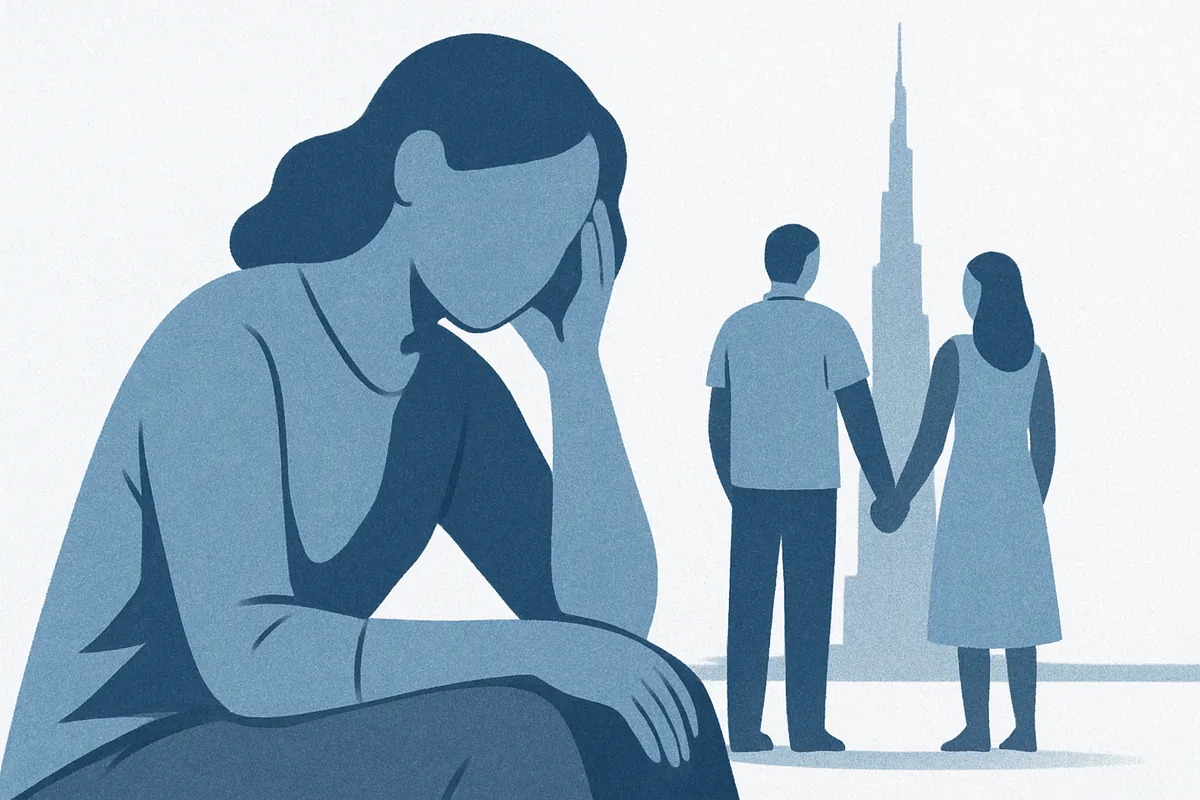
- Depression prevalence among Gulf migrants ranges from 20% to 34.5%, significantly higher than host-national rates, with family separation and job insecurity identified as primary clinical drivers (BMC Psychiatry, 2020).
- Adjustment disorder affects 5–20% of outpatient mental health patients globally; DSM-5 criteria require symptom onset within three months of an identifiable stressor with functional impairment that does not meet threshold for another disorder.
- Dubai's specific structural stressors, visa-tied employment, revolving social circles, compound-style living, and career compression for trailing spouses, create a cumulative psychological load that routine adjustment frameworks do not account for.
- Young expats aged 18–34 face the highest psychological distress burden in UAE population surveys, approximately four times higher than adults over 55, making early identification clinically important.
- Dubai's May 2024 Federal Mental Health Law prohibits workplace discrimination against employees with a mental health condition, meaning visa-dependent expats who seek therapy are legally protected from employment consequences.
Depression prevalence among Gulf migrants ranges from 20% to 34.5%, significantly higher than host-national rates, with family separation and job insecurity identified as primary clinical drivers, according to a 2020 evidence synthesis published in BMC Psychiatry. That figure is not a fringe finding. It reflects a structural reality: expat lifestyle mental health in Dubai is not simply a matter of personality or resilience. The city's design, economy, and social architecture create conditions that place a sustained load on psychological functioning, even for people who are, by every outward measure, managing fine.
This article is not about crisis. It is for the person who moved to Dubai, built a life here, and still finds themselves running on empty in ways they cannot fully explain. You are probably coping. Dubai tends to attract people who cope. But "coping" and "doing well" are not the same thing, and the structural features of expat life in this city make the gap between those two states wider than most people expect. What follows is a frank clinical account of why Dubai makes mental health harder for expats, what the most common presentations look like, and when self-management stops being enough.
At CAYA World, we work with a large proportion of clients who describe exactly this pattern: high functioning on the outside, quietly depleted on the inside, and uncertain whether what they are experiencing is "real" enough to warrant professional attention. It is. And the first step is understanding the structural reasons it happens here in the first place.
Why Dubai's expat lifestyle creates a unique mental health risk
Expats constitute approximately 88–92% of the UAE's total population, which means expat mental health is effectively a population-level public health concern, not a niche one. Yet the framework most people bring to life in Dubai is borrowed from the language of tourism or short-term relocation: "It's an adventure." "You get used to it." "People would kill for this opportunity." That framing actively works against accurate self-assessment.
The psychological research on migration consistently distinguishes between voluntary migration with strong social support, voluntary migration with weak social support, and precarious migration. Most professional expats in Dubai fall somewhere in the second category. They chose to come, often enthusiastically, but arrived into a city where their social network was zero on day one, their legal right to remain is tied to continued employment, and their cultural reference points do not map cleanly onto the local environment. That is a fundamentally different psychological context from moving within your home country or to a place where you have existing roots.
A 2021 study published in the International Journal of Environmental Research and Public Health found that 25.1% of male migrant workers in the UAE met clinical criteria for depression, with 6.3% reporting suicidal ideation. These figures come from a population that is largely employed and resident, not from a marginalised or housing-insecure group. Employment protects mental health in many contexts. In Dubai, employment is also the source of much of the psychological risk, because losing it means losing your visa, your housing, and your right to remain in the country where you have built your life. That particular form of precarity has no clean parallel in most Western mental health literature, and it shapes the emotional experience of work in ways that are easy to underestimate.
At CAYA World, we see this risk compound over time rather than resolve. Clients who arrive managing well often present two to three years into their time in Dubai, having absorbed the structural pressures without naming them, and having confused endurance with adaptation.
The structural stressors: what makes expat mental health in Dubai different
Understanding why expat lifestyle mental health in Dubai carries a distinct clinical profile requires looking at the specific features of the city rather than applying generic relocation frameworks. Several structural stressors recur consistently in the clinical presentations we see.
Visa-tied employment and contract precarity
In most countries, losing your job is financially and professionally stressful. In Dubai, it also triggers a residential clock. The visa grace period means that job loss is not simply a career problem but an existential one: where will you live, and will your family have to leave? This creates a particular form of hypervigilance at work that is rarely named and almost never factored into workplace stress assessments. People tolerate conditions, managers, or workloads they would not accept elsewhere, because the alternative is not just inconvenience but displacement. Over months and years, this distorts the relationship to work in ways that generate chronic low-grade anxiety, and eventually burnout.
Revolving social circles and compounded loss
Dubai's expat community is characterised by high turnover. Friendships form quickly and intensely, which is one of the city's genuine attractions. But those friendships are also regularly broken by contract endings, visa changes, or the family decision to return home. For long-term residents, the cumulative experience of repeated social loss becomes clinically significant. Each individual departure is manageable. The pattern, across five or ten years, functions more like chronic grief than adjustment. People often describe feeling reluctant to invest in new relationships because they have learned that those relationships will end. That is a learned emotional withdrawal, and it has real consequences for mood and sense of belonging.
Family separation and trailing-spouse dynamics
Many Dubai expats live at significant distance from their families of origin. For some, this means periodic visits home and the emotional cost of maintaining relationships at a remove. For others, it means navigating major life events, including illness, bereavement, and parenting milestones, from a time zone that makes real-time presence difficult. This chronic background grief is frequently unprocessed because it does not fit neatly into the category of "a problem" in the way that a bereavement in the immediate family would.
The trailing-spouse dynamic adds a second layer. Partners who follow the primary visa holder to Dubai often experience a sharp contraction of professional identity. Work authorisation is tied to sponsorship, professional networks start at zero, and the cultural capital that made someone effective in their home country does not automatically transfer. Research consistently identifies unemployment and loss of professional identity as primary drivers of depression in migrant populations, and yet the trailing-spouse experience is rarely treated as a clinical concern until it has already generated significant distress.
Heat, compound living, and social infrastructure gaps
Dubai's summer heat restricts outdoor movement for four to six months of the year. This is not a minor inconvenience. Reduced physical activity, reduced casual social interaction, and reduced access to natural light have well-documented effects on mood regulation. Many expats spend the summer in a pattern of air-conditioned isolation that mimics the conditions known to exacerbate or trigger depressive episodes. Compound living, while offering community, can also create a social intensity that leaves little psychological space for solitude or privacy, creating a different but equally real form of social fatigue.
At CAYA World, our clinical team assesses these structural factors as part of the intake process for all adult clients. Understanding the environmental context is not incidental to treatment planning. For many expats, it is central to it. Our life transitions therapy service is specifically structured to address the compound identity, relationship, and environmental stressors that accumulate over time in Dubai's expat context.
If you recognise these patterns in yourself, a brief conversation with a psychologist can help clarify whether what you are carrying is within the range of normal adaptation or has crossed into clinical territory. At CAYA World, our intake team can help you get oriented quickly, without any commitment to a longer process. Send a WhatsApp message on +971 4 572 3755 and describe what you are noticing. We will tell you honestly what we think the next step should be.
The most common clinical presentations among Dubai expats
Structural stressors do not produce random outcomes. At CAYA World, we see consistent clinical patterns among Dubai expats, shaped by the specific pressures described above. Naming them matters because many clients arrive uncertain whether their experience constitutes a "real" mental health concern. It usually does.
Adjustment disorder
Adjustment disorder affects 5–20% of outpatient mental health patients globally, according to NCBI clinical reference data. The DSM-5 definition requires symptom onset within three months of an identifiable stressor, with clinically significant distress or functional impairment that does not meet the threshold for another disorder. In Dubai, the identifiable stressor is often not a single event but an accumulation: a new role, a social circle that has dispersed, a contract renewal that did not come through as expected. Many expats meet the criteria for adjustment disorder without recognising it, because they frame their experience as "just stress" or "just adjustment."
Burnout with depressive features
Dubai's professional culture skews heavily toward performance, visibility, and output. The combination of visa-tied employment and a social environment built around professional achievement creates conditions in which reducing workload feels structurally impossible and psychologically threatening. Burnout in this context tends to present with depressive features: emotional flatness, loss of motivation, difficulty concentrating, and a growing cynicism toward work that was previously meaningful. It is frequently mistaken for laziness or ingratitude, which delays both self-recognition and help-seeking.
Anxiety disorders
Generalised anxiety, health anxiety, and social anxiety all appear at elevated rates in expat clinical populations. In Dubai, anxiety frequently centres on employment security, financial exposure (many expats carry significant costs linked to housing, school fees, and repatriation logistics), and social belonging. The hypervigilance generated by visa precarity is physiologically indistinguishable from the hypervigilance of generalised anxiety disorder. Over time, what began as a rational response to real uncertainty becomes an entrenched anxiety pattern that persists even when circumstances improve.
Relationship and family strain
Couples therapy referrals at CAYA World frequently involve the trailing-spouse dynamic, with one partner experiencing identity compression and the other experiencing the guilt and helplessness of watching that happen without a clear solution. Distance from extended family adds a second layer: decisions about ageing parents, sibling relationships, and family events must be managed from thousands of kilometres away, often without adequate support structures in Dubai to absorb the emotional load.
The following table summarises the clinical presentations we see most frequently among Dubai expats, alongside their typical onset patterns and associated structural drivers.
| Clinical Presentation | Typical Onset Pattern | Primary Structural Driver in Dubai |
|---|---|---|
| Adjustment disorder | Within 3 months of relocation or major change | Relocation, social loss, contract change |
| Burnout with depressive features | Gradual, often 1–3 years post-arrival | Visa-tied employment, performance culture |
| Generalised anxiety | Insidious onset; often pre-existing and amplified | Contract precarity, financial exposure |
| Social disconnection and chronic low mood | After repeated friendship loss cycles | Revolving expat social circles |
| Relationship and couple strain | 6–18 months after trailing-spouse arrives | Identity compression, role imbalance |
| Major depressive episode | Often after a threshold event (redundancy, divorce, family loss) | Multiple compounding stressors |
Adjustment disorder, anxiety, or depression: how to tell the difference
One of the most clinically important questions for expats is whether what they are experiencing is a time-limited adjustment response or something that warrants active treatment. The distinction matters because the clinical pathways are different, and because misidentifying a depressive episode as "just adjustment" can extend unnecessary suffering by months.
Adjustment disorder: what it looks like and how long it lasts
Adjustment disorder is characterised by emotional or behavioural symptoms that arise in response to an identifiable stressor and resolve within six months once the stressor is removed or adapted to. The distress is real and clinically significant, but the prognosis with or without treatment is generally good, and many people recover without formal intervention. The critical marker is the identifiable stressor and the time-limited nature of the response. If you moved to Dubai six months ago, your social life is still patchy, and you are finding the transition harder than expected, that pattern fits adjustment disorder. It does not mean you are fine and should push through. It means your distress is proportionate to your circumstances, and targeted support can significantly shorten the adjustment period.
Anxiety disorder: when the alarm system stops switching off
Anxiety becomes a clinical disorder when it persists across contexts, cannot be linked to a specific current stressor, and begins to affect functioning. In Dubai, the distinction matters because many expats carry a generalised sense of threat related to employment security that feels rational in context. A useful clinical test: if your anxiety would persist even if your contract were secured for the next two years, it has likely crossed from rational vigilance into a disorder that needs treatment. Our anxiety therapy service uses cognitive behavioural therapy to help clients identify where the alarm system has become disproportionate and build skills to interrupt the cycle.
Depression: more than low mood
Depression in the DSM-5 sense requires at least five of nine specified symptoms for a minimum of two weeks, including either depressed mood or loss of interest in previously enjoyable activities. The critical distinguishing features from burnout or adjustment disorder are the pervasiveness, the loss of pleasure (anhedonia), and the cognitive symptoms, particularly difficulty concentrating and negative thinking about the self. If you have reached the point where things that used to give you energy or pleasure no longer do, and that pattern has been consistent for two or more weeks, a clinical assessment is warranted. Our depression therapy service provides structured diagnostic assessment alongside evidence-based treatment.
At CAYA World, our clinical team regularly helps clients work through exactly this diagnostic question during the first consultation. Many people arrive unsure whether they meet "the bar" for therapy. In our experience, that uncertainty is itself a signal worth taking seriously.
Wondering if It's Time to Talk to Someone?
Our specialist team at CAYA World offers comprehensive assessment and evidence-based treatment, conducted from our clinic in Palm Jumeirah, Dubai.
The "Dubai performance trap" and why expats delay seeking help
Dubai has a particular relationship with visible success. The city's social infrastructure, from its residential compounds to its networking events to its social media landscape, is saturated with signals of achievement. This creates a specific psychological environment that we refer to informally at CAYA World as the Dubai performance trap: the implicit expectation that you are here to succeed, and that anything short of visible flourishing represents a personal failure rather than a structural reality.
The performance trap interacts with several other barriers to create significant delays in help-seeking among Dubai expats.
Fear of visa consequences
The most commonly cited barrier we hear in initial consultations is fear that seeking mental health support will somehow affect employment standing or visa status. This fear was more grounded historically than it is today. Under UAE Federal Mental Health Law effective May 2024, employees are explicitly protected from workplace discrimination or termination on the basis of mental health status. Employers are also required to maintain wellness programmes. This is a meaningful legal shift, and it removes one of the most significant structural deterrents to help-seeking for visa-dependent expats. Therapy at CAYA World is confidential. Your employer does not have access to your clinical records, your diagnosis, or your attendance, unless you choose to share that information for specific purposes such as a workplace accommodation.
Cultural expectations and stoicism
Many expat communities, particularly those from South Asian, East Asian, and Middle Eastern backgrounds, carry strong cultural narratives around emotional self-sufficiency. Seeking professional help for psychological distress can feel like admitting failure, particularly when the distress itself is framed as a voluntary consequence of a chosen lifestyle. "You chose to come here" is a thought that actively suppresses help-seeking among expats across nationalities. It is worth stating plainly: choosing to move abroad does not mean accepting unlimited psychological costs as part of the deal.
The high-functioning delay
High-functioning individuals often seek help later because external performance remains intact long after internal distress has become clinically significant. In Dubai, where professional output is socially legible and personal distress is often private, this gap can persist for years. Many of our clients describe a tipping point, typically a specific event (a redundancy, a relationship breakdown, a health scare), that forced acknowledgment of distress that had been accumulating for much longer. Waiting for a tipping point is not necessary. Earlier presentation typically means shorter, less intensive intervention.
Young expats face a compounding version of this pressure. UAE population survey data indicates that adults aged 18 to 34 carry approximately four times the psychological distress burden of adults over 55. This cohort is also among the least likely to seek help, because distress at this age is framed as normal intensity rather than clinical concern.
When to seek professional support versus self-manage
Not every expat in Dubai needs therapy. Some adjustment is genuinely normal, and many people develop effective coping patterns without clinical support. The clinical question is not whether you are struggling but whether the struggle is self-resolving or entrenching. The following markers are a practical guide, not a diagnostic tool. They indicate when professional assessment adds clear value over self-management.
Seek professional support when
- Symptoms have persisted for more than four weeks without improvement despite changes in sleep, exercise, or social contact.
- Functioning has been affected in two or more domains, such as work performance, relationship quality, physical health, and sleep, simultaneously.
- You find yourself regularly using alcohol, cannabis, or other substances to manage mood or sleep.
- Low mood or anxiety is present most days and is not clearly linked to a specific temporary stressor.
- You have withdrawn from activities or relationships that previously gave you energy or pleasure.
- You are having recurring thoughts that life is not worth living or that others would be better off without you.
- A partner, close friend, or family member has expressed concern about your wellbeing.
Self-management may be appropriate when
- Distress is clearly linked to a specific recent event and has been present for fewer than four weeks.
- Functioning in most domains remains intact and there are clear windows of normal mood or energy.
- Social connection and physical health are maintained and provide genuine relief.
- The stressor is likely to resolve or change within a defined timeframe.
If you are uncertain which category fits your situation, that uncertainty is itself a reason to seek a single consultation rather than a reason to wait. A one-session assessment at CAYA World will give you an honest clinical picture and a recommendation. There is no obligation to proceed to ongoing therapy based on that conversation.
Dubai's Health Authority launched a significant multi-year Mental Wealth Strategy in July 2024, covering all residents including non-nationals, with components that include anti-burnout workplace sessions for private-sector employees, expanded GP mental health screening, and mandated minimum mental health insurance benefits from 2026. The DHA crisis helpline (800 111) is free and available daily to all residents. These are meaningful infrastructure expansions. For clinical-level concerns, they complement rather than replace formal psychological assessment and treatment.
For a broader map of what support looks like across Dubai's mental health landscape, our overview of expat mental health in Dubai covers the full range of services, access pathways, and what to expect when you first seek help. If burnout is your primary concern, our clinical team also works with the specific transition and identity pressures that drive depletion among long-term Dubai expats.
Frequently Asked Questions About Expat Mental Health in Dubai
Both are possible simultaneously. Some adjustment distress is a normal response to a significant life change. What matters clinically is the duration, severity, and functional impact. If low mood or anxiety persists beyond four weeks, affects your work or relationships, or is not linked to a specific current stressor, it has likely moved beyond normal adjustment and warrants a clinical assessment. Feeling this way does not mean something is fundamentally wrong with you. It means the structural demands of relocation have exceeded your current coping resources, which is a practical problem with practical solutions.
Adjustment disorder is time-limited, linked to an identifiable stressor, and typically resolves within six months. Anxiety disorder and depression are distinguished by their persistence across contexts, their functional impact, and in the case of depression, the presence of anhedonia (loss of pleasure) and cognitive symptoms such as difficulty concentrating or persistent negative self-evaluation. The most accurate way to distinguish them is through a clinical assessment. Attempting to self-diagnose can lead to under-treatment of depression or over-pathologising of normal adjustment. A psychologist can clarify this in a single structured conversation.
Yes. Therapy at a private psychology clinic in Dubai is confidential. Your employer has no legal access to your clinical records, diagnosis, attendance, or anything discussed in sessions, unless you provide explicit written consent for disclosure. Under the UAE Federal Mental Health Law effective May 2024, employees are additionally protected from discrimination or termination on the basis of mental health status. These protections apply to all UAE residents, including those on employer-sponsored visas. Attending therapy does not appear on any employment record and does not affect your visa status.
Research on cultural and relocation adjustment typically describes a U-shaped curve: an initial honeymoon phase, a trough of difficulty at roughly three to twelve months, followed by gradual stabilisation. However, this framework applies to single relocations with stable employment and growing social connection. In Dubai, where social circles are in constant flux and employment security is tied to visa status, adjustment is rarely a linear process. Many long-term Dubai residents report needing to re-adjust with each social loss cycle or contract change. If adjustment feels ongoing rather than completing, that is worth discussing with a psychologist rather than normalising indefinitely.
Coverage varies significantly by plan tier and insurer. Basic Dubai health insurance plans historically excluded or capped mental health outpatient visits. The Dubai Health Authority's Mental Wealth Strategy includes a mandate for expanded minimum mental health insurance benefits from 2026, which is expected to improve baseline coverage across plans. In the meantime, it is worth checking your policy's mental health outpatient sub-limit and whether pre-authorisation is required. Some plans cover a defined number of psychology sessions per year; others require a GP referral first. At CAYA World, our administrative team can help you check your coverage and advise on the pre-authorisation process before your first appointment.
Sources and Further Reading
- Depression and anxiety among Gulf migrants: a systematic reviewBMC Psychiatry (2020)
- Prevalence of depression and suicidal ideation among male migrant workers in the UAEInternational Journal of Environmental Research and Public Health (2021)
- Adjustment Disorder: DSM-5 criteria and clinical thresholdsNational Center for Biotechnology Information / NCBI (2022)
- Dubai Mental Wealth Strategy 2024–2029Dubai Health Authority (2024)
- UAE Federal Mental Health Law (effective May 30, 2024): employee protections and employer mandates. UAE Federal Government (2024)
- Diagnostic and Statistical Manual of Mental Disorders, Fifth Edition (DSM-5). American Psychiatric Association (2013)
- Depression and anxiety in expat and migrant populations: prevalence, risk factors, and clinical management. International Journal of Environmental Research and Public Health (2021)