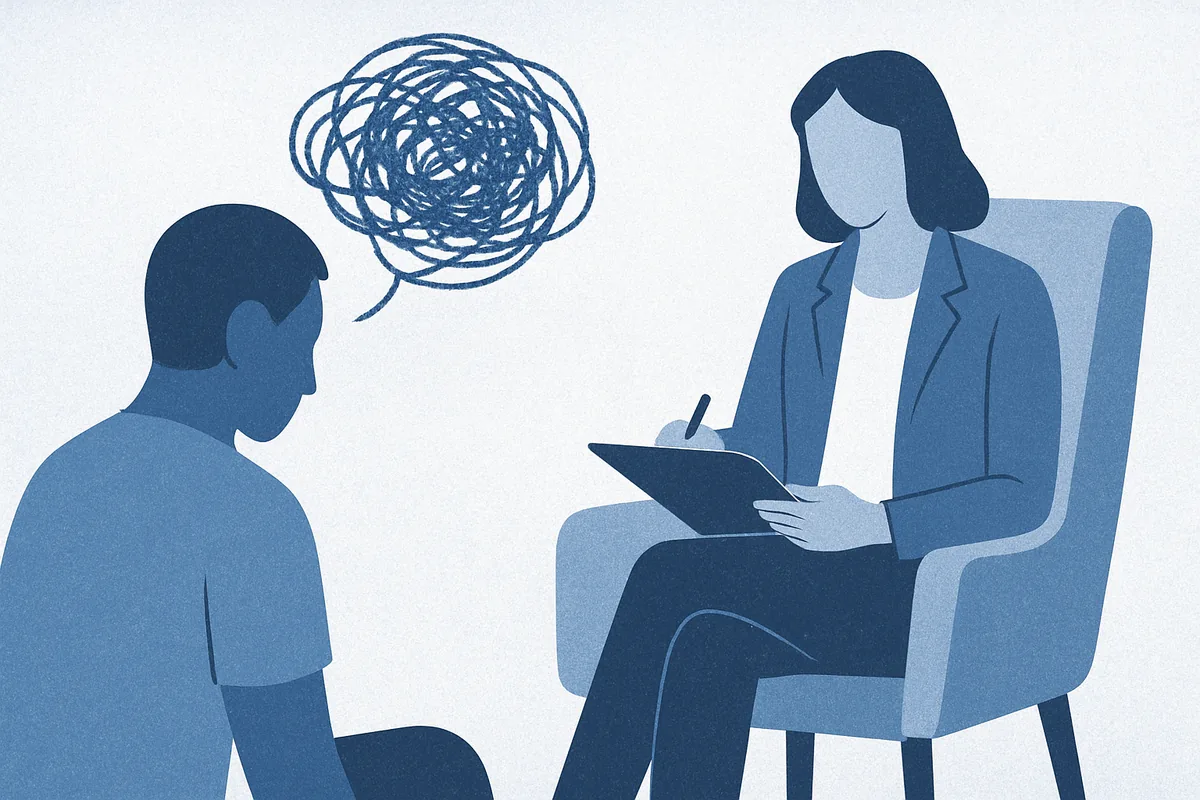
- ICD-11 complex PTSD (CPTSD) is a formally distinct diagnosis from PTSD, defined by the presence of all standard PTSD criteria plus three disturbances in self-organisation: affect dysregulation, a persistently negative self-concept, and difficulty sustaining close relationships.
- A 2025 systematic review found CPTSD affects approximately 6.2% of the general population globally, rising to 44.7% in clinical samples, meaning the majority of people seeking complex trauma therapy in Dubai are likely meeting CPTSD rather than PTSD criteria.
- A 2024 UAE community study found 65% of UAE residents reported at least one adverse childhood experience (ACE), directly relevant to CPTSD's developmental trauma origins in Dubai's highly mobile, multi-origin population.
- Phase-based complex PTSD therapy in Dubai follows a three-stage structure, safety and stabilisation, trauma processing, and integration, because moving directly to trauma processing without an established stabilisation foundation frequently destabilises rather than helps.
- At CAYA World, complex trauma assessments identify which of the three DSO clusters are most active and use this to plan the sequence and pacing of therapy, with most CPTSD treatment courses running substantially longer than single-incident PTSD work.
A 2025 systematic review published on PubMed found that complex PTSD affects approximately 6.2% of the general population, rising to 44.7% in clinical samples and 40% among survivors of domestic violence and sexual abuse. That gap between population and clinical rates tells an important story: people living with complex PTSD are far more likely to end up in a psychologist's office than those without it, yet many arrive without a clear understanding of why standard coping strategies and even previous therapy attempts haven't resolved what they're experiencing.
Complex PTSD therapy in Dubai addresses a diagnosis that is formally distinct from standard PTSD, one defined by a specific set of self-organisation disturbances that most trauma articles, and many general trauma therapy descriptions, do not fully account for. This article is not a repeat of our general trauma therapy overview, nor does it focus on individual modalities such as EMDR. It focuses specifically on what ICD-11 complex PTSD is, how it differs clinically from standard PTSD, what the three disturbance clusters look like in practice, and how phase-based treatment for CPTSD is structured in Dubai.
At CAYA World, we see this presentation regularly across our Palm Jumeirah practice, adults whose symptoms don't fully fit the single-incident trauma model, whose difficulties span emotion, self-perception, and relationships in ways that require a different clinical approach from the outset.
What is complex PTSD and how did the diagnosis develop?
Complex PTSD was formally recognised as a distinct diagnosis in the ICD-11, the World Health Organization's 11th International Classification of Diseases, which came into effect globally in 2022. Its inclusion resolved a decades-long clinical debate. Clinicians working with survivors of prolonged trauma, childhood abuse, domestic violence, captivity, war, sustained neglect, had long observed that their patients' presentations differed meaningfully from those with single-incident PTSD. The symptom picture was broader, more pervasive, and touched areas of functioning that re-experiencing and avoidance alone couldn't explain.
The concept emerged from the work of psychiatrist Judith Herman, whose 1992 text Trauma and Recovery proposed the term "complex PTSD" to capture what she called the "complex traumatic syndromes" produced by prolonged, repeated trauma, particularly trauma from which escape is difficult or impossible. Herman's original framing identified seven symptom clusters, including alterations in affect regulation, consciousness, self-perception, relations with others, somatisation, and systems of meaning. The ICD-11 working group refined this into a tighter clinical model built on what is now termed disturbances in self-organisation (DSO).
It is worth being explicit about what the ICD-11 formal diagnosis requires. A person meets criteria for ICD-11 CPTSD when they satisfy all three core PTSD criteria, re-experiencing the traumatic event(s) in the present, deliberate avoidance of trauma-related stimuli, and a persistent sense of current threat, AND they additionally show all three DSO clusters. The DSO clusters are the diagnostic and clinical differentiator; without them, the diagnosis remains PTSD, not CPTSD. This matters practically because treatment approaches that work well for PTSD may be premature, insufficient, or even destabilising when applied to a presentation that includes the full DSO picture.
One important regulatory note for people in Dubai: the DSM-5, which is widely used in the United States and by some US-trained clinicians globally, does not currently include CPTSD as a separate diagnosis. The DSM-5 has its own extended PTSD specifier and a related diagnosis of Personality Disorder with complex features, but CPTSD as a standalone entity is an ICD-11 classification. At CAYA World, our clinical team works with both classification systems and can explain where your presentation sits within each.
How does ICD-11 complex PTSD differ from PTSD?
The clearest way to understand the relationship between PTSD and CPTSD is to think of the latter as a superset. Every person who meets ICD-11 CPTSD criteria also meets ICD-11 PTSD criteria, but they additionally carry the DSO clusters that define the more complex presentation. The WHO estimates that approximately 3.9% of the global population has experienced PTSD across their lifetime, and that approximately 70% of people worldwide will encounter at least one potentially traumatic event. What determines whether PTSD or CPTSD emerges typically relates to the nature of the trauma itself, specifically, whether it was prolonged, repeated, and inescapable.
Single-incident trauma, a road accident, a one-time assault, a natural disaster, is the prototype for PTSD. The traumatic event has a clear beginning and end, even if its psychological aftermath does not. Complex PTSD, by contrast, typically develops from trauma that was ongoing and from which the person could not readily exit: years of childhood abuse or neglect, sustained domestic violence, prolonged exposure to conflict zones, or repeated institutional trauma. The inescapability is clinically significant because it shapes the nervous system's adaptation in ways that a single acute stressor does not.
The table below maps the core clinical differences between ICD-11 PTSD and ICD-11 CPTSD:
| Feature | ICD-11 PTSD | ICD-11 Complex PTSD |
|---|---|---|
| Re-experiencing trauma in the present | Required | Required |
| Avoidance of trauma-related stimuli | Required | Required |
| Persistent sense of current threat | Required | Required |
| Affect dysregulation (DSO cluster 1) | Not required | Required |
| Negative self-concept (DSO cluster 2) | Not required | Required |
| Relational disturbances (DSO cluster 3) | Not required | Required |
| Typical trauma origin | Single-incident or time-limited | Prolonged, repeated, inescapable |
| DSM-5 equivalent | PTSD | No direct equivalent (see PTSD with complex features) |
A 2025 meta-analysis found that in non-war-exposed, higher-income settings, a reasonable proxy for Dubai's general population, PTSD prevalence sits at approximately 2% and CPTSD at approximately 4%, meaning CPTSD is actually more common in settings like Dubai than standard PTSD. This is counterintuitive to many people who assume complex trauma is primarily a conflict-zone phenomenon. Dubai's reality, as we discuss below, includes a population with extensive exposure to developmental and relational trauma that fits the CPTSD profile precisely.
The functional difference in day-to-day life is also significant. People with PTSD often describe their difficulties as primarily fear-based and trauma-specific: triggers, flashbacks, avoidance of specific stimuli. People with CPTSD more frequently describe difficulties that feel global, an inability to trust that isn't tied to any single event, a persistent sense of being fundamentally broken or worthless, relationships that repeatedly go wrong in similar ways, emotional responses that feel completely out of proportion to immediate circumstances. This global quality reflects the DSO clusters, which we explain in the next section.
What are the three disturbances in self-organisation that define complex PTSD?
The three DSO clusters are the defining clinical feature of ICD-11 CPTSD. They are not secondary symptoms or comorbidities. They are part of the diagnostic core, and understanding them in plain language is essential both for people considering therapy and for clinicians building a treatment plan.
DSO Cluster 1: Affect dysregulation. This refers to difficulty regulating emotional responses, specifically, responses that are either excessively intense, persistently suppressed, or both at different times. In practice, this might look like explosive anger that feels uncontrollable and is followed by shame, emotional numbness that persists for days and makes it impossible to feel present with people who matter, or rapid emotional cycling that makes relationships feel unpredictable even to the person experiencing it. The dysregulation is not simply "being emotional". It reflects a nervous system that adapted to prolonged threat by becoming either hyperreactive (mobilised, fight-or-flight) or hyporesponsive (shut down, dissociated) as default modes, rather than as temporary responses to actual threat.
DSO Cluster 2: Negative self-concept. ICD-11 specifies this as persistent beliefs about oneself as diminished, defeated, or worthless, accompanied by deep and pervasive feelings of shame, guilt, or failure. The key word here is persistent, not triggered by a specific situation, but present as a background condition. Cognitive behavioural therapy can help identify and restructure the specific thought patterns that sustain these beliefs, but the beliefs themselves are often deeply embedded and pre-verbal in origin, having formed during developmental periods when the person lacked the cognitive architecture to challenge them. People with this cluster frequently describe a conviction, not a fear, but a conviction, that they are fundamentally different from other people in some defective way.
DSO Cluster 3: Disturbances in relationships. This cluster captures difficulty forming or sustaining close relationships, often described as a persistent sense of distance from other people. It may manifest as an inability to trust that others won't cause harm, a pattern of relationships that feel intense and then collapse, a sense of being fundamentally alone even in company, or difficulty believing that others' positive regard is real or durable. In the Dubai context, this cluster is particularly clinically relevant: many expats are geographically separated from their primary attachment networks and face significant social barriers to building new close relationships in a transient, work-focused city. For someone whose relational capacity is already compromised by CPTSD, this environment compounds the isolation substantially.
At CAYA World, our clinical assessment for complex trauma specifically maps which of these three DSO clusters are most prominent and how they interact with each other. The interplay matters: someone whose affect dysregulation is primary will need different early-phase work than someone whose presentation is dominated by a profoundly negative self-concept. Both require careful sequencing, and both require a treatment model built for CPTSD, not adapted from PTSD protocols.
If what you're reading here resonates, if you've wondered why previous attempts at therapy didn't shift the sense of being fundamentally broken, or why your emotional responses still feel outside your control, a conversation with our clinical team at CAYA World is a useful starting point. You can reach us by WhatsApp, phone, or email; our intake process begins with a brief conversation to understand your situation before any formal assessment is scheduled.
Wondering if It's Time to Talk to Someone?
Our specialist team at CAYA World offers comprehensive assessment and evidence-based treatment, conducted from our clinic in Palm Jumeirah, Dubai.
Who develops complex PTSD, and what does this look like in Dubai?
The trauma types most associated with CPTSD share a structural quality: they are sustained, repeated, and take place within relationships or systems from which escape is constrained. Childhood physical or emotional abuse, prolonged childhood neglect, domestic violence across months or years, sexual abuse within a family or institutional setting, captivity, torture, and sustained exposure to conflict zones are the trauma types that clinical and research literature most consistently links to CPTSD presentations. The inescapability is the operative variable, the nervous system's adaptation to a threat environment that cannot be left is qualitatively different from its adaptation to a threat that, however severe, has an end.
Dubai's population profile makes CPTSD highly clinically relevant in ways that aren't always visible from the outside. A 2024 UAE community study published in Frontiers in Public Health found that 65% of UAE participants reported at least one adverse childhood experience (ACE), with higher ACE scores significantly predicting depression and stress in adulthood. This figure is not low. It reflects a population with substantial developmental trauma exposure, consistent with CPTSD's aetiology. Dubai's working population draws from countries with historically high rates of adversity exposure: the Indian subcontinent, the Arab world, East and West Africa, Southeast Asia, and Eastern Europe are all substantially represented, each with populations that have navigated political instability, economic precarity, or social violence within living memory.
The clinical picture at CAYA World reflects this. We regularly see adults whose CPTSD presentation is rooted in childhood adversity that occurred in another country and was, at the time, normalised within their cultural context, only recognised as traumatic through the lens of adult distance or a changed environment. We also see relocation itself as a trauma activator: the loss of familiar social structures, the pressure of employment-dependent residency, and the distance from family attachment networks can reactivate CPTSD symptoms that were previously managed through proximity to support systems. For some clients, the experience of domestic trauma within Dubai, occurring within the same employment-dependent, residency-constrained system, fits the inescapability criterion almost precisely.
The Knight Frank Middle East Mental Health Report (2024) found that 60% of UAE patients with poor mental health do not seek help or treatment. For people with CPTSD, this barrier is often compounded by the DSO clusters themselves, a negative self-concept makes it easy to conclude that the problem is unfixable, affect dysregulation makes sustained therapeutic engagement feel risky, and relational disturbances create specific hesitation about trusting a clinician. Recognising these barriers as symptoms rather than personal failures is part of what assessment and early-phase therapy at CAYA World addresses directly.
Grief and loss frequently intersect with complex trauma histories, the loss of a childhood that should have been different, of relationships that were damaged by the trauma, of a self-concept that pre-dates the adversity. Our grief and loss therapy work at CAYA World often overlaps with complex trauma support, particularly for clients processing what prolonged adversity cost them over time.
How is complex PTSD therapy in Dubai structured?
The defining feature of well-structured complex PTSD therapy is that it does not move directly to trauma processing. This is the single most important structural distinction from standard PTSD treatment protocols. With single-incident PTSD, evidence-based treatments such as prolonged exposure or trauma-focused CBT can begin processing work relatively early in therapy. With CPTSD, this sequencing is typically unsafe. The DSO clusters, particularly affect dysregulation, mean that direct trauma exposure work, before the person has developed sufficient emotional regulation capacity, frequently produces destabilisation rather than relief.
The dominant clinical framework for structuring CPTSD therapy is the three-phase model, endorsed by the International Society for Traumatic Stress Studies (ISTSS) and adopted across evidence-based trauma care globally:
- Phase 1. Safety and stabilisation: This phase establishes the internal and external conditions necessary for trauma work. Internally, it focuses on building affect regulation skills, teaching the person to recognise and manage emotional escalation before it becomes overwhelming, to identify their nervous system's warning signals, and to use specific techniques that return the system to a regulated state. Externally, it addresses practical safety, social support, and daily functioning. Cognitive behavioural therapy is well-evidenced in this phase for building concrete regulation skills. This phase may take weeks or months; it is not a prelude to "real" therapy, it is therapy.
- Phase 2. Trauma processing: Only once stabilisation is established does the therapeutic work turn toward the traumatic memories themselves. This phase uses trauma-focused approaches to help the person process the unintegrated memories that drive re-experiencing and hyperarousal. The pacing is careful and titrated, working within the person's window of tolerance to avoid overwhelming the system. For many people with CPTSD, trauma processing is not a single linear progression but involves returning to stabilisation work between processing sessions as needed.
- Phase 3. Integration and reconnection: This phase addresses how the person rebuilds a coherent sense of self, relationships, and future orientation after the dominant symptoms have reduced. The work here often intersects with grief, processing what the trauma took away, and with identity reconstruction, particularly for people whose CPTSD originated in childhood and whose sense of self formed substantially within the traumatic context.
At CAYA World, complex PTSD therapy in Dubai is individually tailored to reflect where someone is across these three phases when they first present. Some clients arrive in functional crisis and need stabilisation to be the entire initial focus. Others arrive with strong regulation skills already developed through previous therapy or personal resilience and are ready to begin processing work earlier. Our clinical team conducts a thorough assessment before any treatment plan is agreed, mapping the DSO clusters, understanding the trauma history, and identifying which phase of the model fits the person's current state.
Cognitive behavioural therapy, which our team delivers, is applicable across all three phases: in Phase 1 for emotion regulation and safety-building, in Phase 2 as the backbone of trauma-focused cognitive work, and in Phase 3 for rebuilding meaning and self-concept. The treatment is not a set protocol applied uniformly. It is a structured framework that allows the clinician and client to be responsive to what the work requires at each stage.
Duration is an honest question. CPTSD therapy takes longer than single-incident PTSD therapy. A typical evidence-based protocol for standard PTSD might run 12–20 sessions. Complex PTSD therapy, particularly when Phase 1 requires substantial stabilisation work, more commonly runs 18 months to several years of regular contact, depending on severity and the complexity of the trauma history. This is not an indefinite open-ended arrangement; treatment has clinical endpoints and measurable markers of progress at each phase transition. But managing expectations about pacing is part of ethical complex trauma care. The trauma therapy team at CAYA World will discuss realistic timelines during assessment, not after months of therapy have already begun.
Frequently Asked Questions About Complex PTSD Therapy in Dubai
ICD-11 PTSD is defined by three clusters: re-experiencing the traumatic event in the present, avoidance of trauma-related stimuli, and a persistent sense of current threat. ICD-11 complex PTSD requires all three of those criteria PLUS three additional disturbances in self-organisation, affect dysregulation, a persistently negative self-concept, and difficulty sustaining close relationships. CPTSD typically develops from trauma that was prolonged, repeated, and inescapable, rather than a single incident. The DSM-5 does not yet include CPTSD as a separate diagnosis; it is currently an ICD-11 classification.
Yes. The ICD-11 definition requires that the trauma was prolonged, repeated, or inescapable, not that it was dramatic by external standards. Childhood emotional neglect, chronic invalidation, sustained emotional abuse, or growing up in a household with persistent domestic violence can all produce a CPTSD presentation, even in the absence of a single identifiable catastrophic event. In fact, many people with CPTSD find it difficult to name a specific traumatic event at all, the trauma was a sustained relational and environmental condition rather than a discrete incident, which is part of why the diagnosis is sometimes missed.
A formal clinical assessment is the only way to answer this with confidence, but some indicators suggest CPTSD rather than standard PTSD: difficulties that feel global rather than specific to certain triggers, a persistent sense of being fundamentally flawed or different, a long-standing pattern of relationship difficulties that isn't tied to one relationship, emotional responses that feel chronically dysregulated rather than situationally triggered, and a sense that the problems pre-date any identifiable adult trauma event. At CAYA World, our assessment process maps the specific DSO clusters present and identifies where you are across the three-phase treatment model before any treatment plan is agreed.
Considerably longer than single-incident PTSD therapy. Standard PTSD protocols typically run 12–20 sessions. Complex PTSD therapy, which requires a Phase 1 stabilisation stage before trauma processing can safely begin, more commonly runs 18 months to several years of regular contact, depending on the severity and origin of the trauma, the strength of the person's existing coping and regulation skills, and their social support context. Treatment is structured with measurable phase-transition goals rather than being indefinite, but the realistic timeline should be discussed explicitly at assessment, not after the first few months of work.
EMDR has substantial evidence for trauma processing and produces large effect sizes for PTSD symptom reduction. Its use in CPTSD is more carefully sequenced: clinicians trained in EMDR for complex presentations typically ensure Phase 1 stabilisation work is complete before beginning EMDR-based processing, and they adapt the protocol to account for the DSO clusters, particularly affect dysregulation. At CAYA World, we describe the evidence base for different trauma-focused approaches during assessment and work with each client to identify what fits their presentation and phase of treatment. Cognitive behavioural approaches are the framework our team applies across all three phases of the model.
Sources and Further Reading
- Global prevalence of ICD-11 complex PTSD: a systematic review and meta-analysis, PubMed / ScienceDirect (2025)
- Pooled one-month CPTSD prevalence meta-analysis, SAGE Journals (2025)
- PTSD and CPTSD prevalence by conflict-exposure and income setting: meta-analysis, PubMed (2025)
- Post-traumatic stress disorder fact sheet, World Health Organization (2023)
- Adverse childhood experiences and adult mental health in the UAE, Frontiers in Public Health (2024)
- Mental health overview: The Middle East 2024, Knight Frank (2024)
- EMDR effect sizes for PTSD and complex trauma symptom reduction, PMC / EMDR Research Review (2024)
- ICD-11 for Mortality and Morbidity Statistics: 6B41 Complex post-traumatic stress disorder, World Health Organization (2022)