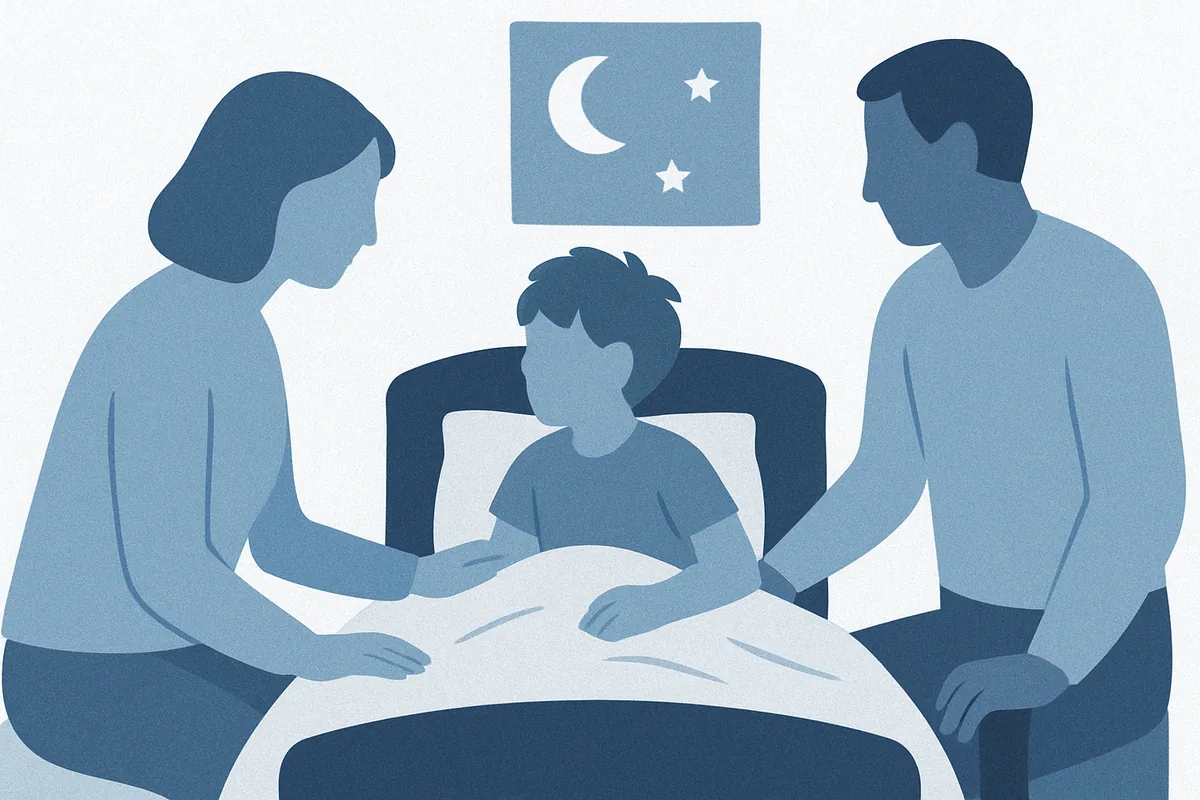
- Up to 70% of children with ADHD experience insomnia symptoms, driven primarily by a neurologically delayed circadian clock rather than poor habits or lack of discipline.
- Children with ADHD have measurably later melatonin onset, later sleep onset, and later cortisol rhythms than neurotypical peers, a pattern confirmed in recent circadian research published in PMC/European Journal of Neuroscience (2024-2025).
- Dubai's early school start times, year-round indoor lifestyle, and culturally late evenings compound circadian delay in children with ADHD, making structured behavioural sleep routines especially important here.
- Behavioural sleep interventions, including bedtime fading, stimulus control, and consistent wind-down routines, are first-line treatment; melatonin is a supported adjunct for sleep-onset delay when behavioural steps alone are insufficient.
- Obstructive sleep apnea affects approximately 25-30% of children with ADHD compared with roughly 3% of the general paediatric population, so snoring or witnessed pauses in breathing warrant a medical referral, not just a routine adjustment.
Up to 70% of children with ADHD experience insomnia symptoms, according to a 2024 PMC review synthesising research on ADHD and sleep. For many Dubai families, that number lands with immediate recognition: the child who cannot switch off at 9 p.m., who is back downstairs at 11 p.m., who is exhausted by 7 a.m. but simply will not settle at night. ADHD sleep problems in children are not a parenting failure, and they are not the same as typical childhood sleep resistance. The mechanisms are neurobiological, and the solutions are specific.
It is worth noting at the outset that ADHD-related sleep difficulties are driven by different mechanisms than sleep problems in children with autism, which are more closely tied to sensory sensitivities and co-occurring anxiety. ADHD sleep is primarily shaped by circadian delay and hyperarousal. Understanding that distinction matters, because the interventions differ meaningfully.
At CAYA World, we work with a significant number of families navigating exactly this challenge. Dr. Nour Al Ghriwati, our Co-Founder and Chief Clinical Psychologist, has observed that sleep is often the hidden amplifier behind the daytime difficulties families come to us about. This article explains the neuroscience, the Dubai-specific context, and the practical strategies that clinical evidence actually supports.
Why do children with ADHD struggle to sleep? The neuroscience explained
The most important thing parents can hold onto is this: a child with ADHD who cannot fall asleep at a reasonable hour is not being wilfully defiant. Their brain clock is running late. A 2024-2025 study published via PMC and the European Journal of Neuroscience confirmed that children with ADHD have consistently delayed circadian phases across multiple biological markers: later melatonin onset, later sleep onset, later cortisol rhythms, and later core body temperature cycles compared with neurotypical peers. None of these are under conscious control.
Delayed circadian phase: the internal clock runs late
The circadian system governs when the body begins winding down for sleep. In neurotypical children, melatonin secretion typically rises in the early evening, prompting drowsiness before the intended bedtime. In children with ADHD, this onset is shifted later, often by one to two hours. The child is genuinely not tired at 8 p.m. Demanding that they lie still and sleep at that hour is the neurological equivalent of asking a typical adult to sleep at 6 p.m. The biology simply has not shifted into the right state yet.
Dopamine dysregulation and hyperarousal
ADHD is fundamentally a disorder of dopamine signalling, and dopamine does not clock off at bedtime. The same reward-seeking, stimulation-seeking drive that makes focus difficult during the school day keeps the brain alert and activated in the evening. Clinicians refer to this as hyperarousal: the nervous system remains in a high-readiness state even when external demands have stopped. Screens, conversations, and any mild stimulation maintain that state well into the night. Without deliberate intervention, the arousal level simply does not drop to a point where sleep onset becomes possible.
The evening surge parents often describe
Many parents notice that their child with ADHD seems paradoxically more energised as the evening progresses. This is consistent with what we know about the interaction between circadian delay and stimulant medication wearing off. When daytime stimulant doses clear the system in the late afternoon, there is often a rebound period of heightened restlessness and emotionality before the child eventually crashes. That pattern is important clinical information, and it is one reason why medication timing is always part of our sleep conversation at CAYA World.
How ADHD and sleep problems feed each other in Dubai children
Sleep deprivation does not simply leave a child tired. In a child with ADHD, poor sleep directly worsens the core symptoms that are already challenging to manage. A landmark study in JAMA Pediatrics found that 73.3% of children with ADHD had sleep problems as reported by parents, with 44.8% rated moderate to severe. The bidirectional relationship is well established: ADHD disrupts sleep, and disturbed sleep intensifies ADHD symptoms the following day.
What sleep loss does to an ADHD brain
The prefrontal cortex, the brain region most responsible for impulse control, sustained attention, and emotional regulation, is disproportionately sensitive to sleep loss. In a child whose prefrontal function is already compromised by ADHD, even one night of shorter or fragmented sleep produces a measurable increase in distractibility, irritability, and behavioural dysregulation. Teachers often notice on Mondays following a late weekend that a child's classroom behaviour is qualitatively different. That is not coincidence; it is neurophysiology.
The Dubai school-day pressure point
Many UAE private and international schools begin at approximately 7:30 a.m. Some children require transport pick-ups as early as 6:00 a.m., which means a 5:30 a.m. wake time is not unusual. A child with ADHD whose circadian system pushes natural sleep onset to 11 p.m. or midnight, and who then needs to be functional by 6 a.m., is operating on a chronic sleep debt that compounds across the school week. The CDC's 2023 data published in Preventing Chronic Disease found that 40.3% of children with ADHD had short sleep duration, compared with 34.7% of children in the general population. In Dubai, where early school starts are the norm rather than the exception, that gap likely registers even more acutely.
Wondering whether your child's sleep difficulties are connected to their ADHD, or whether structured clinical support might help untangle the two? A CAYA specialist can walk you through the picture in an initial conversation. Send a WhatsApp message or call us at +971 4 572 3755 and we will help you figure out the right next step.
Common sleep comorbidities parents should know about
Not every sleep problem in a child with ADHD is purely circadian in origin. Several sleep disorders occur at significantly higher rates in this population, and missing them means treating the wrong thing.
Obstructive sleep apnea
Obstructive sleep apnea (OSA) affects approximately 25-30% of children with ADHD, compared with roughly 3% of the general paediatric population, according to a 2024-2025 PMC review. The review further noted that sleep-disordered breathing has been reported in up to 56.8% of children with ADHD in some samples. OSA interrupts sleep architecture repeatedly through the night without the child waking fully, producing daytime symptoms that look almost identical to ADHD itself: inattention, irritability, hyperactivity, and poor memory consolidation. A child who snores loudly, breathes through the mouth, or whose breathing seems to pause during sleep warrants a paediatric ENT or respiratory assessment, not just a bedtime routine adjustment.
Restless legs syndrome and periodic limb movement disorder
Both restless legs syndrome (RLS) and periodic limb movement disorder (PLMD) are more common in children with ADHD than in the general population. Children with RLS may describe an uncomfortable creeping or restless feeling in their legs when they lie still, which understandably prevents sleep onset. They may not have the vocabulary to name this clearly, and it can present as a simple refusal to stay in bed. If your child reports that their legs feel uncomfortable or keep moving on their own at night, raise this with your paediatrician.
Delayed sleep phase disorder
Delayed sleep phase disorder (DSPD) is a circadian rhythm disorder characterised by a sleep-wake cycle shifted two or more hours later than conventional timing. Research cited in the 2024 PMC review suggests DSPD occurs in approximately 9% of children with ADHD in population-based samples. A child with DSPD and ADHD has a double circadian disadvantage. DSPD requires specific chronotherapy interventions, including carefully timed light exposure and in some cases low-dose melatonin at strategic times, which differ from standard sleep hygiene advice.
Evidence-based bedtime strategies for children with ADHD
Behavioural sleep interventions are first-line treatment for ADHD-related insomnia, as confirmed in a 2024 review in Expert Review of Neurotherapeutics. The strategies below are drawn from that evidence base and from what we observe working in clinical practice at CAYA World.
Build a consistent, predictable wind-down routine
The ADHD brain responds well to structure it can predict. A 30-45 minute wind-down routine, starting at the same time each night, signals to the nervous system that sleep is approaching. The routine should move progressively from moderately engaging activities to low-stimulation ones: a shower or bath (body temperature drop aids sleep onset), a light snack if needed, 15 minutes of quiet reading or drawing, then lights out. Consistency matters more than perfection. If the routine holds on five out of seven nights, that is a meaningful anchor.
Bedtime fading
If a child consistently cannot fall asleep at the target time, putting them to bed earlier does not help and often makes things worse, creating a cycle of lying awake and building anxiety about not sleeping. Bedtime fading is a structured technique where bedtime is temporarily set at the child's actual natural sleep time, then gradually shifted earlier by 15-minute increments every few nights as sleep onset consolidates. This aligns the bedtime with the child's circadian readiness rather than fighting it.
Stimulus control
The bedroom should be associated with sleep and only sleep. Screen use, homework, arguments, and active play in the bedroom all undermine the brain's association between that environment and rest. This is harder than it sounds in a Dubai apartment where space may be shared, but even small consistent rules, such as charging devices outside the room and keeping the bedroom dim in the evening, begin to shift the associative conditioning over time.
Screen curfews are not optional in ADHD
Blue-light exposure from screens suppresses melatonin secretion, and in a child whose melatonin onset is already delayed, this effect compounds significantly. A minimum 60-minute screen curfew before the intended sleep window is clinically reasonable. For children with ADHD, who often find device disengagement particularly difficult, building the screen-off moment into a concrete routine event, such as "screens off after dinner is cleared," reduces the daily negotiation that otherwise erodes the habit.
Our CBT-based ADHD therapy for children in Dubai addresses the behavioural and emotional patterns that make sleep routines difficult to sustain, including the transition difficulties and emotional dysregulation that often surface at bedtime specifically.
Wondering if It's Time to Talk to Someone?
Our specialist team at CAYA World offers comprehensive assessment and evidence-based treatment, conducted from our clinic in Palm Jumeirah, Dubai.
The Dubai-specific sleep challenges and how to work around them
Dubai presents a specific constellation of environmental factors that interact with ADHD-related sleep difficulties in ways that are distinct from other cities. Acknowledging them directly is more useful than generic advice that does not account for local realities.
Indoor, air-conditioned living reduces natural light exposure
Natural light is the primary external anchor for the circadian system. Dubai's extreme summer heat means that many children spend the vast majority of their day in air-conditioned indoor environments, often with tinted windows or blackout blinds that dramatically reduce light input. Without adequate morning bright-light exposure, the circadian clock has no external signal to align to. In the summer months specifically, deliberate strategies become necessary: opening blinds immediately on waking, sitting near a window during breakfast, or in some cases using a clinical-grade light therapy lamp for 20-30 minutes in the morning.
Use cooler months for outdoor evening activity
From October through April, Dubai's evenings are genuinely pleasant. Physical activity in the 60-90 minutes before the wind-down routine begins serves as a sleep-promoting anchor for children with ADHD, who often need physical discharge to reduce evening hyperarousal. An after-school outdoor session or evening walk during cooler months is a genuinely useful strategy, not simply general wellness advice. During summer, indoor physical activity, such as swimming in a cooled pool or active indoor play, serves the same purpose.
Late cultural evenings and family schedules
Extended family dinners, social gatherings, and late cultural evenings are a meaningful part of life in the UAE. For children with ADHD whose circadian systems are already delayed, habitual late evenings on weekends create a social jet-lag effect: the body clock shifts even later, and Monday morning becomes harder for both the child and the family. This is not a cultural critique; it is a clinical reality to plan around. Where possible, maintaining a consistent sleep anchor on weekend nights, even if bedtime is slightly later than weekdays, reduces the Monday reset cost.
AC temperature and the bedroom environment
Core body temperature needs to drop slightly for sleep onset to occur. Many Dubai homes keep air conditioning at temperatures that are comfortable for adults but may be suboptimal for children's sleep architecture. A bedroom temperature in the range of 18-22 degrees Celsius supports sleep physiology. This is an easy adjustment with a meaningful impact.
Should you consider melatonin? What to discuss with your clinician first
Melatonin is among the most commonly discussed options when parents are managing ADHD sleep problems in children, and the clinical picture is nuanced. The 2024 Expert Review of Neurotherapeutics confirmed that melatonin is a supported short-term adjunct for sleep-onset delay in children with ADHD when behavioural interventions alone are insufficient. However, the way it is used matters considerably.
How melatonin works and why timing is critical
Melatonin is not a sedative. It is a chronobiotic: it signals to the brain that it is time to begin shifting into a sleep-ready state. Used at the wrong time, it can shift the circadian clock in the wrong direction. For a child with ADHD and delayed sleep phase, low-dose melatonin given 60-90 minutes before the target sleep onset time can advance the circadian phase over weeks of consistent use. Used close to sleep onset simply as a sleep aid, it has a weaker and less durable effect.
Dosing in children is lower than most parents expect
Clinical guidance consistently points to lower doses than those marketed in many commercial preparations. For children, 0.5-1 mg is commonly recommended as a starting point; the large doses often available over the counter (3-5 mg or higher) are not well supported for paediatric use and may produce daytime grogginess or paradoxical effects. Discuss dosing specifically with your paediatrician or a specialist before beginning.
Melatonin availability in Dubai
Melatonin is available in the UAE but is regulated differently from many Western countries where it sits freely on pharmacy shelves. In Dubai, it typically requires a prescription or pharmacist consultation. This is a sensible regulatory position given that it is an active hormone, not a simple supplement. Parents should not import melatonin from abroad without checking current UAE regulations and should always loop in their child's paediatrician before use.
Melatonin does not replace behavioural work
A common pattern we observe at CAYA World is families using melatonin without the surrounding behavioural structure, finding it effective for a period, then losing efficacy over time. Melatonin works best as a bridge: something that helps establish a new sleep-onset pattern while the behavioural foundations are being built. Without consistent routines, stimulus control, and screen management, melatonin alone is unlikely to produce durable improvement.
For families navigating the parent-child dynamic around ADHD routines and bedtime, our parent coaching for ADHD in Dubai offers structured, practical strategies tailored to your child's specific profile. Working with a clinician who understands ADHD behaviour means the routines you build actually account for the way your child's brain works.
When to seek a formal sleep referral
Many ADHD-related sleep difficulties respond well to the structured behavioural strategies described above, ideally implemented with clinical support. There are situations, however, where a formal referral is the appropriate next step rather than continued home management.
Signs that warrant a paediatric assessment
- Loud snoring, mouth breathing during sleep, or witnessed pauses in breathing: these raise the question of obstructive sleep apnea and require assessment by a paediatric ENT or sleep physician.
- Restless, uncomfortable legs that prevent sleep onset or cause frequent waking: this pattern should be evaluated for restless legs syndrome or periodic limb movement disorder.
- Sleep onset consistently later than midnight despite consistent behavioural management for four or more weeks: this degree of delay is consistent with delayed sleep phase disorder and may benefit from specialist chronotherapy.
- Daytime sleepiness so significant that the child cannot sustain attention even in activities they enjoy: this level of functional impairment warrants evaluation beyond standard sleep hygiene.
- ADHD medication timing that seems to be disrupting sleep at night: this is a pharmacological question that your prescribing paediatrician or psychiatrist needs to address directly.
How a clinical sleep assessment works
A formal sleep assessment typically begins with a detailed clinical history from parents, a sleep diary collected over one to two weeks, and validated questionnaires such as the Children's Sleep Habits Questionnaire (CSHQ). Depending on findings, the clinician may refer for a polysomnography (overnight sleep study) if apnea or movement disorders are suspected. For circadian assessment, actigraphy, a wrist-worn activity monitor worn for one to two weeks, provides objective data on sleep-wake patterns that is far more reliable than parent or child recall alone.
At CAYA World, our sleep support service in Dubai offers assessment and structured behavioural intervention for children whose sleep difficulties are linked to ADHD or other developmental profiles. Where specialist medical referral is needed, we coordinate with the child's existing clinical team.
A UAE tertiary-care study of 428 children and adolescents with ADHD, published in Global Pediatric Health (SAGE, 2022), confirmed sleep problems as one of the top five comorbidities in this population. This tells us that sleep difficulties in ADHD are not a peripheral concern: they are a core part of the clinical picture that deserves dedicated attention.
Frequently Asked Questions About ADHD Sleep Problems in Dubai
This is one of the most consistent observations parents describe, and it has a clear neurological basis. Children with ADHD have a delayed circadian clock, meaning their brain's wind-down signal arrives later than in neurotypical children. Additionally, the dopamine-driven hyperarousal that characterises ADHD does not simply switch off in the evening. The result is a child who is genuinely activated at the time parents expect them to be winding down. If daytime stimulant medication is also wearing off in the late afternoon, there can be a rebound period of heightened energy before exhaustion eventually sets in. Recognising this as biology rather than behaviour is the first step toward an effective response.
Melatonin has reasonable short-term safety data for children with ADHD and sleep-onset delay. In Dubai, it is regulated and typically requires a prescription or pharmacist consultation rather than being freely available on pharmacy shelves. Low doses in the range of 0.5-1 mg, taken 60-90 minutes before the target sleep onset time, are more consistent with current clinical guidance than the higher doses in many commercial preparations. Always consult your child's paediatrician before starting melatonin. It works best as an adjunct to behavioural strategies, not as a standalone solution.
A 30-45 minute wind-down routine, starting at the same time each night, is the clinical standard. It should move from mildly engaging to low-stimulation activities: a bath or shower first, then a quiet activity such as reading or drawing, then lights out. Screens should be off at least 60 minutes before the sleep window. The sequence matters as much as the duration: the brain learns to associate the routine's steps with approaching sleep over consistent repetition. On nights when the routine cannot be completed fully, maintaining at least the final 10-15 minutes of quiet and dim light preserves the conditioning effect.
Yes, reliably so. The prefrontal cortex, which governs impulse control, sustained attention, and emotional regulation, is among the brain regions most sensitive to sleep deprivation. In a child whose prefrontal functioning is already affected by ADHD, even moderate sleep shortfall produces a measurable increase in distractibility, irritability, and difficulty with transitions. Teachers frequently notice sharper behavioural challenges on days following poor sleep, and parents often describe a cycle where a bad night makes the next day harder, which in turn makes the following night's routine more difficult to implement. Addressing sleep is part of addressing ADHD, not separate from it.
Seek a referral if your child snores loudly or has witnessed pauses in breathing during sleep (possible sleep apnea), if their legs seem restless or uncomfortable when they lie still (possible restless legs syndrome), if sleep onset remains consistently later than midnight despite four or more weeks of structured behavioural management, or if daytime sleepiness is severe enough to interfere with activities they normally enjoy. A referral is also appropriate if you suspect ADHD medication timing is contributing to the sleep difficulty. A paediatric sleep physician can arrange a sleep study or actigraphy assessment and work alongside your child's ADHD treatment team.
Sources and Further Reading
- Sleep problems in children with attention-deficit/hyperactivity disorderJAMA Pediatrics (2003)
- ADHD and short sleep duration in US children aged 3-17CDC / Preventing Chronic Disease (2023)
- Sleep disorders in children with ADHD: a comprehensive reviewPMC (Lunsford-Avery et al. synthesis, 2024)
- Circadian rhythm dysregulation in ADHDPMC / European Journal of Neuroscience (2024-2025)
- Sleep-disordered breathing and obstructive sleep apnea in ADHDPMC review (2024-2025)
- Comorbidities in children and adolescents with ADHD at a UAE tertiary care centreGlobal Pediatric Health / SAGE (2022)
- Behavioural and pharmacological management of sleep in ADHDExpert Review of Neurotherapeutics (2024)