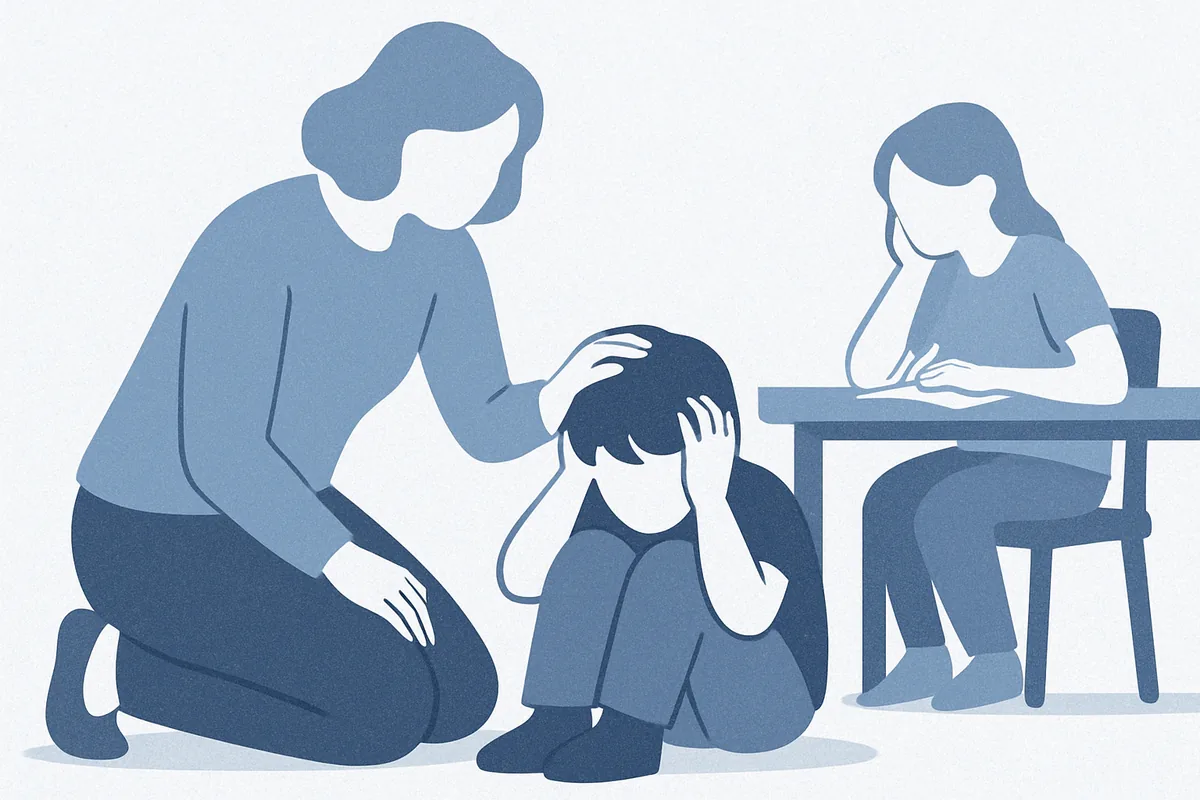
- An ADHD meltdown is typically driven by frustration-tolerance failure and emotional lability: it rises fast, peaks quickly, and the child often recovers within minutes once the trigger is removed or the emotion discharges.
- An autism meltdown follows a three-phase arc of build-up (rumble), peak, and recovery; the recovery phase alone can take 20 minutes to several hours, and sensory or routine disruption is the most common trigger rather than thwarted goals.
- A 2017 study found that 46.9% of children with ADHD show significantly elevated emotional lability compared with 15.4% of children without ADHD, confirming that explosive reactions are a core feature of ADHD, not just poor behaviour.
- Roughly 14.4% of children with a primary ADHD diagnosis also have co-occurring autism spectrum disorder, meaning meltdowns in these children may combine both frustration and sensory pathways simultaneously.
- In Dubai's international school environment, the after-school period is a recognised high-risk window for both meltdown types; DHA-accredited assessment reports are required for children to access KHDA Students of Determination accommodations.
When a child explodes, shuts down, or loses all capacity to respond to reason, the instinct of every parent is to try to fix it immediately. But how you respond in those first 60 seconds matters enormously, and the right response depends on what is actually driving the episode. An ADHD meltdown vs autism meltdown may look similar from across the room, yet the neurological pathways behind each are genuinely different, and confusing the two leads to strategies that make things worse rather than better.
A 2017 study published in PubMed found that 46.9% of children with ADHD show significantly elevated emotional lability compared with just 15.4% of children without the condition. Understanding the underlying differences between ADHD and autism gives parents the right framework to read what they are seeing. This article is not about diagnostic criteria. It is about the episode itself: what causes it, what it looks like phase by phase, and what you should actually do while it is happening.
At CAYA World Clinic in Palm Jumeirah, Dubai, Dr. Nour Al Ghriwati and our clinical team work regularly with children and families dealing with recurrent meltdown cycles. The framework below draws on that clinical experience, peer-reviewed research, and the specific stressors that Dubai's international school environment places on children with ADHD and autism.
What is a meltdown, and how is it different from a tantrum?
A tantrum is goal-directed. A child having a tantrum is, on some level, aware of the audience and the potential outcome. If you give them the biscuit or the screen time, the tantrum often resolves. That is not cynicism: it is a normal part of emotional and behavioural development between the ages of 18 months and five years. Most children grow through it.
A meltdown is a neurological event, not a performance. The child is not trying to manipulate the situation. They have lost access to the regulatory systems that would allow them to modulate their response. Reason does not reach them during a meltdown because the prefrontal cortex, the part of the brain that processes logic and consequence, is effectively offline. Trying to argue, reason, or negotiate during a meltdown does not work, and it can escalate the episode significantly.
Both ADHD and autism involve differences in how the brain regulates arousal, emotion, and sensory input. That is why both conditions can produce what looks from the outside like the same kind of explosion. The key is understanding which regulatory system has been overwhelmed and why, because that tells you what to do next.
In clinical terms, we distinguish meltdowns by their antecedents (what came before), their behavioural signature (what they look like), and their recovery pattern (how long it takes and what helps). All three differ meaningfully between ADHD-driven and autism-driven meltdowns.
What triggers an ADHD meltdown vs an autism meltdown?
The single most useful question parents can ask is: what happened just before this? The answer will usually tell you which pathway is active.
ADHD meltdown triggers
ADHD-driven meltdowns are almost always tied to frustration-tolerance failure. The child wanted something, was working toward something, or was in the middle of something, and that goal was blocked. The block could be small by adult standards: a homework problem that will not come right, a video game death, losing a turn in a card game, being told to stop an activity they are absorbed in, or a sibling taking something. Because children with ADHD have reduced dopamine signalling and weaker executive control over emotional regulation, the gap between feeling frustrated and losing behavioural control is much narrower than in neurotypical children.
Other common ADHD meltdown triggers include:
- Transitions between preferred and non-preferred activities, particularly when the child was not given adequate warning
- Fatigue, which compounds impulsivity and reduces the already-limited buffer before dysregulation
- Hunger, a trigger so reliable it has been documented in the ADHD behaviour literature
- Accumulated minor frustrations across the school day that finally discharge at home
- Feeling criticised, corrected, or singled out repeatedly
Autism meltdown triggers
Autism meltdowns are overwhelmingly driven by sensory overload, routine disruption, or social demand exceeding capacity. The autistic nervous system processes sensory information differently, often with lower perceptual filtering. What registers as manageable background noise to most people can accumulate as acute pain or threat for an autistic child. Similarly, a change in expected sequence, an unexpected social demand, or the loss of a predictable structure can push the system past tolerance.
Common autism meltdown triggers include:
- Loud, crowded, or visually complex environments such as school assemblies, shopping centres, or birthday parties
- Unexpected changes to routine: a substitute teacher, a cancelled plan, a different route home
- Clothing textures, food smells, or physical sensations that have gone unaddressed for hours
- Extended periods of social masking, where the child has been suppressing autistic traits to fit in at school, leading to a decompression crash at home
- Demand overload: too many instructions, transitions, or social expectations within a short window
In Dubai specifically, the after-school window is a high-risk period for both types. International school days are long, often six to seven hours, frequently multilingual, and academically intense. Children with either ADHD or autism arrive home carrying a significant accumulated load. At CAYA World, we often hear parents describe the pattern: their child holds it together all day, then decompresses explosively the moment the front door closes. Understanding whether that decompression is frustration-driven or sensory-driven changes how the home environment should be structured from 3pm onwards.
What does each meltdown look like in the moment?
Behavioural signatures overlap enough to confuse even experienced observers. The table below captures the most clinically reliable distinguishing features.
| Feature | ADHD Meltdown | Autism Meltdown |
|---|---|---|
| Onset speed | Rapid, often within seconds of the trigger | May build gradually over minutes or hours (rumble phase) |
| Primary driver | Frustration, blocked goal, perceived injustice | Sensory overload, routine disruption, demand excess |
| Behavioural expression | Verbal outbursts, crying, throwing objects, physical aggression | Verbal or physical aggression, self-injurious behaviour, or complete shutdown/non-responsiveness |
| Awareness of audience | Child may direct anger at a specific person | Child often appears unaware of or indifferent to who is present |
| Duration of peak | Often shorter: 5 to 20 minutes once the emotion discharges | Peak can sustain 20 to 60 minutes or longer |
| Recovery speed | Can be relatively quick; child may seem fine within 30 minutes | Recovery is often prolonged: 20 minutes to several hours; child may sleep |
| Post-episode state | Child may feel remorseful, embarrassed, or show rapid mood shift | Child is often exhausted, disoriented, or emotionally flat post-episode |
| Response to verbal input during episode | May escalate if challenged; can sometimes hear redirection | Typically unable to process verbal language; may increase distress |
One pattern we see repeatedly at CAYA World is parents trying to use verbal reasoning during a full autism meltdown because they assume the child is simply very upset, the way a child in an ADHD meltdown is very upset. The autistic child in full meltdown cannot process your words. The words become additional sensory input, adding to the overload rather than reducing it. Reducing environmental stimulation and physical presence is almost always more effective than talking.
If you are trying to determine which pattern fits your child, our ADHD assessment service for children in Dubai and our autism assessment service both include detailed behavioural history that maps meltdown patterns, triggers, and recovery profiles as part of the diagnostic process.
The before/during/after arc: why autism meltdowns follow a different pattern
This is the section most parent resources miss, and it is arguably the most clinically useful framework for parents of autistic children. Autism meltdowns do not simply happen. They follow a recognisable three-phase arc: the rumble phase, the peak phase, and the recovery phase. Each phase has different observable signals and different optimal responses.
Phase 1: The rumble phase
The rumble phase is the period of escalating but pre-meltdown arousal. The nervous system is accumulating load. The child may show early warning signs such as repetitive behaviours increasing, scripted speech or echolalia becoming more frequent, withdrawal from interaction, heightened sensitivity to sensory input, rigidity around minor details, or visible agitation. Many parents describe this phase as the child being "off" or "wired," without the explosion yet starting.
The rumble phase is the intervention window. Reducing sensory input, offering a preferred decompression activity, removing demands, or providing a quiet space away from stimulation can prevent the meltdown from escalating to peak. Once the peak begins, these interventions are largely ineffective.
Phase 2: The peak phase
This is the meltdown itself. The nervous system has exceeded tolerance. The child has lost access to their regulatory capacity. During the peak, the priority is physical safety, minimal stimulation, and minimal verbal demand. Limit instructions to single words or none at all. Remove objects that could cause harm. Stay calm and present without requiring the child to interact with you. Moving to a quieter, lower-stimulation environment, if that can be done without escalating the child further, is beneficial.
Phase 3: The recovery phase
Recovery from an autism meltdown is genuinely physiological. The child's nervous system has been in a state of acute stress response. Recovery takes time, often significantly longer than the peak itself. A child who had a 20-minute meltdown may need 90 minutes of quiet, low-demand time before they are neurologically back to baseline. Attempting to process what happened, discuss the behaviour, or return to regular demands before recovery is complete will often trigger a secondary meltdown.
ADHD meltdowns also have a recovery phase, but it is typically shorter and the child returns to baseline faster. They may show remorse or embarrassment relatively quickly, which can make it feel appropriate to address the behaviour soon after it ends. Even with ADHD meltdowns, waiting until the child is genuinely regulated before having any reflective conversation is always better than rushing.
A 2013 to 2015 population study of 5,326 youth, published in the American Journal of Psychiatry and accessible via PubMed (PMC4282137), found that 38% of children with ADHD had parent-rated impairing emotional lability. That figure confirms these are not occasional blips but recurring, clinically significant episodes that benefit from structured strategies rather than reactive responses.
Wondering if It's Time to Talk to Someone?
Our specialist team at CAYA World offers comprehensive assessment and evidence-based treatment, conducted from our clinic in Palm Jumeirah, Dubai.
When your child has both ADHD and autism: why meltdowns become harder to read
A significant proportion of children have both conditions. A 2025 meta-analysis published in Expert Review of Neurotherapeutics found pooled ADHD prevalence in autistic children and adolescents of 38.5% current and 40.2% lifetime. A 2024 study in the Journal of Clinical Child and Adolescent Psychology found that 14.4% of children with a primary ADHD diagnosis have co-occurring autism spectrum disorder.
For information on when both conditions are present, the diagnostic picture becomes substantially more complex. But the meltdown complexity is equally significant. A child with both ADHD and autism can have a meltdown that starts from a frustration trigger (the ADHD pathway) and then, once they are dysregulated, floods into sensory sensitivity because the regulated nervous system that normally manages sensory filtering is no longer online (the autism pathway). What started as blocked-goal frustration becomes, within a few minutes, a full sensory overload cascade.
Parents of these children often report that no single strategy works consistently. The episode that responded well to the give-them-space approach last Tuesday responded very differently on Friday. This inconsistency is not failure. It reflects genuine variability in which pathway is dominating on a given day, depending on what the child's nervous system had already processed that week.
For dual-diagnosis children, the most reliable approach is to treat the episode as autism-first during the peak: reduce stimulation, reduce demand, do not require verbal interaction. Once the child is at least partially regulated, you can assess whether frustration or a specific blocked need is still present and address that element in the recovery phase. This approach errs on the side of caution and is less likely to inadvertently escalate.
At CAYA World, Dr. Nour Al Ghriwati and our clinical team assess meltdown profiles as part of both ADHD and autism evaluations. Where dual diagnosis is suspected, a comprehensive multidisciplinary assessment is the appropriate starting point, not a process of trying one diagnosis and seeing if it fits.
If your child is having meltdowns that feel impossible to read, our specialist assessment team can help you understand what is driving them. A brief WhatsApp conversation with a CAYA clinician is often the fastest way to determine whether a formal evaluation makes sense for your family. Send us a message at +971 4 572 3755 and we will respond quickly.
What to do in the moment: strategies matched to each meltdown type
The right in-the-moment strategy depends on which pathway is active. The following guidance is clinically grounded and draws on cognitive-behavioural principles for post-episode work alongside the co-regulation research underpinning in-the-moment response.
During an ADHD meltdown
The core principles are: stay calm, reduce your own emotional volume, and do not match the child's intensity. Shouting back, withdrawing all attention, or trying to deliver consequences during the meltdown are all counterproductive. The child's regulatory system is already overloaded. Adding emotional pressure increases load rather than reducing it.
- Use a calm, low, steady voice. Reduce the number of words you use significantly.
- Name the emotion without judgment: "I can see you're furious right now." This gives the feeling a label, which activates the prefrontal cortex slightly and can begin to interrupt the emotional cascade.
- Do not remove all presence, but do reduce active engagement. Simply being near the child without adding demand can be regulating.
- Once the intensity begins to drop, offer a concrete transition: "When you're ready, come find me and we'll figure it out."
- Wait until the child is fully regulated before discussing the episode, usually 20 to 30 minutes after the peak has passed.
During an autism meltdown
The core principle is: reduce input. Talking more does not help. Explaining does not help. Consequences do not help. The nervous system is in overload and needs load reduction, not added stimulation.
- Move the child to the lowest-stimulation environment accessible: a quieter room, a dimmer area, a familiar space with predictable sensory qualities.
- Remove or dim sensory input: lower lights, reduce noise, remove tight or uncomfortable clothing if possible and appropriate.
- Do not require eye contact, verbal responses, or acknowledgment of your presence.
- Stay physically nearby at a comfortable distance to ensure safety, but do not attempt physical comfort unless you know from prior experience that the child finds it regulating. Many autistic children find touch during a meltdown actively painful.
- Keep your own movements calm and predictable. Sudden movements or raised voices will add to the load.
- Allow the full recovery phase before reintroducing any demands. This is the single most commonly skipped step and the most common cause of secondary meltdowns.
After the episode: what actually helps
Post-meltdown reflection, done at the right time and in the right way, builds the child's capacity to recognise their own early warning signals. For ADHD meltdowns, brief CBT-informed work on identifying the moment frustration begins can give children a vocabulary and a set of tools to interrupt the escalation before it reaches meltdown intensity. For autism meltdowns, sensory profiling and environmental mapping are more useful: identifying the specific sensory triggers that accumulated and whether they can be reduced proactively.
In both cases, repeated meltdown cycles that are not improving with good environmental management are a signal to seek clinical support. The meltdown pattern itself is diagnostic information, and a formal assessment will help you understand not just what is happening but what specifically to do about it.
UAE school-based research published in SAGE Open Medicine (2022) reports ADHD prevalence of approximately 4.1% by parent report and 3.4% by teacher report among school-age children in the UAE. Given these rates and the particular demands of Dubai's international school environment, ensuring children with ADHD and autism have properly structured school support plans, backed by DHA-accredited clinical reports for KHDA Students of Determination status, can significantly reduce the cumulative load that drives meltdown frequency.
Frequently Asked Questions About ADHD and Autism Meltdowns in Dubai
Look at three things: what triggered it, how fast it came on, and how long recovery takes. ADHD meltdowns are typically triggered by frustration or a blocked goal and resolve relatively quickly once the emotion discharges. Autism meltdowns are more often triggered by sensory overload, routine change, or demand accumulation, build more gradually, and require a longer recovery window before the child is back to baseline. A formal assessment by a licensed psychologist can map your child's specific pattern with clinical precision.
ADHD meltdown peaks typically last 5 to 20 minutes, with recovery beginning relatively quickly once the trigger is removed or the emotion discharges. Autism meltdown peaks can sustain 20 to 60 minutes or longer, and the recovery phase often takes 20 minutes to several hours. Some children sleep after a significant autism meltdown because the neurological cost of the episode is equivalent to acute physical stress. Attempting to return to regular demands before recovery is complete frequently triggers a secondary meltdown.
In practice, dual-diagnosis children often have meltdowns that engage both pathways within a single episode: frustration triggers the initial reaction, but once they are dysregulated, sensory sensitivity floods in because the regulated nervous system that normally manages sensory filtering is no longer functioning at capacity. During the peak, treat the episode as autism-first: reduce stimulation and demand, do not require verbal interaction. In the recovery phase, once the child is partially regulated, assess whether a specific frustration or blocked need is still present and address that separately. Consistency is harder with dual-diagnosis children, which is why a comprehensive clinical assessment and tailored management plan is especially valuable.
It depends on the meltdown type. For ADHD meltdowns, a calm, low-volume verbal presence that names the emotion without judgment can help. For autism meltdowns, verbal input during the peak typically adds to sensory load rather than reducing it, and most autistic children cannot process language meaningfully during full meltdown. During an autism meltdown, reduce words to a minimum, reduce environmental stimulation, and stay nearby without requiring interaction. Post-episode, once the child is genuinely regulated, is the appropriate time for any verbal reflection or problem-solving for either meltdown type.
If your child is having recurrent meltdowns that are significantly disrupting family life, school functioning, or the child's own wellbeing, and if environmental management strategies have not reduced their frequency or intensity over six to eight weeks of consistent effort, a formal assessment is the appropriate next step. In Dubai, a DHA-accredited clinical report from a licensed psychologist is required for your child to access KHDA Students of Determination accommodations at school, meaning the assessment has direct practical consequences for school support. CAYA World's assessment team can assess for ADHD, autism, or both, and provide a report that meets DHA and KHDA requirements.
Sources and Further Reading
- Emotional lability in children with ADHD: prevalence and clinical correlatesPubMed Central, PMC5110580 (2017)
- Emotional dysregulation in children with ADHD: population study of 5,326 youthAmerican Journal of Psychiatry via PubMed Central, PMC4282137 (2013-2015)
- ADHD prevalence in autistic children and adolescents: a meta-analysisExpert Review of Neurotherapeutics (2025)
- Co-occurring ASD in children with primary ADHD diagnosisJournal of Clinical Child and Adolescent Psychology (2024)
- ADHD prevalence among school-age children in the UAESAGE Open Medicine (2022)
- Sensory overload-type reactions in paediatric populations. Washington University School of Medicine (2023)